
NLP Learning Notes / NLP001
NLP: from language to research applications
Natural language processing (NLP) uses computational methods to work with human language. Systems use explicit rules or learn patterns from data to analyze, extract, predict, and generate information. Large language models are one family of technologies within this field. [1]
- section
- key term
- reading note
 ELLE · READING COMPANION
Take a moment to connect the ideas
A few foundations, with Elle
Open a term when you need it, then try one quick question.
NLP
Computational methods for analysing and generating human language.
Context
The surrounding words and situation help determine what an expression means.
Summarization
Condensing a longer text while retaining its important information.
The big picture
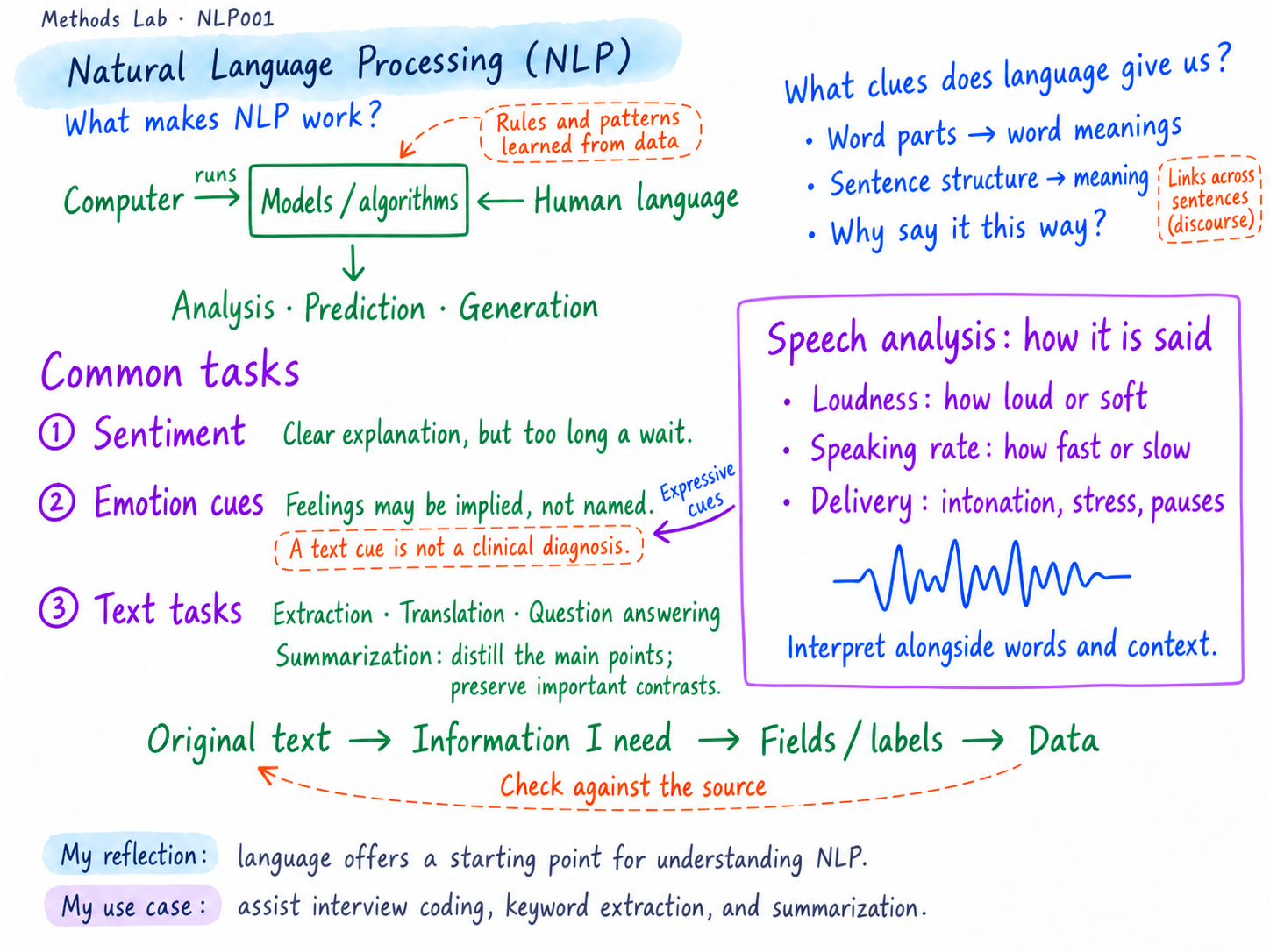
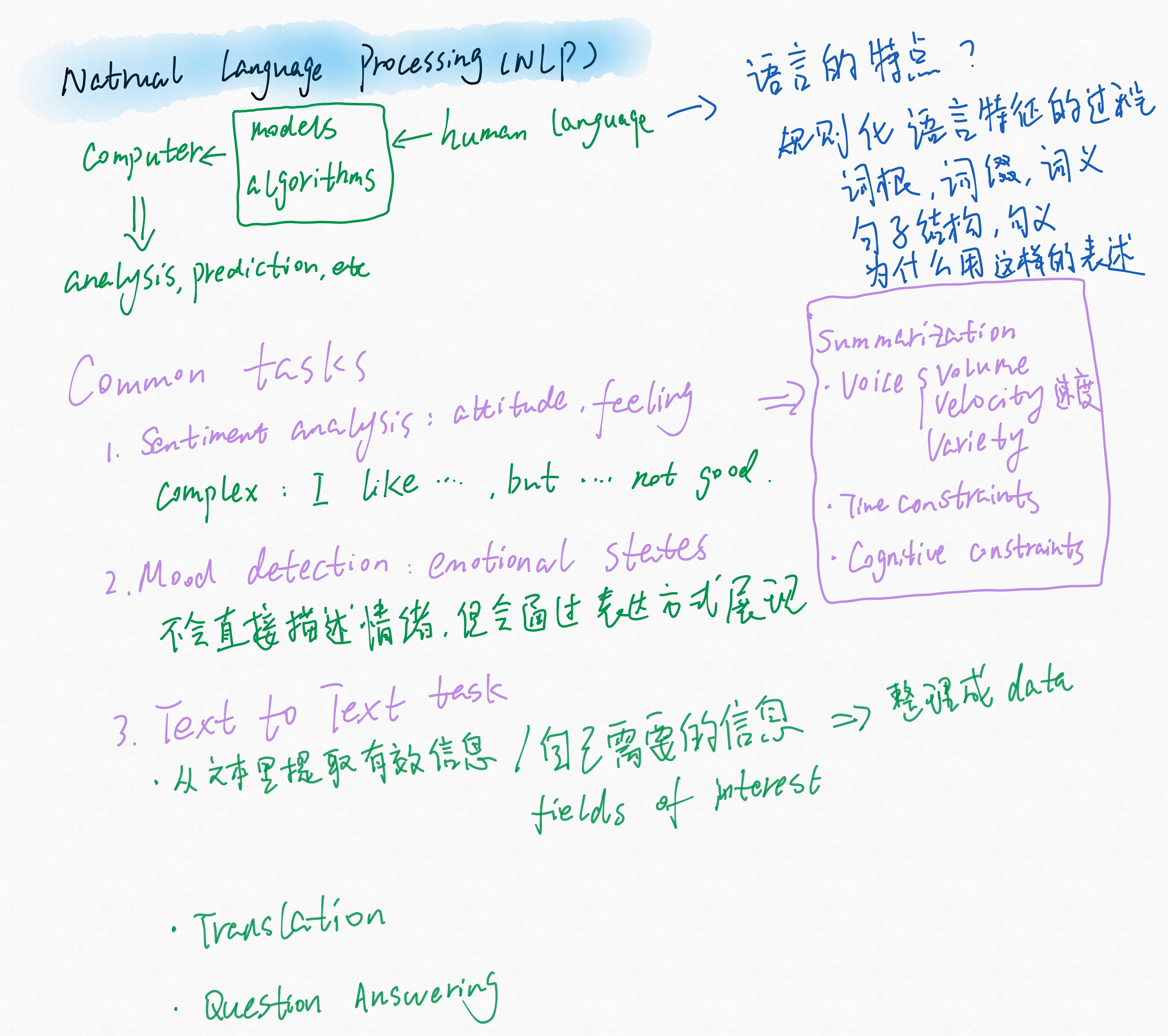
Tap a region to jump to that part of the note; use ⤢ Enlarge to see the full picture.
Information in language
| Perspective | What to look for | Example |
|---|---|---|
| Word structure and meaning | How words are formed and what they mean | happy → unhappy; “satisfied” versus “not satisfied” |
| Sentence structure and meaning | Roles, evaluation targets, and contrasts | “The explanation was clear, but the wait was too long” evaluates two things differently |
| Context and intent | References across sentences and the purpose of an utterance | “These instructions are confusing” may be a request for clarification |
These perspectives help explain language; they are not mandatory sequential stages in every model. [1][2]
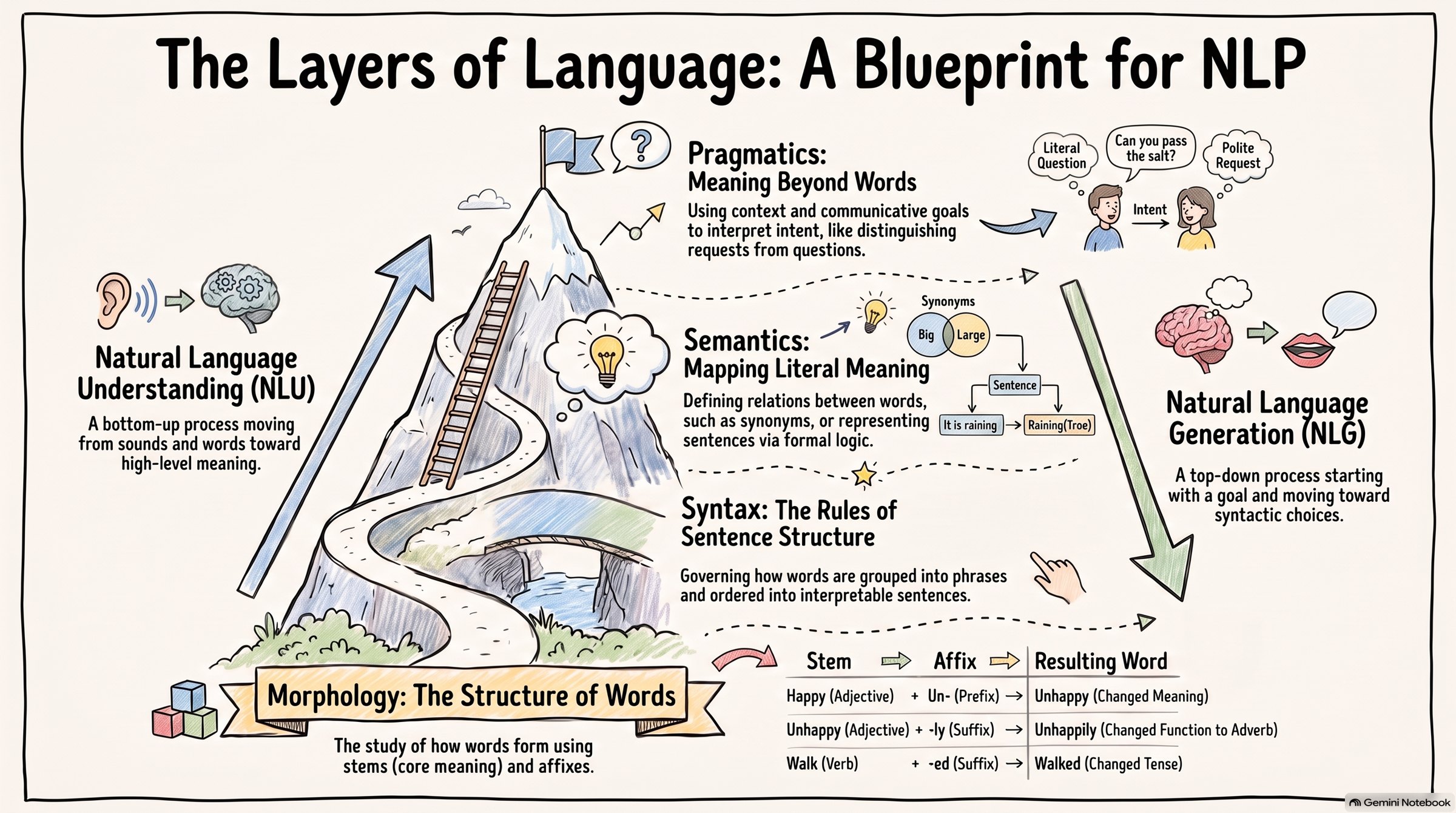
A conceptual illustration, not a fixed architecture inside a model. NLU and NLG need not follow strictly inverse pipelines, and context matters across perspectives.
Speech analysis: how something is said
| Cue | What it captures |
|---|---|
| Loudness | How loud or soft the voice is, and how it changes |
| Speaking rate | How quickly or slowly someone speaks |
| Delivery | Intonation, stress, pauses, and related patterns |
Listen: same words, two patients
“I am okay with this treatment.” Patient Asounds sure
Patient Bsounds unsure
Transcribed, both recordings read exactly the same. Their loudness is almost identical; the difference lies mainly in speaking rate and pauses, which are the cues a transcript drops. Voice analysis can flag moments like this for a second listen. It offers a cue, not a diagnosis.
The clips are synthesized voices made for this note's companion video, not recordings of real patients. Durations and pauses were measured from the audio.
Interpret acoustic and prosodic cues alongside the words and the situation. A plain transcript usually does not preserve all of them; analysis needs audio or the relevant acoustic features. Speech and text analysis can be combined, but measuring vocal features is different from interpreting linguistic content. [3]
Common tasks
| Task | The question it addresses |
|---|---|
| Sentiment analysis | What is being evaluated positively, negatively, or in mixed terms? |
| Emotion cue recognition | What feelings are expressed or implied? A cue is not a clinical diagnosis |
| Information extraction | Which themes, entities, or events should become fields or labels linked to the source? |
| Summarization | What are the main points of an interview, meeting, or body of material? Preserve important contrasts and uncertainty |
| Translation and question answering | How can information be expressed in another language, or used to answer a question? |
Summarization concerns the key content, while speech analysis examines vocal cues. A workflow can use both.
My perspective & use case
My starting point
Language itself makes NLP more approachable. Connecting words, sentences, and context to specific tasks helps me understand the broader framework.
My research direction
I have worked with interviews by manually marking passages and extracting keywords. I want to explore NLP-assisted organization and summaries of participants' main points.
- Research question
- Information needed
- Fields or labels
- Source check
Usefulness depends on omissions, label quality, and time saved after corrections.
Exploring next
How text becomes model input
References
- Jurafsky & Martin, Speech and Language Processing ↗
- Words and Tokens ↗
- audEERING, prosody and speech features ↗
Further reading
Tang et al. (2023), evaluating medical evidence summarization ↗
Its findings concern particular models and a specific task; they do not validate an interview-analysis workflow.