
NLP 学习笔记 / NLP004
从词义到知识图谱:词位、WordNet、FrameNet 与知识图谱
上一期讲了怎样把文本切成 token、给词贴上词性和实体标签。这一期往前走一步:当算法开始理解词义和句意,就可以理清词与词、句子与句子之间的关系,再把这些关系连起来,形成知识图谱。这条路可以分成四站:词位 → WordNet → FrameNet → 知识图谱。
From Word Meaning to Knowledge Graphs: Lexemes, WordNet, FrameNet, and Knowledge Graphs
The previous note covered splitting text into tokens and labeling words with parts of speech and entity types. This one goes a step further. Once an algorithm can grasp what words and sentences mean, it can work out how words relate to words and sentences to sentences, then connect those relations into a knowledge graph. The path has four stops: lexemes → WordNet → FrameNet → knowledge graphs.
- 章节 / section
- 关键概念 / key term
- 阅读提示 / reading note
 ELLE · 阅读向导 / READING COMPANION
把概念连起来,再往下读 / Take a moment to connect the ideas
和 Elle 一起理清基础概念 / A few foundations, with Elle
点开概念理清区别,再试三道小题;选错后可以重新选择。 / Tap a concept to explore it, then try three short questions. You can change any answer.
同形异义与一词多义 / Homonymy and polysemy
同形异义:形式相同、意思无关,例如河岸和银行。一词多义:同一个词的几个义项彼此相关,例如银行和血库。 / Homonymy: the same form with unrelated meanings, like a river bank and a money bank. Polysemy: one word with related senses, like a bank and a blood bank.
同义词集 synset / Synset
一组表达同一概念的近义词。WordNet 连接的是同义词集而不是单个词,所以 car、auto、automobile 指向同一个概念。 / A set of near-synonyms that express one concept. WordNet links synsets, not single words, so car, auto, and automobile point to the same concept.
语义框架 / Semantic frame
描述一类情境及其参与者的结构。I ate a sandwich 中,ate 唤起 Ingestion(进食)框架:I 是进食者,sandwich 是被吃的东西。 / A structure for a type of situation and its participants. In I ate a sandwich, ate evokes the Ingestion frame: I is the Ingestor, the sandwich the Ingestibles.
知识图谱 / Knowledge graph
把事实存成“实体—关系—实体”的连接,例如 阿莫西林 —可治疗→ 肺炎,从而可以查询和互相连接。 / Facts stored as entity–relation–entity links, such as amoxicillin —treats→ pneumonia, so they can be queried and connected.
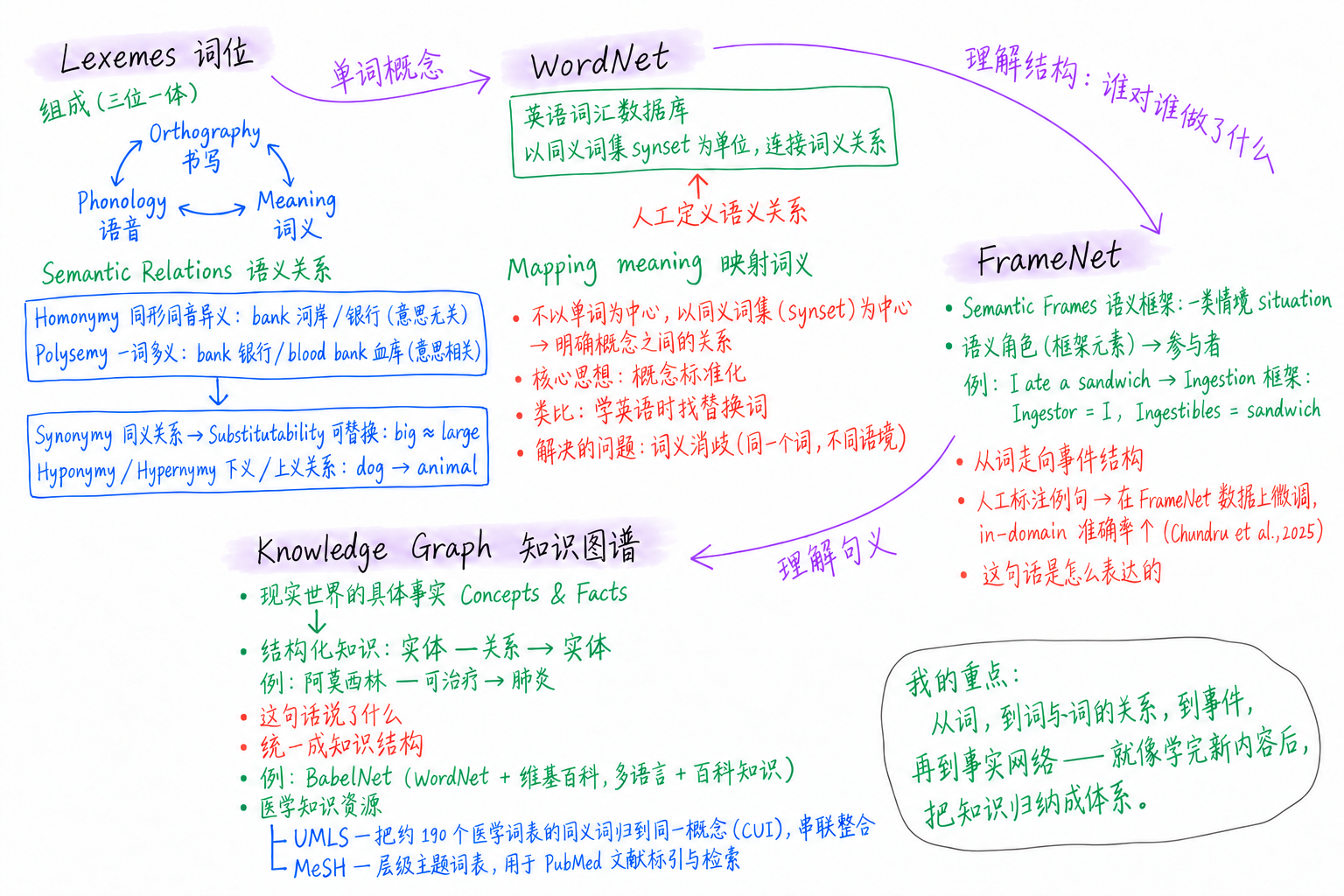
全景图:从词义到知识图谱
沿紫色箭头读:左上的词位是起点,WordNet 把词义整理成概念网络,紫色大弧线走到右侧的 FrameNet,从单个词走向事件结构,最后落到底部的知识图谱和医学知识资源。右下角是我的主要收获。
根据我的手写笔记整理,做了几处修正和补充。
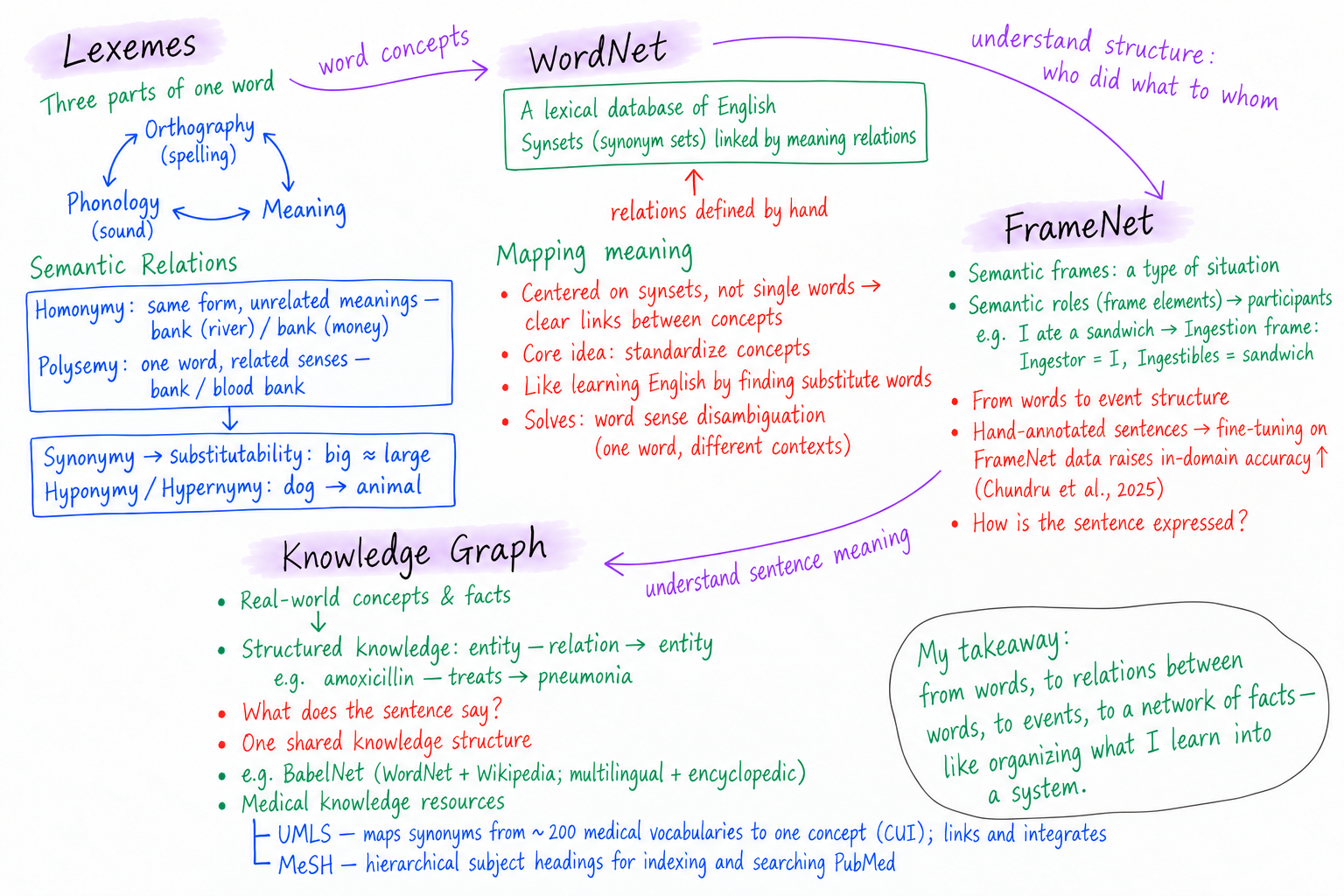
The big picture: from word meaning to knowledge graphs
Follow the purple arrows. Lexemes at the top left are the starting point. WordNet organizes word meanings into a network of concepts. The large purple arc leads right to FrameNet, which moves from single words to event structure, and the path ends at the bottom with knowledge graphs and medical knowledge resources. The note at the bottom right is my main takeaway.
Tidied up from my handwritten page, with a few corrections and additions.
第一站:词位——词的形式与意义
词位(lexeme)是词汇的基本单位:一个特定的形式(书写和读音)与它的意义配成一对。这三个面向分别是:
| 面向 | 英文 | 例子 |
|---|---|---|
| 书写 | Orthography | content 的拼写 c-o-n-t-e-n-t |
| 语音 | Phonology | 名词读 /ˈkɒntent/,形容词读 /kənˈtent/ |
| 词义 | Meaning | 名词“内容”;形容词“满足的” |
同一个拼写不一定是同一个词位:content 作名词和形容词时,读音和意义都不同,是两个词位。反过来,run、runs、ran 形式不同,却属于同一个词位,词典里用 run 作代表(这个代表形式叫 lemma)。SLP3 附录 I
词与词之间的语义关系
理解词义之后,下一步是描述词与词的关系。四种最常见的关系:
| 关系 | 含义 | 例子 |
|---|---|---|
| 同形异义 Homonymy | 形式相同,意思毫无关联 | bank:河岸 / 银行 |
| 一词多义 Polysemy | 一个词有多个彼此相关的义项 | bank:银行 / blood bank 血库(都是“储存之处”) |
| 同义 Synonymy | 不同的词,意思相同或相近;判断标准是能否互相替换而不改变句意 | big ≈ large |
| 上下义 Hyponymy / Hypernymy | 具体类别与上位类别的层级关系 | dog 是 animal 的下义词,animal 是 dog 的上义词 |
同义关系往往只在某些语境下成立:How big is that plane? 可以换成 large;但 big sister(姐姐)不能换成 large sister。所以“可替换性”需要放在语境里判断。SLP3 附录 I
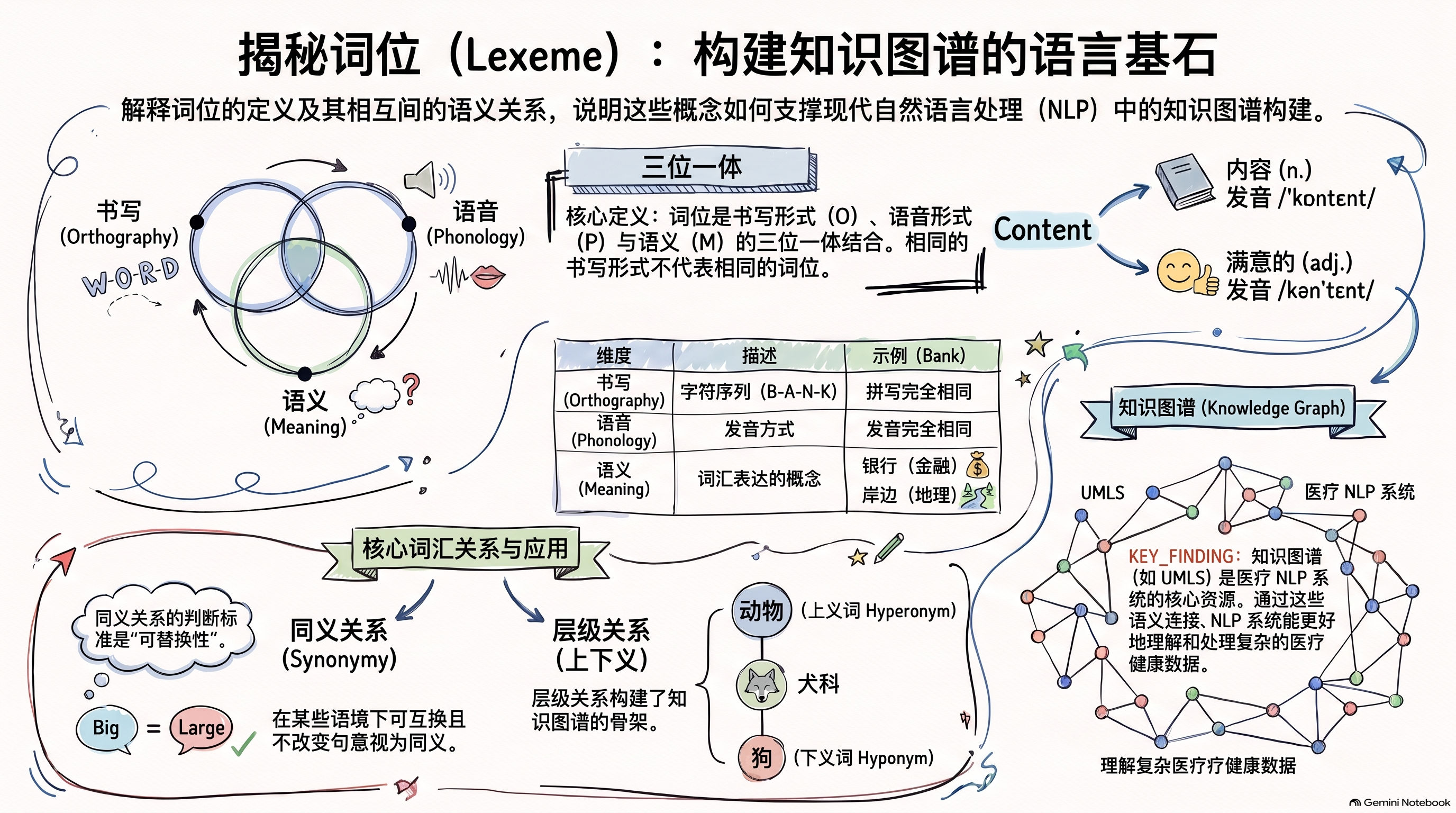
阅读提示:右下角的“KEY_FINDING”是生成图时留下的标签,可以理解为“要点”。图中把“动物 → 犬科 → 狗”画成一条上下义链,这是对的;同义关系的“可替换”要加上“在某些语境下”。
Stop 1: Lexemes, the form and meaning of a word
A lexeme is a basic unit of vocabulary: a particular form (its spelling and pronunciation) paired with its meaning. The three aspects are:
| Aspect | Term | Example |
|---|---|---|
| Spelling | Orthography | content spelled c-o-n-t-e-n-t |
| Sound | Phonology | the noun is pronounced /ˈkɒntent/, the adjective /kənˈtent/ |
| Meaning | Meaning | noun: what something contains; adjective: satisfied |
One spelling is not always one lexeme: content as a noun and as an adjective differs in both sound and meaning, so they are two lexemes. In the other direction, run, runs, and ran look different but belong to one lexeme, listed in a dictionary under run (the citation form, called the lemma). SLP3, Appendix I
Semantic relations between words
Once we know what words mean, the next step is to describe how they relate. Four relations come up most often:
| Relation | Meaning | Example |
|---|---|---|
| Homonymy | Same form, unrelated meanings | bank: the side of a river / a financial institution |
| Polysemy | One word with several related senses | bank / blood bank (both a place that stores something) |
| Synonymy | Different words with the same or similar meaning; the test is whether one can replace the other without changing the meaning | big ≈ large |
| Hyponymy / hypernymy | The hierarchy between a specific category and a broader one | dog is a hyponym of animal; animal is a hypernym of dog |
Synonymy often holds only in some contexts. In "How big is that plane?" big can become large, but "big sister" cannot become "large sister." Substitutability has to be judged in context. SLP3, Appendix I
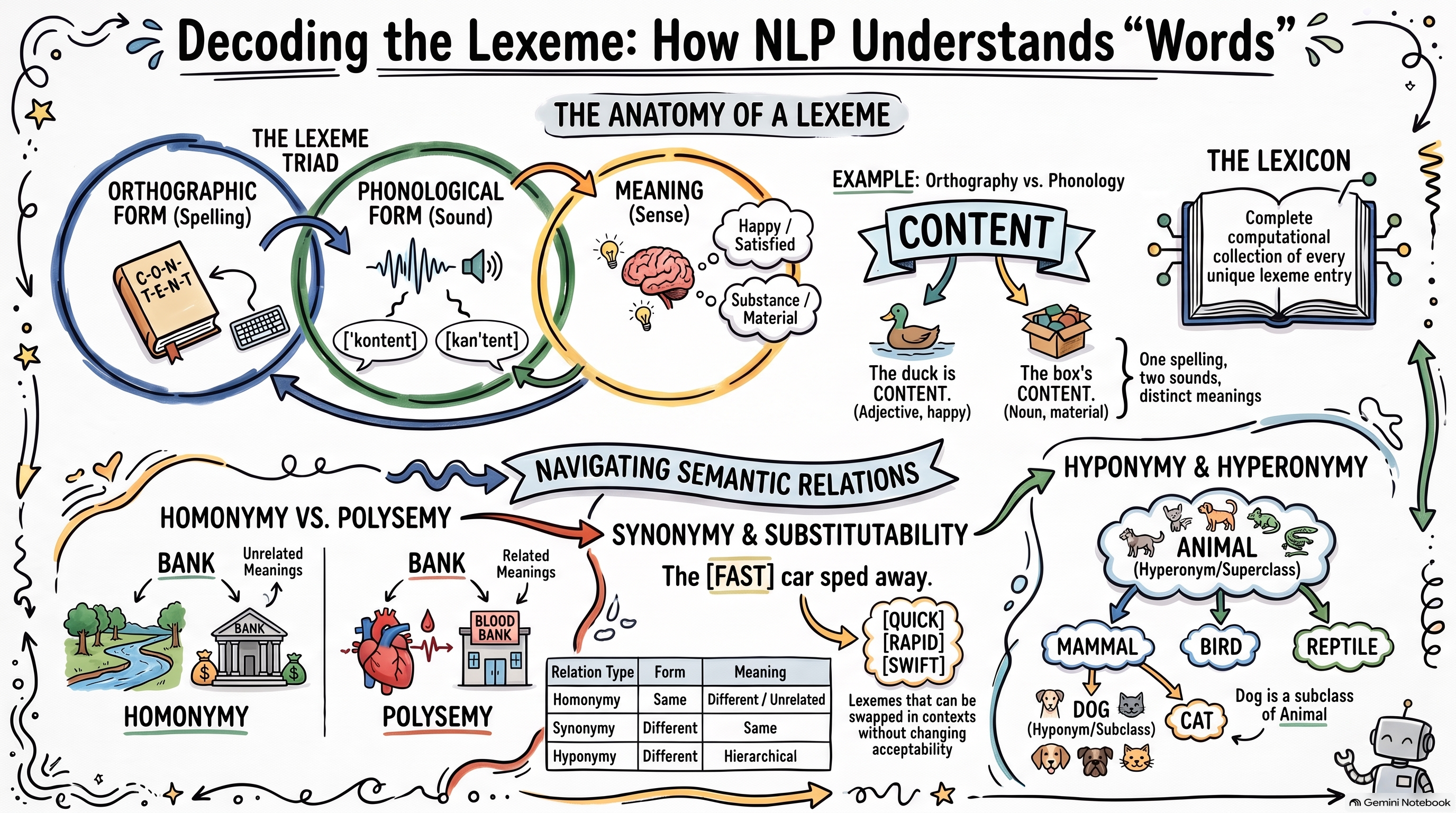
Reading note: the polysemy panel pairs the financial bank with a blood bank, which share the sense of a place that stores things; the river bank in the homonymy panel is unrelated. In the table, "Form: Same" for homonymy means the same spelling and sound.
第二站:WordNet——把词义整理成概念网络
WordNet 是普林斯顿大学建立的英语词汇数据库。它最关键的设计是:不以单词为中心,而以同义词集(synset)为中心。一个 synset 是一组表达同一概念的近义词,并附有释义(gloss)。例如 car、auto、automobile、machine、motorcar 同属一个 synset,代表“汽车”这个概念。
这样做的好处是把概念标准化:同一个概念不管用哪个词说,都对应同一个节点;一个多义词则分属多个 synset。WordNet 再由人工定义 synset 之间的关系,形成网络:
- 上下义:dog → canine → animal,层层往上可以到最抽象的 entity。
- 整体—部分(meronymy):engine 是 car 的一部分。
- 反义:hot ↔ cold(主要用于形容词)。
WordNet 3.0 收录约 11.8 万个名词、1.15 万个动词。名词平均有 1.23 个义项,动词平均有 2.16 个,动词的多义性更高。SLP3 附录 I
它解决的问题:词义消歧
词义消歧(word sense disambiguation, WSD)是判断一个词在当前语境里用的是哪个义项。例如 “I deposited cash at the bank” 和 “We sat on the river bank” 中的 bank 属于不同 synset。WordNet 提供了“候选义项清单”和义项之间的关系,所以长期是 WSD 研究的标准词义库。
这和我学英语时的方法很像:遇到一个多义词,在不同句子里分别找它能替换的同义词,就能分清它在这里是哪个意思。
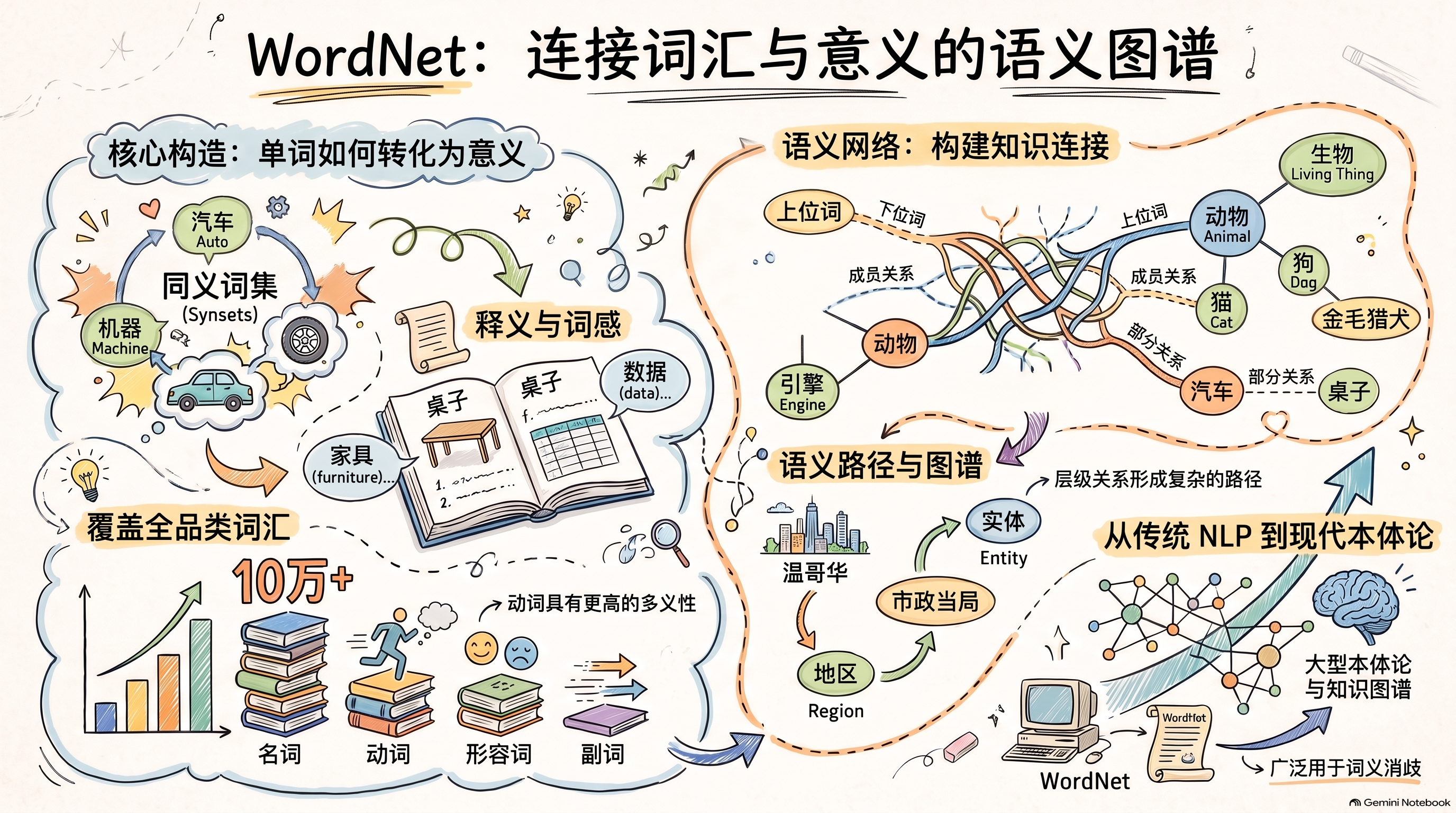
阅读提示:右上角网络中,“成员关系”和“部分关系”属于整体—部分关系(meronymy),与“上位词/下位词”的层级关系是两回事。“机器 Machine”在 WordNet 里确实是 car 的一个同义词,但这是较少见的用法。
Stop 2: WordNet, organizing word meanings into a network of concepts
WordNet is a lexical database of English built at Princeton University. Its key design choice is that it is centered on synsets, not single words. A synset is a set of near-synonyms that express one concept, with a short definition called a gloss. For example, car, auto, automobile, machine, and motorcar share one synset, the concept of a car.
This standardizes concepts: whichever word is used, the same concept maps to the same node, while a word with several meanings belongs to several synsets. WordNet then defines relations between synsets by hand, which turns them into a network:
- Hyponymy: dog → canine → animal, all the way up to the most abstract node, entity.
- Part–whole (meronymy): an engine is part of a car.
- Antonymy: hot ↔ cold (mainly for adjectives).
WordNet 3.0 contains about 118,000 nouns and 11,500 verbs. The average noun has 1.23 senses and the average verb 2.16, so verbs are more polysemous. SLP3, Appendix I
The problem it addresses: word sense disambiguation
Word sense disambiguation (WSD) is deciding which sense of a word is used in a given context. In "I deposited cash at the bank" and "We sat on the river bank," bank belongs to different synsets. Because WordNet supplies both the list of candidate senses and the relations among them, it has long served as the standard sense inventory for WSD research.
This is close to how I learned English: when a word has several meanings, finding a word that could replace it in each sentence shows which meaning is meant there.
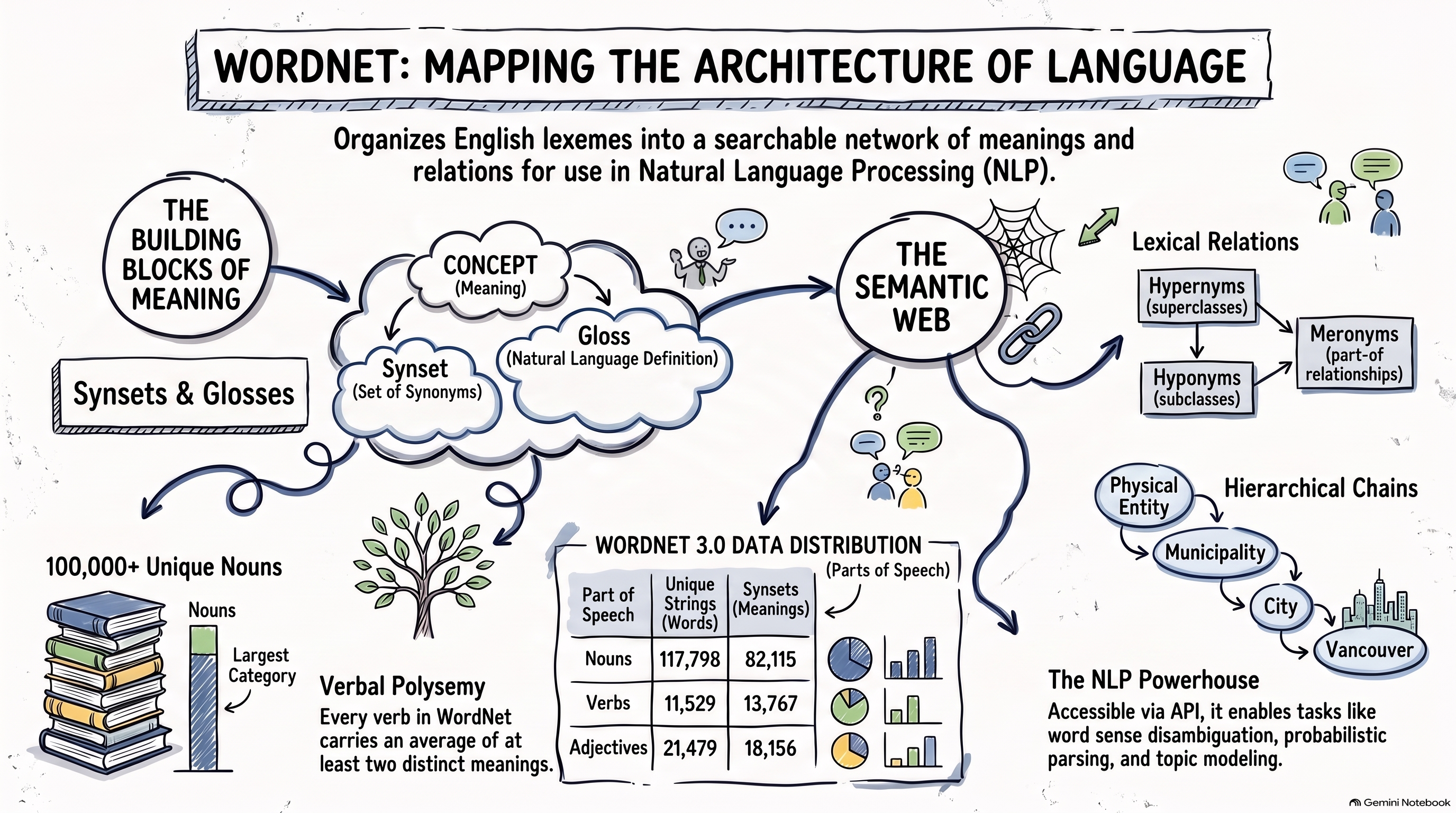
Reading note: "every verb carries an average of at least two distinct meanings" overstates it. The average verb has about 2.16 senses, and many verbs have only one. The counts in the table are distinct word strings and synsets in WordNet 3.0.
第三站:FrameNet——从词走向事件
WordNet 擅长回答“这个词是什么意思”,但不擅长回答“这句话里谁对谁做了什么”。FrameNet 补上的就是这一块。
FrameNet 的核心是语义框架(semantic frame):描述一类情境的背景知识结构,并定义这类情境里的参与者,称为框架元素(frame elements),也就是语义角色。句子里的某个词会“唤起”一个框架。SLP3 第 22 章
| 句子 | 唤起框架的词 | 框架 | 框架元素 |
|---|---|---|---|
| I ate a turkey sandwich. | ate | Ingestion(进食) | Ingestor(进食者)= I;Ingestibles(被吃的东西)= a turkey sandwich |
| The company hired Maria as a nurse. | hired | Hiring(招聘) | Employer = the company;Employee = Maria;Position = a nurse |
不同的动词可以唤起同一个框架:hire、employ、retain 都属于 Hiring。这样,即使说法不同,计算机也能认出它们描述的是同一类事件。FrameNet 目前约有 1,200 个框架,框架之间也有层级关系,类似 WordNet 的上下义。
人工标注的价值
FrameNet 的框架和角色由语言学家人工定义,并配有大量人工标注的例句。这些例句把人对语句的理解规范化,可以直接用来训练模型。Chundru 等人(2025)发现,大语言模型不经专门训练也能较好地识别框架;在 FrameNet 标注数据上微调后,in-domain(与训练数据同类的文本)准确率大幅提升,同时在 out-of-domain 基准上也保持了不错的泛化。Chundru et al., EMNLP 2025
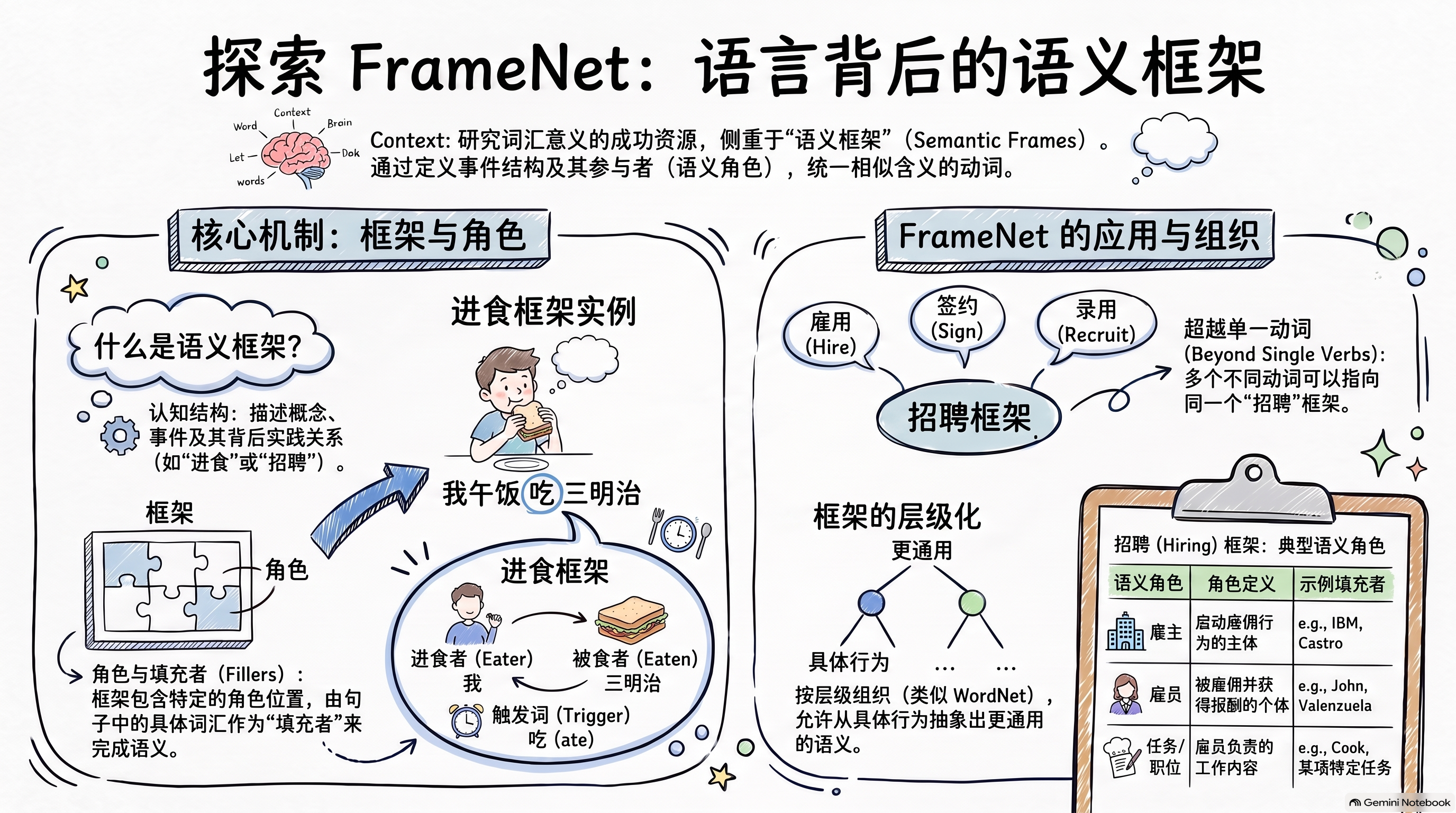
阅读提示:图中的“进食者 / 被食者”在 FrameNet 里的正式名称是 Ingestor / Ingestibles;“触发词”指唤起框架的词(这里是“吃”)。
Stop 3: FrameNet, from words to events
WordNet is good at answering "what does this word mean?" but not "who did what to whom in this sentence?" FrameNet fills that gap.
FrameNet is built on semantic frames: background knowledge structures that describe a type of situation and define its participants, called frame elements, which are semantic roles. A word in a sentence evokes a frame. SLP3, Chapter 22
| Sentence | Word that evokes the frame | Frame | Frame elements |
|---|---|---|---|
| I ate a turkey sandwich. | ate | Ingestion | Ingestor = I; Ingestibles = a turkey sandwich |
| The company hired Maria as a nurse. | hired | Hiring | Employer = the company; Employee = Maria; Position = a nurse |
Different verbs can evoke the same frame: hire, employ, and retain all belong to Hiring. So even when the wording differs, a computer can recognize that the sentences describe the same kind of event. FrameNet has about 1,200 frames, and frames are linked in a hierarchy, much like hyponymy in WordNet.
Why hand annotation matters
Linguists define FrameNet's frames and roles by hand and annotate many example sentences. These examples standardize human understanding of sentences and can be used directly to train models. Chundru et al. (2025) found that large language models can identify frames reasonably well without task-specific training. Fine-tuning on FrameNet's annotated data substantially improved in-domain accuracy (on text like the training data) while still generalizing well to out-of-domain benchmarks. Chundru et al., EMNLP 2025
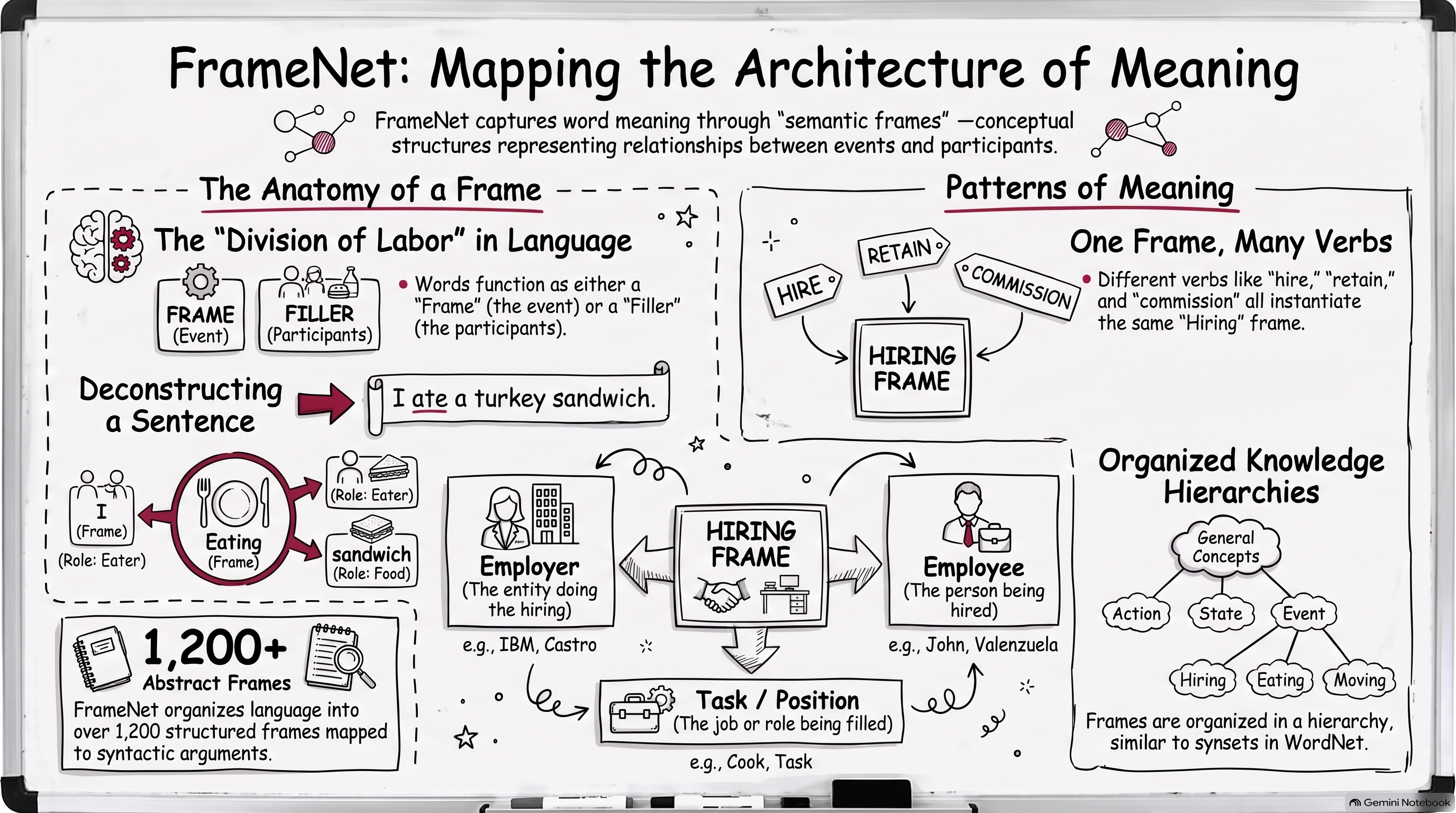
Reading note: in the eating example, "I" is labeled "Frame," but "I" fills a role. It is the verb ate that evokes the frame, which FrameNet calls Ingestion, with the roles Ingestor and Ingestibles rather than Eater and Food.
第四站:知识图谱——把事实连成网络
FrameNet 回答“这句话是怎么表达的”,知识图谱关心的是“这句话说了什么”。知识图谱(knowledge graph)把现实世界的概念和事实表示成“实体—关系—实体”的结构,例如:
- 阿莫西林 —可治疗→ 社区获得性肺炎
- 肺炎 —是一种→ 肺部疾病
当大量事实统一用这种结构表示,知识就从分散的句子变成了可以查询、推理和连接的网络。词汇资源(WordNet、FrameNet)提供了概念和关系的骨架,后来的知识图谱再从百科和网页里大规模抽取事实。
| 资源 | 特点 |
|---|---|
| YAGO(2007 起) | 结合维基百科与 WordNet,事实带有时间和空间信息 |
| Freebase → Wikidata | 协作编辑的大型知识库;Freebase 2016 年关闭后数据迁往 Wikidata |
| Probase | 微软从网页中自动挖掘概念,约 270 万个概念,覆盖许多不常见的“长尾”概念 |
| BabelNet | 把 WordNet 与维基百科等资源整合成多语言、百科式的语义网络,覆盖约 600 种语言 |
BabelNet:覆盖更广,结果也更分散
BabelNet 比 WordNet 更全面,因为它把词义和多语言知识、百科知识连在了一起。About BabelNet 但覆盖更广也让结果更分散。我搜索 library 时,BabelNet 不仅返回了“图书馆”这个常见概念,还返回了一些冷门实体,包括某位歌手的一首歌。这正是它的优点和局限:语义网络更丰富,但也会带来不太相关或过于具体的结果,需要使用者自己筛选。
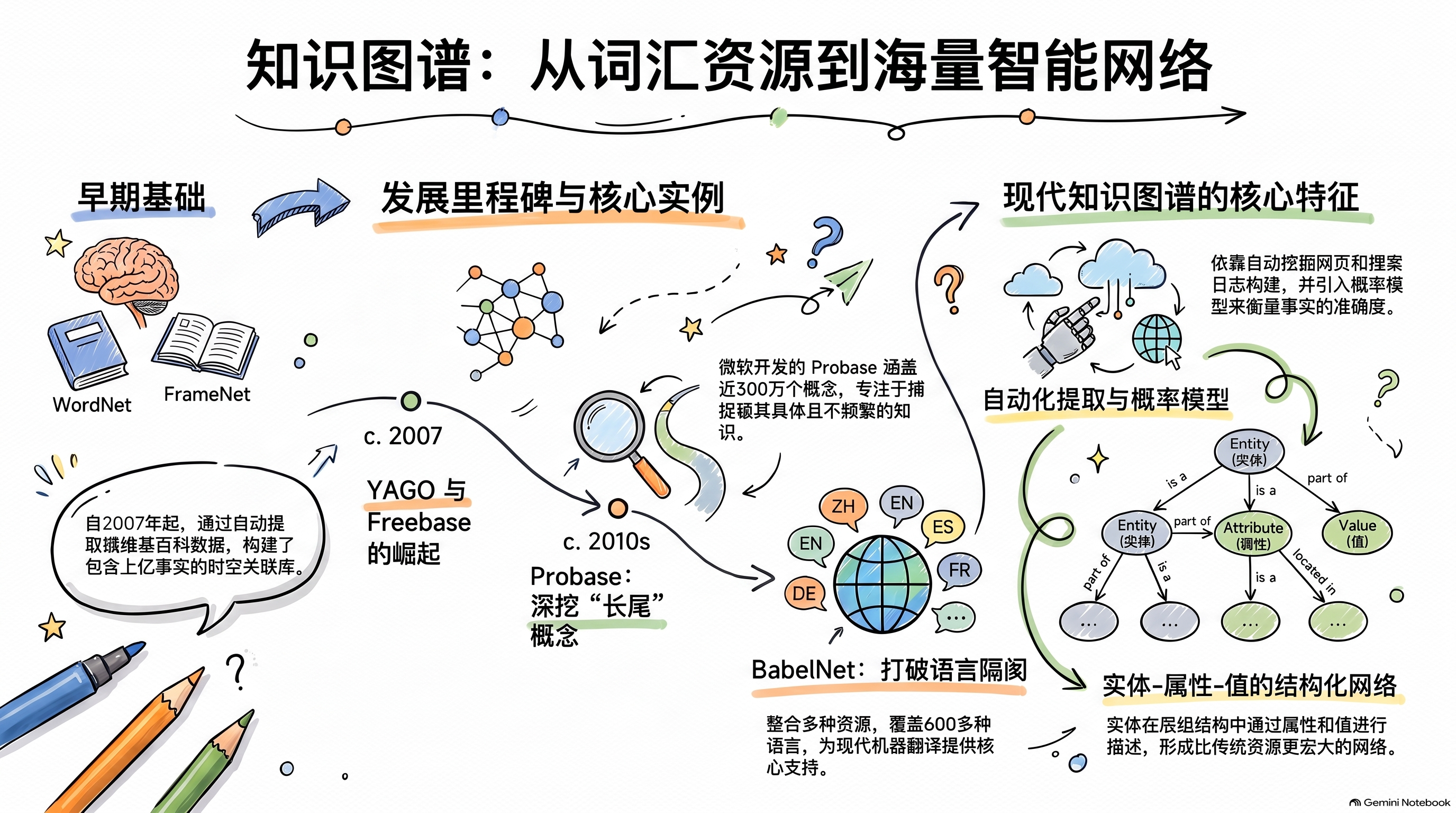
Stop 4: Knowledge graphs, linking facts into a network
FrameNet answers "how is this sentence expressed?" A knowledge graph cares about "what does this sentence say?" A knowledge graph represents real-world concepts and facts as entity–relation–entity structures, for example:
- amoxicillin —treats→ community-acquired pneumonia
- pneumonia —is a→ lung disease
When many facts share this structure, knowledge stops being scattered across sentences and becomes a network that can be queried, reasoned over, and linked. Lexical resources such as WordNet and FrameNet supplied the skeleton of concepts and relations; later knowledge graphs extracted facts at scale from encyclopedias and the web.
| Resource | What stands out |
|---|---|
| YAGO (from 2007) | Combines Wikipedia with WordNet; facts carry time and place |
| Freebase → Wikidata | Large collaboratively edited knowledge bases; after Freebase closed in 2016, its data moved to Wikidata |
| Probase | Microsoft mined about 2.7 million concepts from web pages, including many rare "long-tail" concepts |
| BabelNet | Integrates WordNet, Wikipedia, and other resources into a multilingual, encyclopedic semantic network covering about 600 languages |
BabelNet: broader coverage, more diffuse results
BabelNet is more comprehensive than WordNet because it connects lexical meanings with multilingual and encyclopedic knowledge. About BabelNet However, this broader coverage can also make the results feel more diffuse. When I searched for library, BabelNet returned not only the common concept of a library but also more obscure entities, including a song by a singer. This shows both a strength and a limitation: its broad coverage offers a richer network of meanings and entities, but it can also bring in less relevant or highly specific results that users need to filter out.
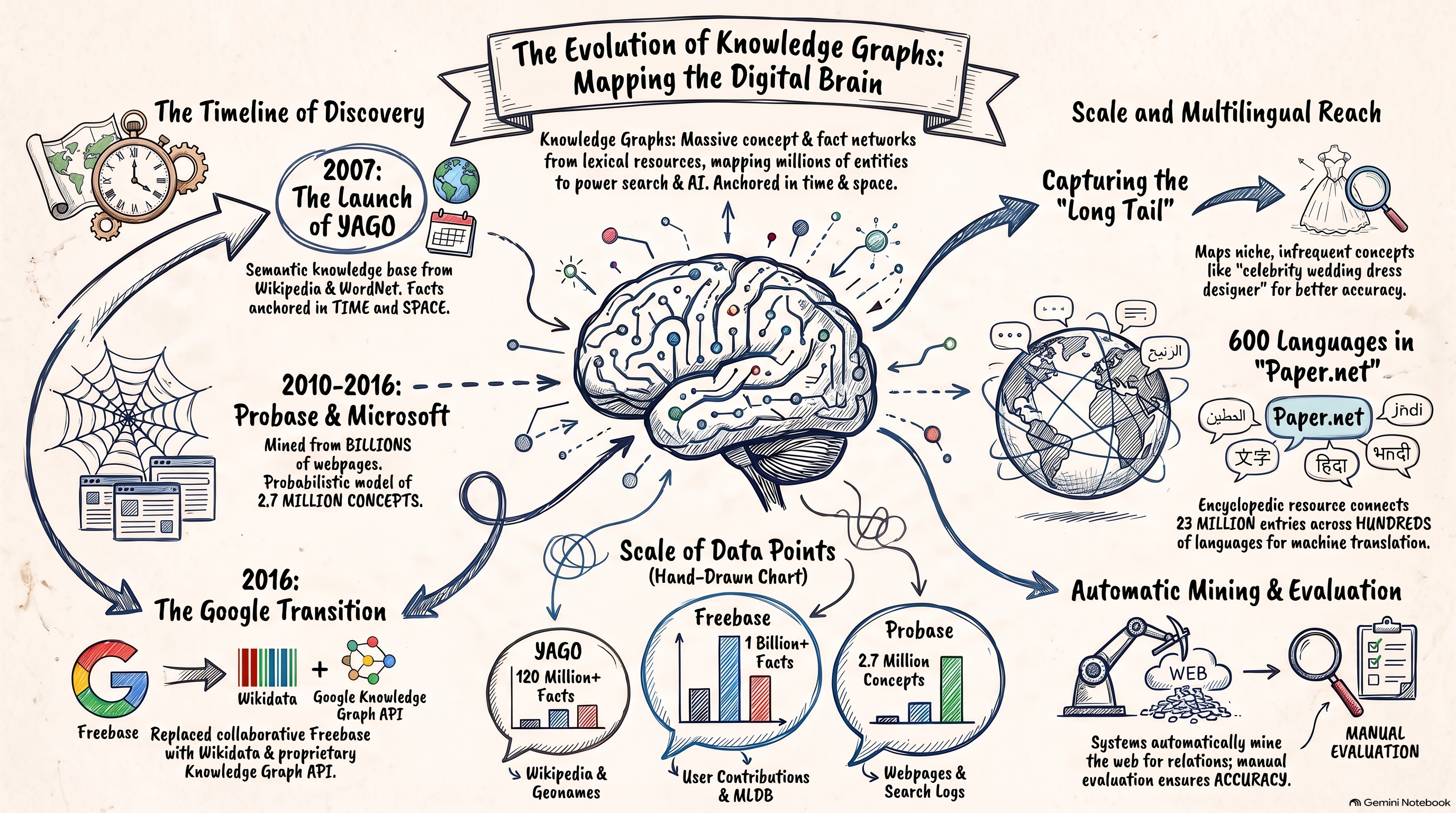
Reading note: "600 Languages in Paper.net" should read BabelNet, the multilingual resource described in the text.
医学里的知识资源:UMLS 与 MeSH
医学领域同一个概念往往有很多说法:心肌梗死、心梗、MI、heart attack。医学 NLP 最常用的两个知识资源,正是为了解决这一点,但分工不同。
| UMLS 统一医学语言系统 | MeSH 医学主题词表 | |
|---|---|---|
| 是什么 | 美国国家医学图书馆(NLM)整合的“元词表”(Metathesaurus),加上语义网络和专业词典 | NLM 编制的受控、层级化主题词表 |
| 怎么组织 | 把约 190 个来源词表(SNOMED CT、ICD-10-CM、RxNorm、LOINC、MeSH 等)中表达同一概念的名称归到同一个概念编号(CUI) | 主题词按从宽到窄的树状层级排列,例如 疾病 → 肿瘤 → … → 肺肿瘤 |
| 主要用途 | 串联、整合不同系统的术语,让病历、编码和检索系统可以互相对应 | 给 PubMed/MEDLINE 文献标引主题,并用于编目和检索 |
| 和知识图谱的关系 | 概念(CUI)是节点,概念间的关系构成网络,常被当作医学知识图谱的基础 | 本身是词表而非完整的知识图谱,但它的层级结构常被并入知识图谱 |
2025AB 版 UMLS 元词表收录约 349 万个概念,来自 190 个来源词表、29 种语言。UMLS 2025AB 统计 MeSH 用于“生物医学和健康信息的标引、编目与检索”。MeSH(NLM)
知识图谱在医学上的一个实际应用是罕见病药物再利用。美国阿拉巴马大学伯明翰分校开发的 mediKanren 用知识图谱把疾病机制、文献和数据库连接起来,寻找已获批药物的新用途,已用于帮助 500 多个罕见病家庭。Foksinska et al., 2022
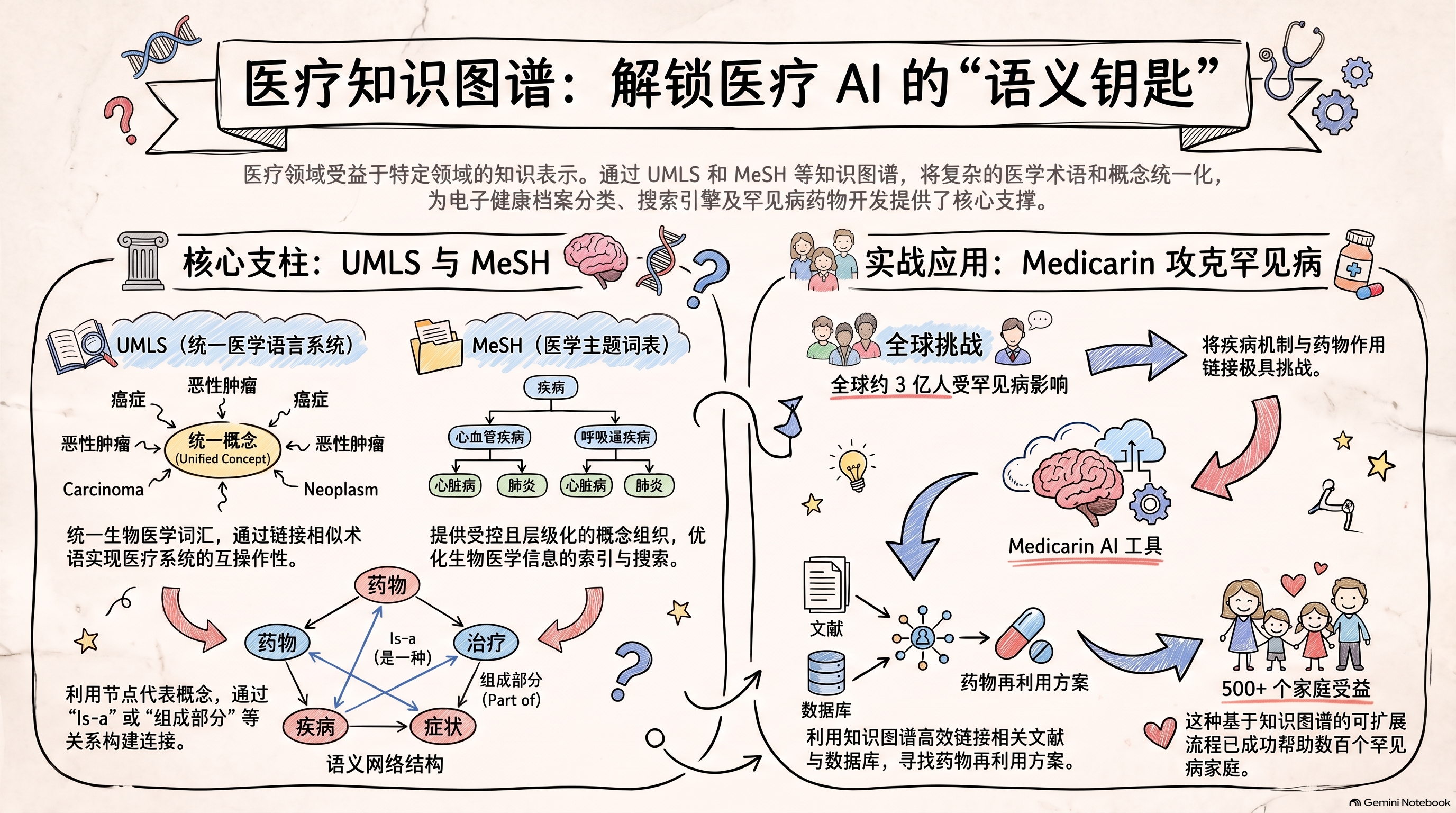
阅读提示:图中的“Medicarin AI 工具”正确名称是 mediKanren。
Medical knowledge resources: UMLS and MeSH
In medicine, one concept often has many names: myocardial infarction, MI, heart attack. The two knowledge resources most used in medical NLP both address this, but they do different jobs.
| UMLS (Unified Medical Language System) | MeSH (Medical Subject Headings) | |
|---|---|---|
| What it is | A Metathesaurus integrated by the US National Library of Medicine (NLM), plus a Semantic Network and a specialist lexicon | A controlled, hierarchical subject-heading vocabulary produced by NLM |
| How it is organized | Names for the same concept from about 190 source vocabularies (SNOMED CT, ICD-10-CM, RxNorm, LOINC, MeSH, and others) share one concept identifier (CUI) | Headings are arranged in a tree from broad to specific, for example Diseases → Neoplasms → … → Lung Neoplasms |
| Main use | Linking and integrating terms across systems so that health records, codes, and search tools can map to each other | Indexing PubMed/MEDLINE articles by subject, and cataloging and searching |
| Relation to knowledge graphs | Concepts (CUIs) are nodes and the relations between them form a network, often used as a foundation for medical knowledge graphs | A vocabulary rather than a full knowledge graph, though its hierarchy is often folded into knowledge graphs |
The 2025AB UMLS Metathesaurus holds about 3.49 million concepts drawn from 190 source vocabularies in 29 languages. UMLS 2025AB statistics MeSH is used "for indexing, cataloging, and searching" biomedical and health information. MeSH (NLM)
One practical use of knowledge graphs in medicine is drug repurposing for rare diseases. mediKanren, developed at the University of Alabama at Birmingham, uses knowledge graphs to link disease mechanisms, literature, and databases to find new uses for approved drugs. It has been used to help more than 500 families affected by rare diseases. Foksinska et al., 2022
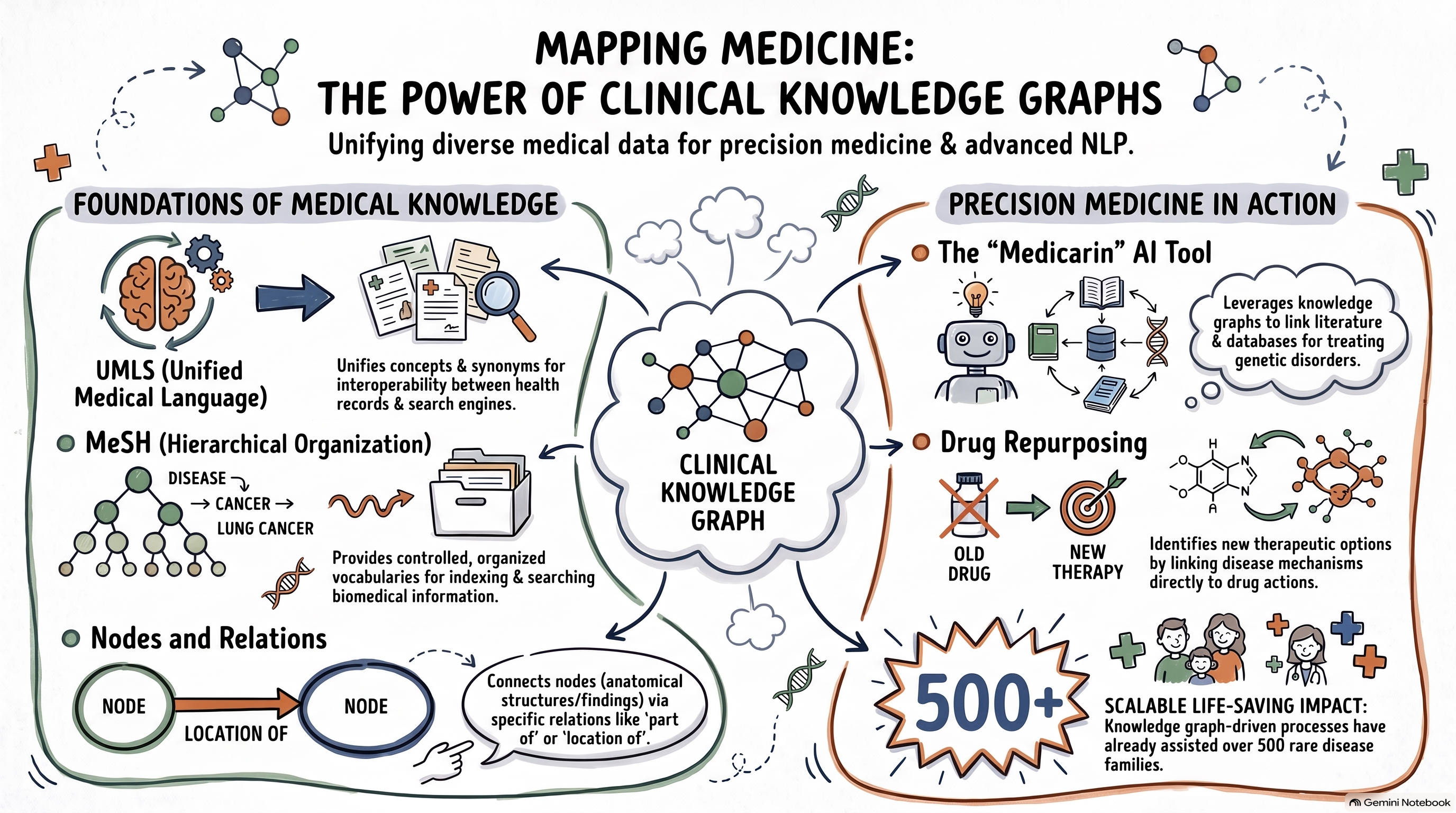
Reading note: UMLS stands for Unified Medical Language System, and the tool labeled "Medicarin" is mediKanren.
我的思考
当算法开始理解词义和句意后,就可以建立知识体系了。简单来说,就是在理解了词和词、句子和句子的含义后,理清它们之间的关系,再把关系连接起来,建立知识图谱。这个步骤也可以映射到我平时的学习过程:学了一定的新内容以后,进行知识归纳。
关系的连接可以从词开始。一个词包括它的读音、写法和具体含义。上一期我们给词贴标签,标签可以是词性,也可以是词义的大类。词和词之间的关系也可以从不同方向定义,比如是否是同义词、反义词、上下义词,这样就建立起了 WordNet。我学英语时也常用这个方法:学习替换词。它能帮助词义消歧——一个词有多个意思时,在不同句子里找到它的同义词,就能分清此处的意思。
有了 WordNet 之后,可以进一步定义语义框架,从词走向一个句子所表达的事件结构,比如理解谁对谁做了什么、句子里各自是什么角色。定义框架时依靠人工标注语料,也就是把人对语料的理解规范化;用这些标注数据训练或微调模型,可以提高同类文本上的准确率。
理解语义框架后,就可以通过语义构建具体的事实和概念(facts and concepts),并把知识结构化,形成知识图谱。
下一步我想研究的问题:简单的语言模型(simple language models)是怎样工作的?
My thoughts
Once an algorithm begins to understand the meaning of words and sentences, it can start building a system of knowledge. Put simply, after understanding what words and sentences mean, it sorts out how they relate and then links those relations into a knowledge graph. I can map this step onto how I learn: after taking in a certain amount of new material, I organize it into a structure.
Linking relations can start with words. A word includes how it sounds, how it is written, and what it means. In the previous note we labeled words, and labels can be parts of speech or broad meaning categories. Relations between words can be defined in different directions, such as synonyms, antonyms, and hyponyms and hypernyms, and that is how WordNet is built. I used this method often when learning English: learning substitute words. It helps with word sense disambiguation. When a word has several meanings, finding its synonym in each sentence shows which meaning is used there.
With WordNet in place, semantic frames go further, from words to the structure of the event a sentence describes: who did what to whom, and which role each part plays. Frames rely on hand-annotated text, which turns human understanding of language into a consistent standard. Training or fine-tuning models on this annotated data can raise accuracy on similar text.
With semantic frames understood, meaning can be used to build concrete facts and concepts and to give knowledge a structure, forming a knowledge graph.
The next question I want to explore: how do simple language models work?
原始手写笔记
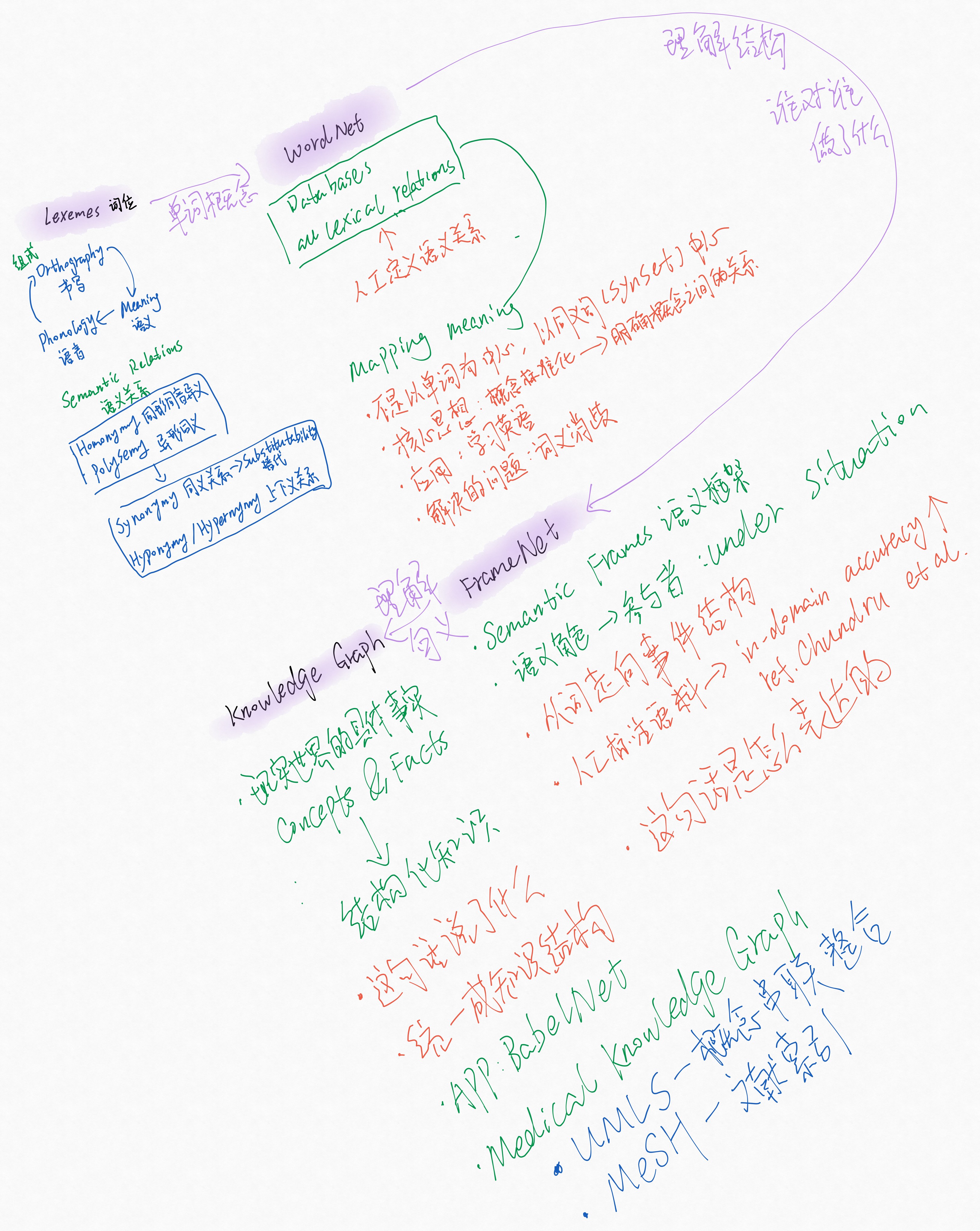
整理后的版本改了这些地方:Phonology 是“语音”而非“语言”;Polysemy 是“一词多义”(意思相关),原笔记写的“异形同义”其实是同义词的意思;WordNet 的“不以单词为中心,以同义词集为中心”补全了否定词;FrameNet 的人工标注与 in-domain 准确率改为对应 Chundru 等人 2025 年的具体结论;MeSH 补充为用于文献标引与检索的层级主题词表。
Original handwritten notes
What changed in the tidied version: phonology is about sound; polysemy means one word with several related senses (my notes had a Chinese gloss closer to "different forms, same meaning," which describes synonymy); the WordNet line now reads "centered on synsets, not single words"; the FrameNet annotation point now matches the specific finding of Chundru et al. (2025); and MeSH is described as a subject-heading vocabulary for indexing and searching literature.
学习来源与资源
本篇基于我在英属哥伦比亚大学(UBC)微证书项目 “Natural Language Processing to Improve Patient Care” 第一门课 “Overview of NLP and Large Language Models” 中的学习笔记。技术细节对照了 Jurafsky 与 Martin《Speech and Language Processing》(第 3 版草稿,2026 年 8 月):附录 I:Word Senses and WordNet、第 22 章:Semantic Role Labeling;以及 Chundru et al.(2025)Do LLMs Encode Frame Semantics? Evidence from Frame Identification、Foksinska et al.(2022)The precision medicine process for treating rare disease using the artificial intelligence tool mediKanren。
动手试试
- Open English WordNet:输入 bank,看它分成多少个 synset,每个 synset 的上义词是什么。
- FrameNet:在框架索引里查 Ingestion 或 Hiring,看它的框架元素和标注例句。
- BabelNet:搜索 library,对比返回的概念和实体,体会“覆盖广”与“结果分散”。
- MeSH Browser:查 Lung Neoplasms,看它在树状层级中的位置。UMLS 的在线浏览需要先免费申请 UTS 账号与许可。
Learning sources and resources
This note is based on my study notes from the University of British Columbia (UBC) micro-certificate program "Natural Language Processing to Improve Patient Care," in the course "Overview of NLP and Large Language Models." Technical details were checked against Jurafsky and Martin, Speech and Language Processing (3rd edition draft, August 2026): Appendix I, Word Senses and WordNet, and Chapter 22, Semantic Role Labeling; Chundru et al. (2025), Do LLMs Encode Frame Semantics? Evidence from Frame Identification; and Foksinska et al. (2022), The precision medicine process for treating rare disease using the artificial intelligence tool mediKanren.
Try it yourself
- Open English WordNet: look up bank to see how many synsets it has and what each one's hypernym is.
- FrameNet: find Ingestion or Hiring in the frame index to see its frame elements and annotated examples.
- BabelNet: search for library and compare the concepts and entities it returns, to see broad coverage and diffuse results side by side.
- MeSH Browser: look up Lung Neoplasms to see where it sits in the tree. Browsing UMLS online requires a free UTS account and license.