
NLP 学习笔记 / NLP005
语言模型的基础:概率
前面四期讲的是设计:计算机怎样拆解词和句子、给它们贴标签,再把词义连成知识。接下来是一个很实际的问题:我们怎样和能处理文本的电脑互动,电脑又是怎样给出回答的?背后的技术其实是生活中常常碰到的东西——概率。简单语言模型统计“接下来通常是什么”:在单词里是下一个字母,在句子里是下一个词,再把这些次数变成概率。
The Basis of Language Models: Probability
The last four notes were about design: how a computer breaks words and sentences apart, labels them, and links their meanings into knowledge. That raises a practical question. How do we actually talk with a computer that handles text, and how does it come up with an answer? The technique underneath is something we meet every day: probability. A simple language model counts what tends to come next, the next letter inside a word or the next word inside a sentence, and turns those counts into probabilities.
- 章节 / section
- 关键概念 / key term
- 阅读提示 / reading note
 ELLE · 阅读向导 / READING COMPANION
把概念连起来,再往下读 / Take a moment to connect the ideas
和 Elle 一起理清基础概念 / A few foundations, with Elle
点开概念理清区别,再试三道小题;选错后可以重新选择。 / Tap a concept to explore it, then try three short questions. You can change any answer.
频率与概率 / Frequency and probability
频率是次数:e 在 103 个字符里出现 11 次。概率再除以总数:11 ÷ 103 ≈ 0.107。所有概率加起来等于 1。 / Frequency is a count: e appears 11 times in a 103-character text. Probability divides by the total: 11 ÷ 103 ≈ 0.107. All the probabilities add up to 1.
条件概率 / Conditional probability
已知前面是什么时,下一个结果的可能性。P(red | big) 是 big 后面紧接 red 的概率,不是 red 在任何地方出现的概率。 / The chance of what comes next once we know what came before. P(red | big) is the probability of red right after big, not the probability of red anywhere.
一元与二元模型 / Unigram and bigram
一元模型只用每个词自己的概率,不看词序。二元模型以前一个词为条件:P(red | big) = big red 的次数 ÷ big 的次数。 / A unigram model uses each word's own probability and ignores order. A bigram model conditions on the previous word: P(red | big) = count of big red ÷ count of big.
抽样 / Sampling
生成时,按每个词的概率把 0 到 1 切成区间,取一个随机数,落在哪个区间就选哪个词;从 <s> 开始重复,直到 </s>。 / To generate, split 0 to 1 into intervals sized by each word's probability and draw a random number; the interval it lands in picks the word. Repeat from <s> until </s>.
全景图:从字母到句子
从左上角开始:英文字母加空格共 27 个符号,数出每个符号出现的次数就是字母频率,再除以总数就是字母概率。黑色箭头指向单词:只用单词各自的概率,就是一元语言模型;旁边的蓝色批注是,词频也能用来区分 AI 写的文字和人写的文字。中间的条件概率加入了上下文:已知前面是什么,下一个是什么。向下的箭头通向生成句子:查单词概率表,一个词一个词地抽出来。右下角是我的重点。
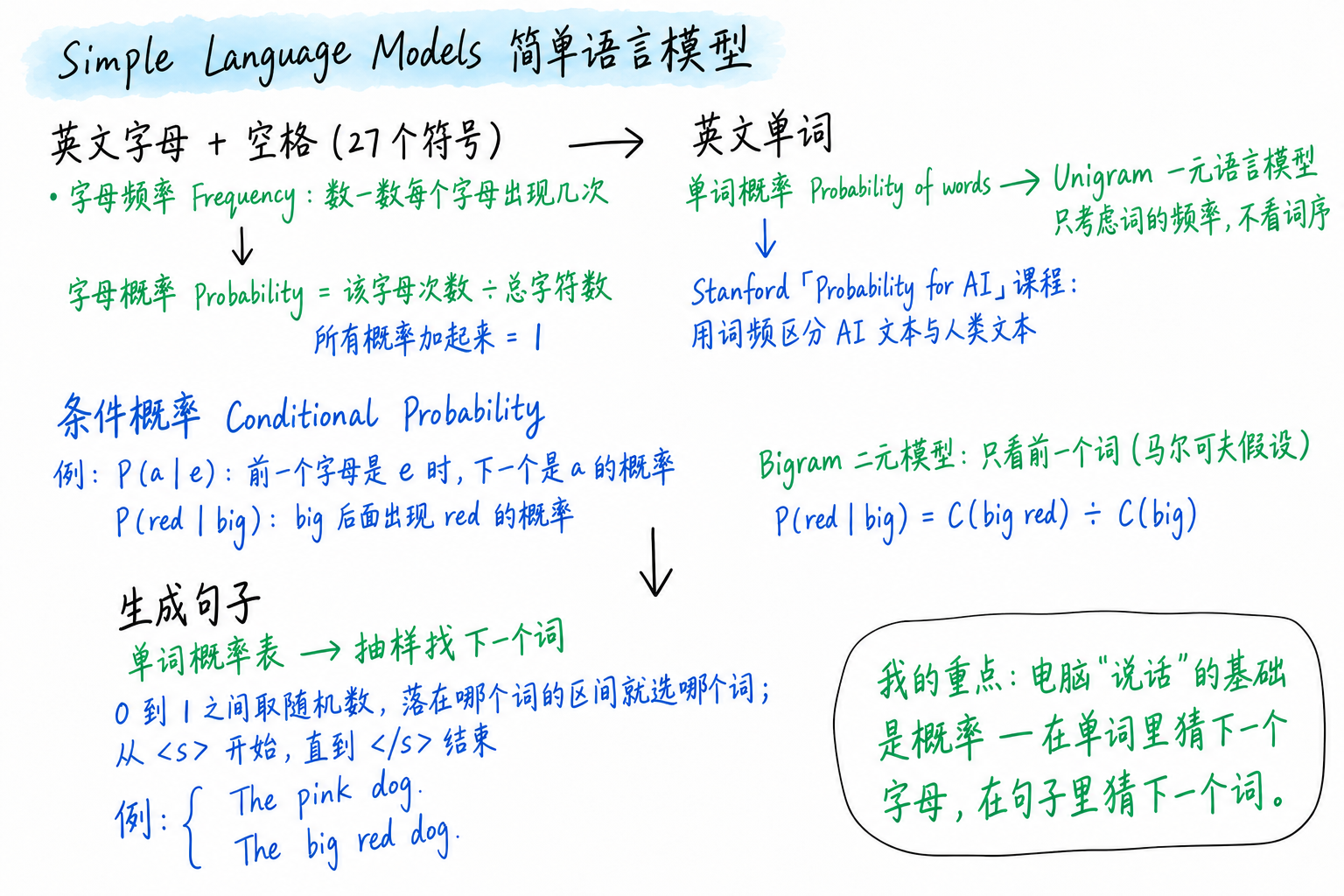
根据我的手写笔记整理,做了几处修正和补充。
The big picture: from letters to sentences
Start at the top left. English letters plus the space give 27 symbols; counting them gives letter frequencies, and dividing by the total gives letter probabilities. The black arrow leads to words: word probabilities on their own make a unigram model, and in the blue note beside it, word frequencies are also a way to tell AI-written text from human writing. In the middle, conditional probability adds context: what comes next given what came before. The arrow down leads to generating sentences from word probability tables. The note at the bottom right is my main takeaway.
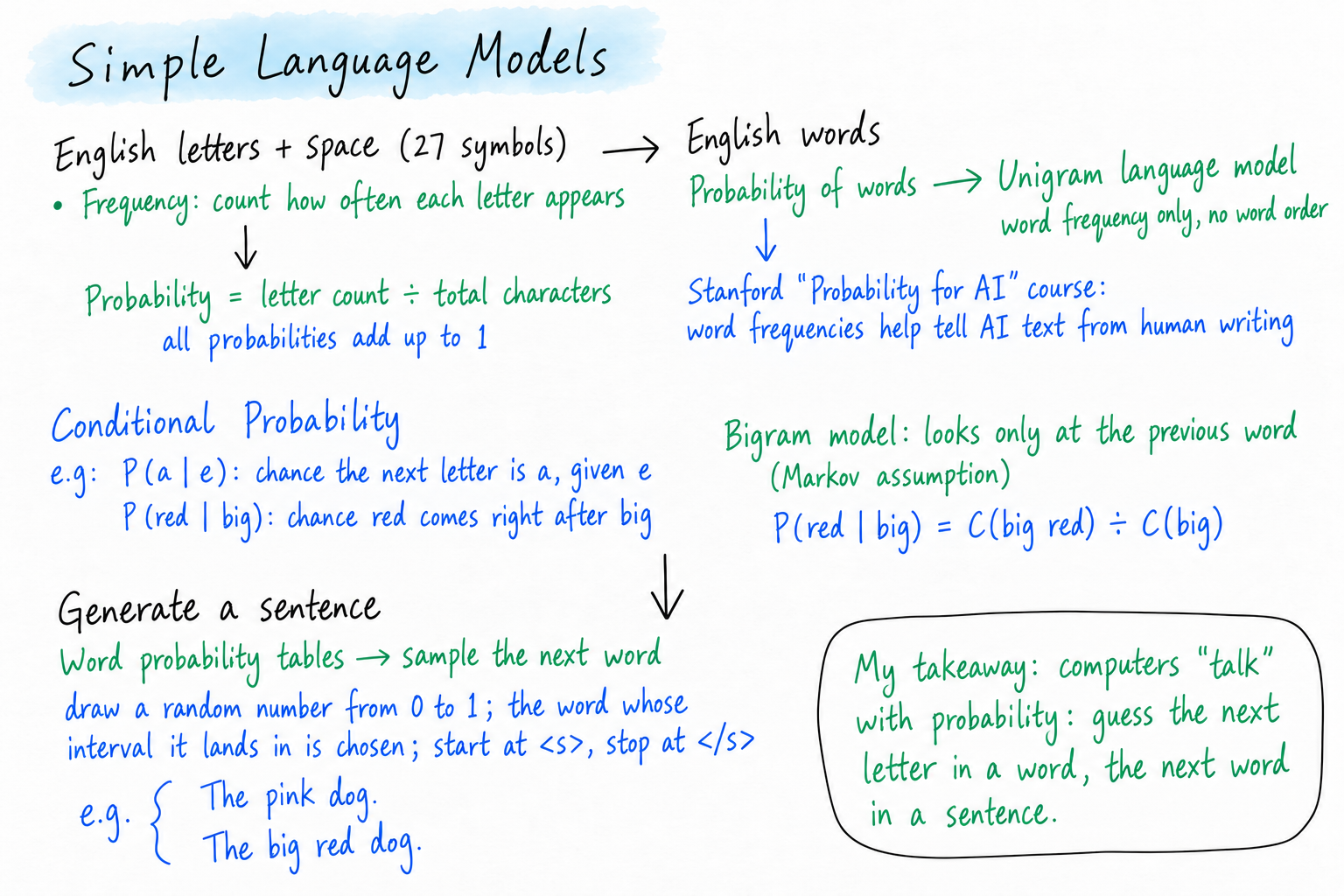
Tidied up from my handwritten page, with a few corrections and additions.
字母:从数次数到概率
最简单的语言模型以字符为单位。取 26 个英文字母加上空格,共 27 个符号,数一数每个符号在一段文字里出现多少次,这就是频率。用它除以总字符数,就得到这个字母的概率:
P(字母) = 该字母出现的次数 ÷ 总字符数
| 符号 | 在 103 个字符的文本中出现次数 | 概率 |
|---|---|---|
| a | 8 | 8 ÷ 103 ≈ 0.078 |
| e | 11 | 11 ÷ 103 ≈ 0.107 |
| 空格 | 14 | 14 ÷ 103 ≈ 0.136 |
无论文本多长,有两点总成立:每个概率都在 0 到 1 之间;27 个概率加起来正好等于 1,因为每个字符都必然是这 27 个符号之一。在一般的英文里,空格出现得最多,其次是 e、a 等元音字母,z、q、x 则很少见。
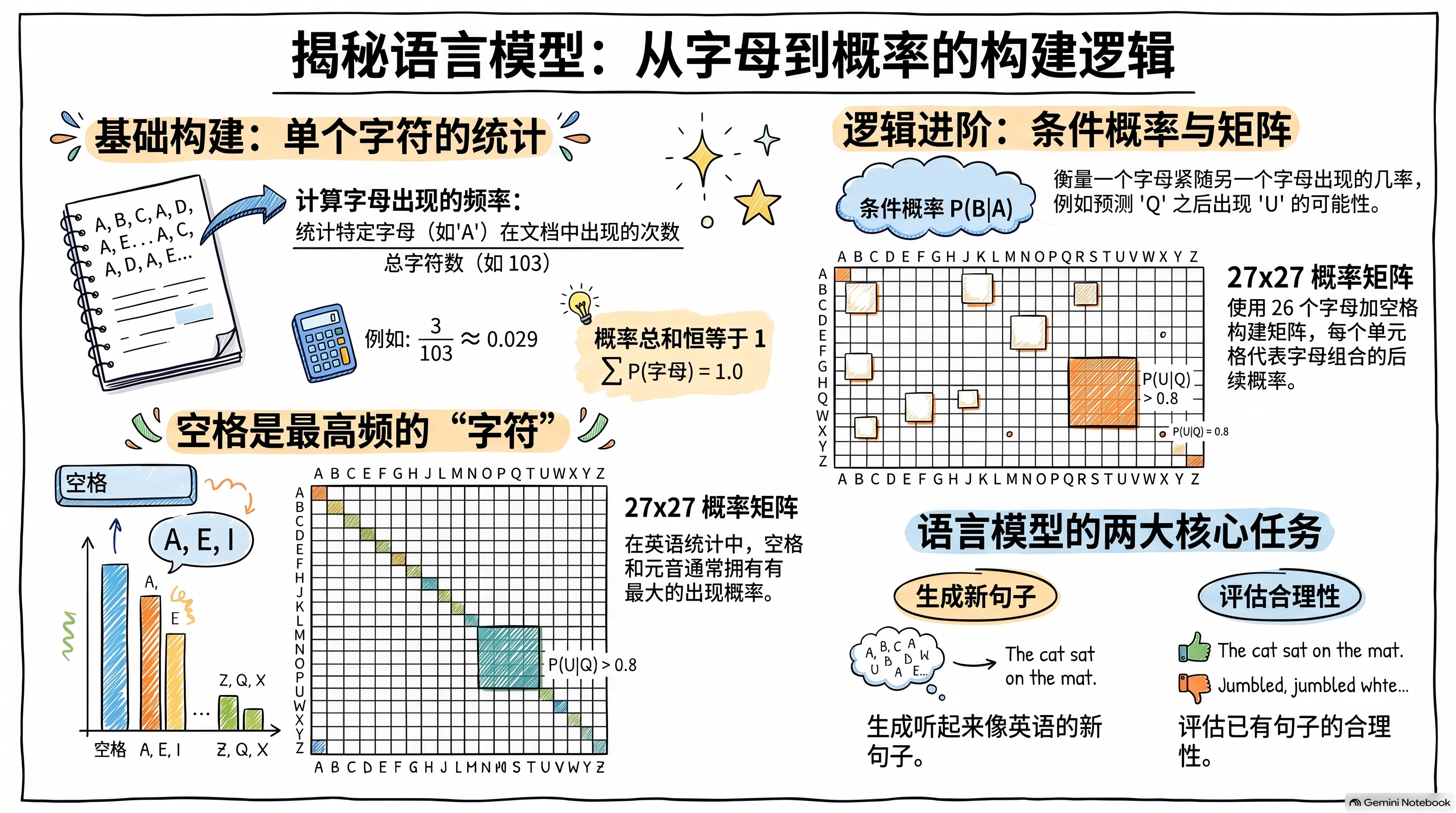
阅读提示:左下角的矩阵把高亮画在对角线上,容易误读成“字母后面接同一个字母”;它想表达的只是“空格和元音最常见”。两个矩阵的字母标签都漏了几个字母,真实的矩阵对 27 个符号各有一行一列。
Letters: from counting to probability
The simplest language model works on characters. Take the 26 English letters plus the space, 27 symbols in all, and count how often each one appears in a text. That count is the frequency. Divide it by the total number of characters and you get the letter's probability:
P(letter) = count of that letter ÷ total number of characters
| Symbol | Count in a 103-character text | Probability |
|---|---|---|
| a | 8 | 8 ÷ 103 ≈ 0.078 |
| e | 11 | 11 ÷ 103 ≈ 0.107 |
| space | 14 | 14 ÷ 103 ≈ 0.136 |
Two properties hold for any text. Each probability lies between 0 and 1, and the 27 probabilities add up to exactly 1, because every character has to be one of the 27 symbols. In ordinary English the space is the most frequent symbol, followed by vowels such as e and a, while letters like z, q, and x are rare.
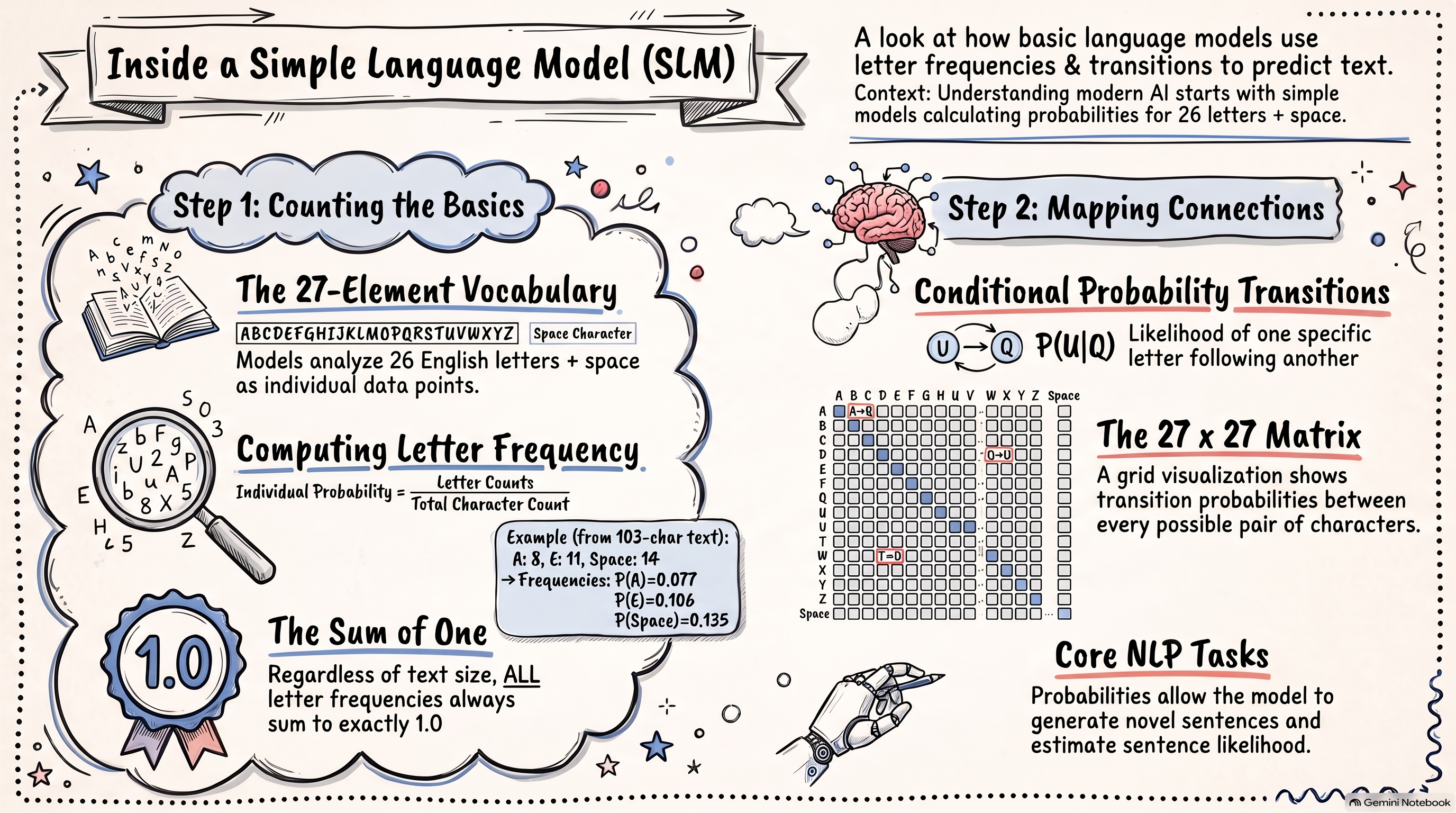
Reading note: P(U | Q) is the probability of U given that the previous letter was Q, so the transition runs Q → U; the small diagram draws the arrow the other way. Some letters are also missing from the matrix labels; the real matrix has one row and one column for each of the 27 symbols. With the counts shown, P(space) = 14 ÷ 103 ≈ 0.136.
单词:一元语言模型
同样的数法可以上升一层:把每个词当作单位,在一大批文本(语料库)里数它出现的次数,再除以总词数。这里有两个术语:
| 术语 | 含义 | 例子:“the cat sat on the mat” |
|---|---|---|
| 词例(token) | 词的每一次出现 | 6 个词例 |
| 词型(type) | 不重复的词,也就是词汇表 | 5 个词型:the、cat、sat、on、mat |
只用这些单词概率的模型叫一元语言模型(unigram)。它只看词频、不看词序,所以会认为 “the cat sat” 和 “sat the cat” 一样可能。要解决这个问题,模型需要上下文。
句子还会加上两个特殊符号:开头的 <s> 和结尾的 </s>。有了它们,模型就能学到哪些词常常出现在句首,以及句子什么时候该结束。SLP3,第 3 章
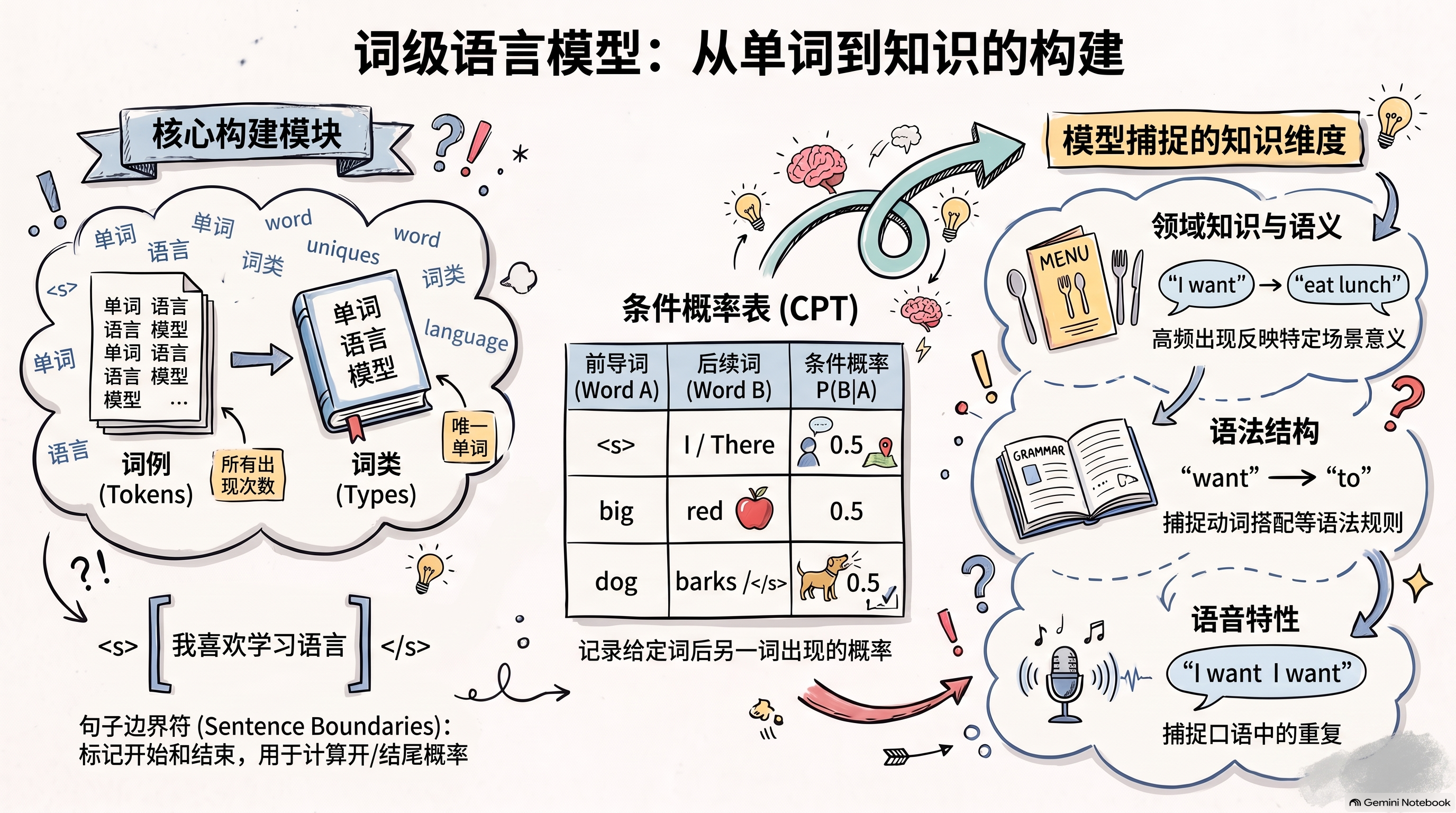
阅读提示:图中的“词类”指词型(type),即不重复的词,和语法上的“词类”(词性)不是一回事。条件概率表里的 0.5 只是示意数值。
Words: the unigram model
The same counting works one level up. Treat each word as a unit, count how often it appears in a large collection of text (a corpus), and divide by the total number of words. Two terms help here:
| Term | Meaning | Example: "the cat sat on the mat" |
|---|---|---|
| Token | Every occurrence of a word | 6 tokens |
| Type | Each distinct word (the vocabulary) | 5 types: the, cat, sat, on, mat |
A model that uses only these word probabilities is a unigram language model. It looks at word frequency alone and ignores order, so it would score "the cat sat" and "sat the cat" as equally likely. To fix that, a model needs context.
Sentences are also marked with two special symbols: <s> at the start and </s> at the end. They let the model learn which words tend to begin a sentence and when a sentence is likely to stop. SLP3, Chapter 3
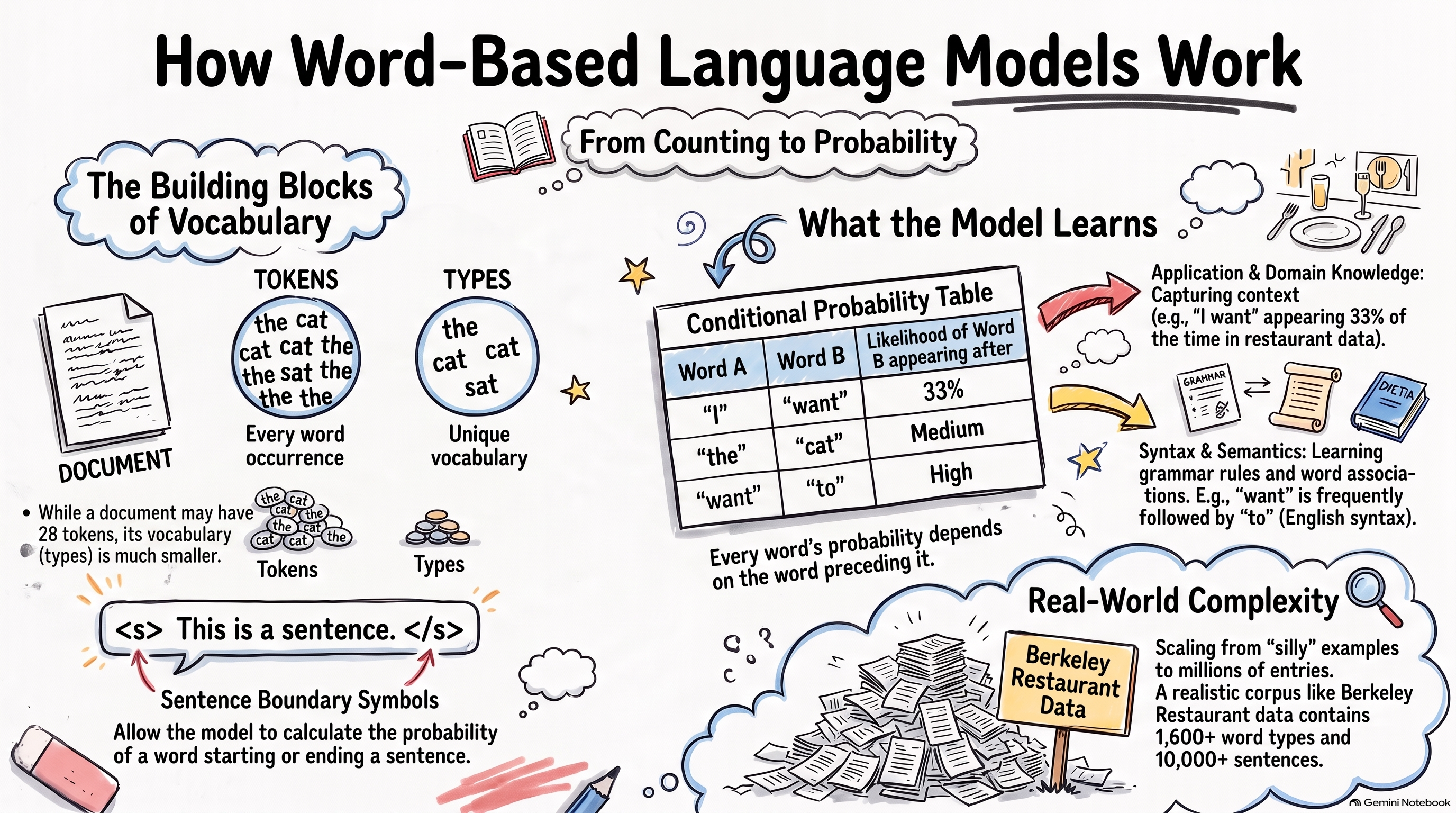
Reading note: in Jurafsky and Martin's textbook, the Berkeley Restaurant Project sample has 9,332 sentences and a vocabulary of 1,446 word types, not "1,600+ word types and 10,000+ sentences." The 33% for "I want" is P(want | I) = 0.33 from that corpus.
条件概率:下一个是什么
条件概率问的是:已知前面出现了什么,接下来某个结果有多大可能。写法是中间加一条竖线,读作“在……条件下”:
- P(a | e):当前字母是 e 时,下一个字母是 a 的概率。
- P(red | big):当前词是 big 时,下一个词是 red 的概率。
对字母来说,27 × 27 种组合构成一张表。有些格子几乎是确定的:英文里 q 后面几乎总是 u。对单词来说,只以前一个词为条件的模型叫二元模型(bigram),它的概率同样来自计数:
P(red | big) = “big red” 出现的次数 ÷ “big” 出现的次数
只看前一个词、不看全部历史,这个简化叫马尔可夫假设。三元模型往前看两个词,n 元模型往前看 n − 1 个词。在 Berkeley Restaurant Project(一个餐厅查询系统收集的问句语料)里,P(want | I) = 0.33:“I” 后面有三分之一的情况接 “want”。SLP3,第 3 章
这些数字记录了真实的规律:“want” 后面常接 “to”,这是英语语法;“I want” 很常见,是因为人们在找餐厅,这是关于任务场景的知识。
Conditional probability: what comes next
A conditional probability asks how likely something is once we know what came before. It is written with a vertical bar, read "given":
- P(a | e): the probability that the next letter is a, given that the current letter is e.
- P(red | big): the probability that the next word is red, given that the current word is big.
For letters, the 27 × 27 combinations form a table. Some cells are almost certain: after q, English nearly always continues with u. For words, a model that conditions on just the previous word is a bigram model, and its probabilities also come from counting:
P(red | big) = count of "big red" ÷ count of "big"
Using one previous word instead of the whole history is called the Markov assumption. A trigram looks two words back, and an n-gram looks n − 1 words back. In the Berkeley Restaurant Project, a corpus of questions to a restaurant-finding system, P(want | I) = 0.33: a third of the time, "I" is followed by "want." SLP3, Chapter 3
These numbers capture real regularities. "want" is often followed by "to," which is English grammar; "I want" is common because people were asking for restaurants, which is knowledge about the task.
给句子打分
语言模型也能给整句话算一个概率。链式法则把每个词在前文条件下的概率相乘;二元模型把每一项的前文缩短为前一个词:
P(<s> i want english food </s>) = P(i | <s>) × P(want | i) × P(english | want) × P(food | english) × P(</s> | food) = 0.25 × 0.33 × 0.0011 × 0.5 × 0.68 ≈ 0.000031
这个数本身非常小,所以实际计算时会把概率取对数再相加,避免数值下溢。重要的是比较:越自然的句子,概率越高。这让语言模型成了一个过滤器。
| 任务 | 概率怎样帮忙 |
|---|---|
| 拼写和语法纠错 | “There are two midterms” 比 “Their are two midterms” 概率更高 |
| 语音识别 | “I will be back soonish” 比 “I will be bassoon dish” 概率更高 |
| 机器翻译、摘要 | 先生成多个候选,再留下概率最高的那个 |
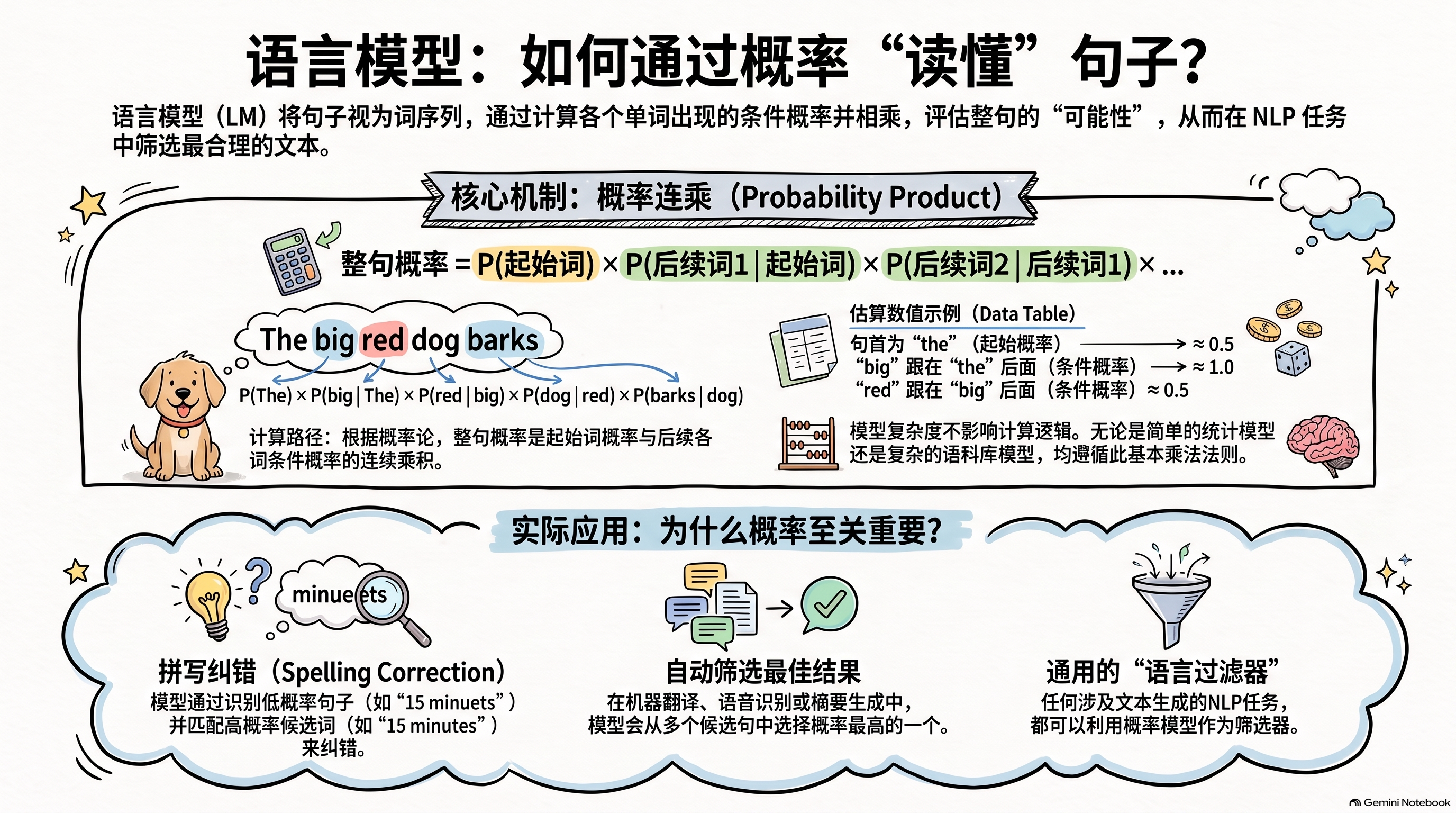
阅读提示:图中的公式只看前一个词,是二元模型的近似;完整的链式法则要以前面所有词为条件,例如 P(后续词2 | 起始词, 后续词1)。图中 P(big | the) ≈ 1.0 等数值来自一个很小的示例语料。
Scoring a sentence
A language model can also give a whole sentence a probability. The chain rule multiplies the probability of each word given the words before it, and a bigram model shortens each context to one word:
P(<s> i want english food </s>) = P(i | <s>) × P(want | i) × P(english | want) × P(food | english) × P(</s> | food) = 0.25 × 0.33 × 0.0011 × 0.5 × 0.68 ≈ 0.000031
The number itself is tiny, so in practice models add log probabilities instead of multiplying, which avoids numerical underflow. What matters is the comparison: a more natural sentence gets a higher probability. That makes the model useful as a filter.
| Task | How probability helps |
|---|---|
| Spelling and grammar correction | "There are two midterms" is more probable than "Their are two midterms" |
| Speech recognition | "I will be back soonish" is more probable than "I will be bassoon dish" |
| Machine translation, summarization | Generate several candidates and keep the most probable one |
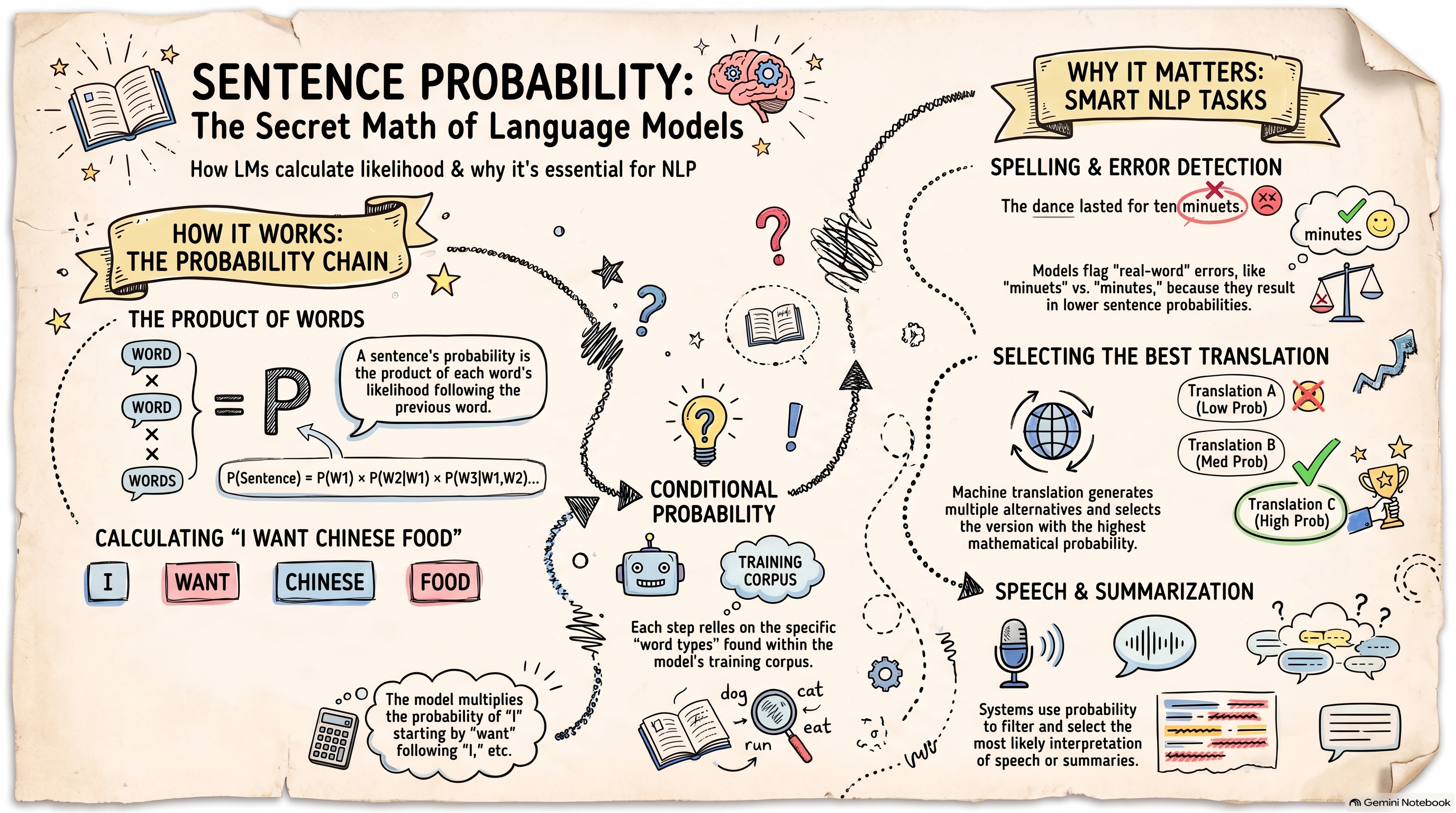
Reading note: the formula P(W1) × P(W2 | W1) × P(W3 | W1, W2) is the exact chain rule; a bigram model approximates each term with only the previous word, so P(W3 | W1, W2) becomes P(W3 | W2). "relles" should read "relies."
生成句子:抽样
要“写”而不只是“打分”,模型靠抽样。把 0 到 1 的数轴切成一段段区间,每个词占一段,长度等于它的概率。取一个 0 到 1 之间的随机数,落在哪个词的区间,就选哪个词。常见词占的区间大,被选中的机会多;罕见词只占很小一段。
- 从 <s> 开始,在 <s> 那一行的概率里抽出第一个词,比如 “the”。
- 转到 “the” 那一行再抽一次,比如 “big”,接着是 “red”、“dog”。
- 抽到 </s> 时停止。
单词概率表就是这样写出 “The pink dog.” 或 “The big red dog.” 的。这句话可能从没在训练文本里出现过:每一对相邻的词都说得通,整句却是新的。上下文越长,生成的句子越连贯:一元模型抽出来的是一堆词,二元模型有局部的连贯,三元、四元模型的句子开始像原文的风格。SLP3,第 3 章
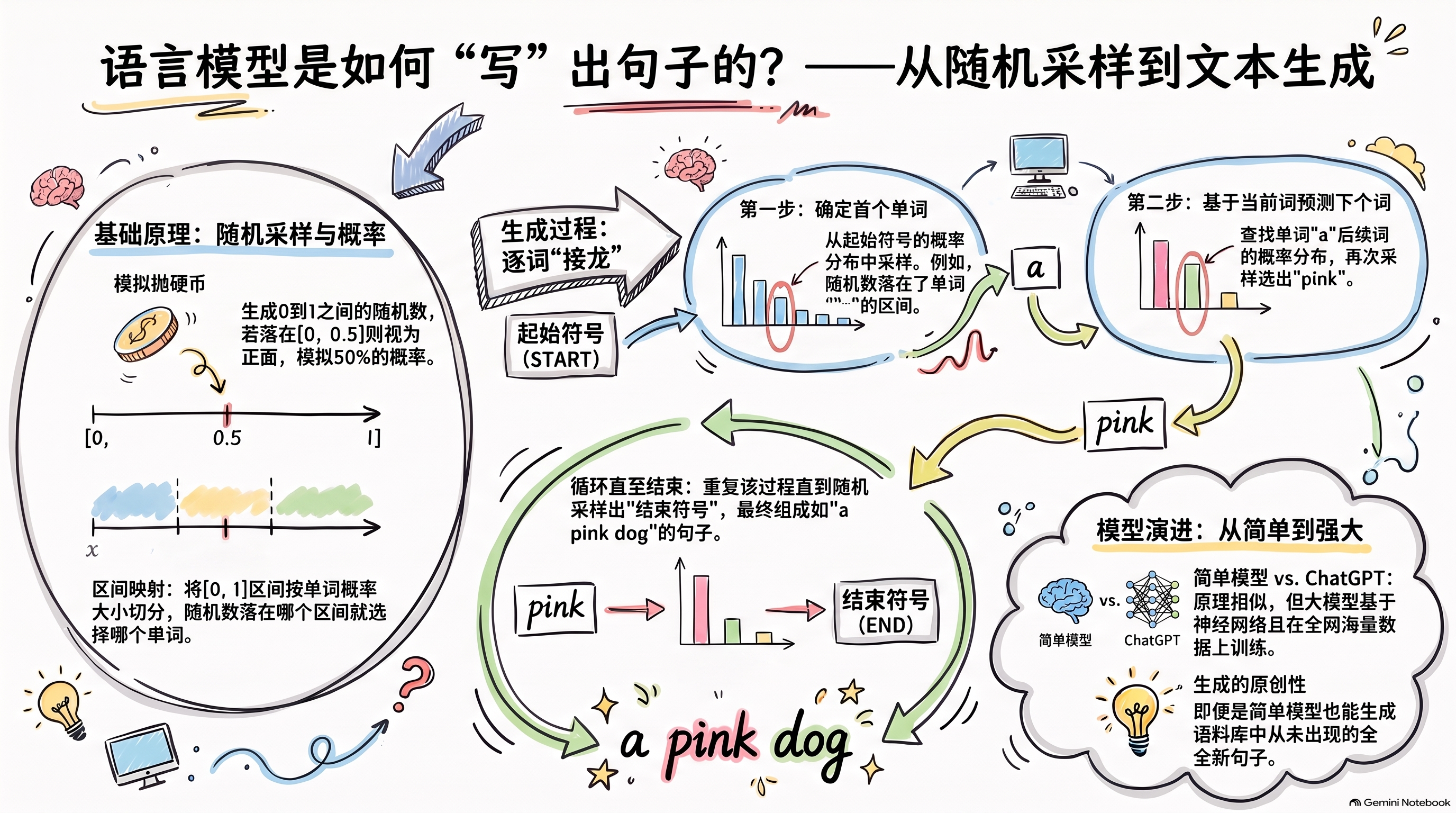
阅读提示:“第一步”里“随机数落在了单词“”…”的区间”中的词没有显示出来,按图中流程应为 “a”。右下角“原理相似”指都在预测下一个词,ChatGPT 用的是神经网络,而不是计数表。
计数的边界
单靠计数有两个先天的限制。训练文本里从没出现过的词对,概率是零,一个没见过的词对就会让整句的概率变成零;加一(拉普拉斯)平滑等方法会给没见过的词对分一点概率。另外,很短的上下文无法把句子里相隔较远的词联系起来。下一期要讲的神经语言模型,通过学习表示而不是存储次数,来处理这两个问题。
Generating a sentence: sampling
To write rather than score, the model samples. Picture the number line from 0 to 1 divided into intervals, one per word, each as long as that word's probability. Draw a random number between 0 and 1; the interval it lands in is the chosen word. Frequent words own large intervals and are picked often, rare words own tiny ones.
- Start from <s> and sample the first word from the row for <s>, for example "the."
- Move to the row for "the" and sample again, for example "big," then "red," then "dog."
- Stop when the sample is </s>.
That is how a word probability table yields "The pink dog." or "The big red dog." The sentence may never have appeared in the training text: each pair of neighbors is plausible, but the whole is new. More context makes the output more coherent. Sentences sampled from a unigram model are word salad, bigram sentences have local coherence, and trigram or 4-gram sentences start to sound like their source. SLP3, Chapter 3
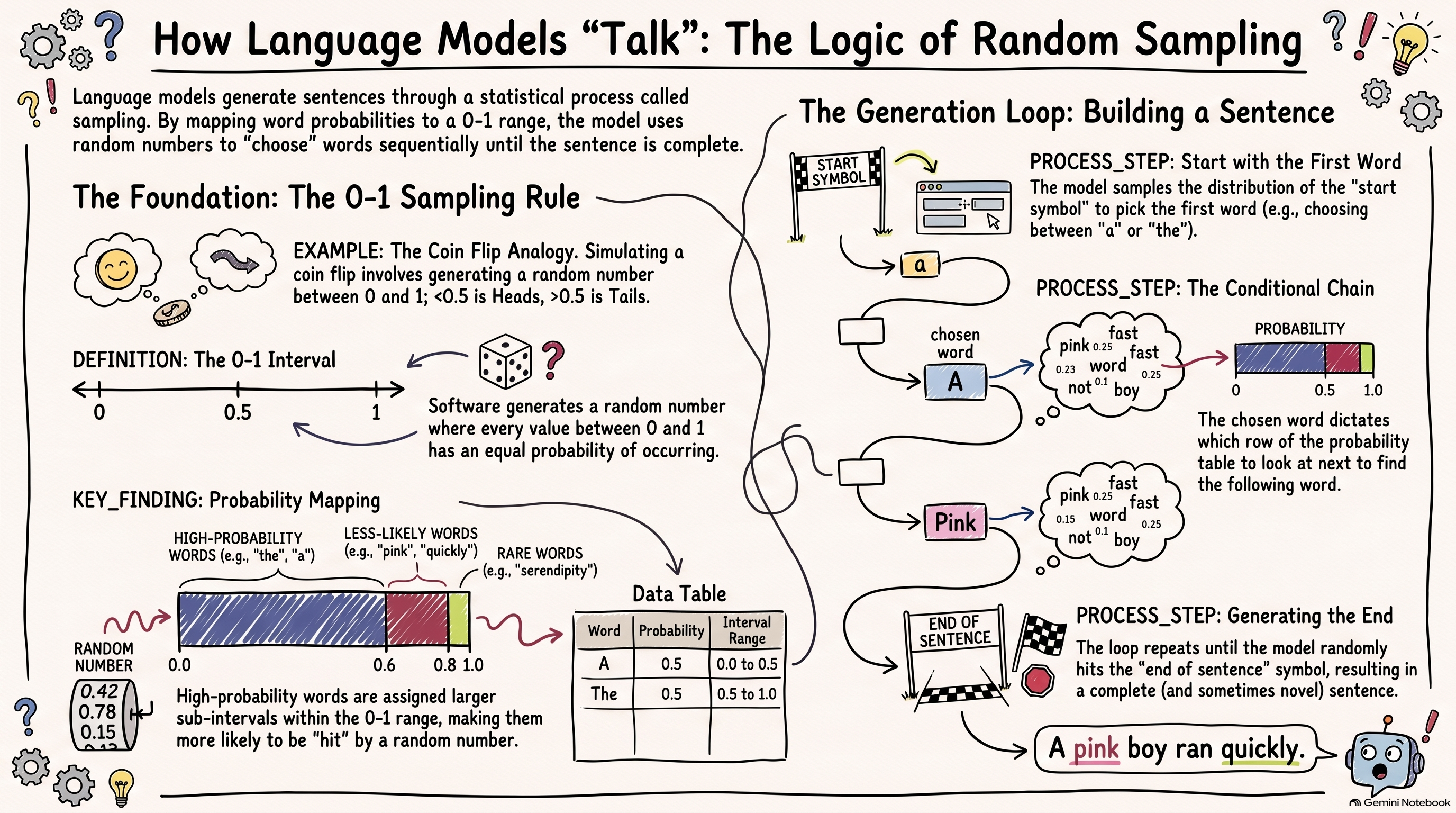
Reading note: the second thought bubble lists "fast" twice; each word appears once in a probability row, and the row's probabilities add up to 1.
Where counting runs out
Counting has two built-in limits. Any word pair that never occurred in the training text gets probability zero, so a single unseen pair makes a whole sentence impossible; smoothing methods such as add-one (Laplace) smoothing give unseen pairs a small share. And a short context window cannot connect words far apart in a sentence. Neural language models, the next topic, address both by learning representations instead of storing counts.
词频与 AI 写的文字
单词概率也像一种“指纹”,能透露一段文字是谁写的。语言模型偏爱某些词的程度和人不同,所以当一批文本里有很多出自 AI 时,词频分布就会发生变化。Stanford 的 Liang 等人(2024)利用这一点,在整个语料库层面(而不是逐篇判断)估计有多少文字被大语言模型大幅修改过。在 ChatGPT 发布后举办的四个 AI 会议的同行评审意见中,这一比例估计在 6.5% 到 16.9% 之间。Liang 等,ICML 2024
Stanford 的免费线上课程 Probability for AI(概率与 AI)由 Chris Piech 和 Mehran Sahami 讲授,面向只具备基础代数的学习者讲解现代 AI 背后的概率,由志愿者带小组讨论。我接下来会去上这门课,并整理学到的内容。Probability for AI
Word frequencies and AI-written text
Word probabilities are also a fingerprint of who, or what, wrote a text. Language models favor certain words more than people do, so the frequency distribution of words in a body of text shifts when much of it is AI-written. Liang et al. (2024) at Stanford used this to estimate, across a whole corpus rather than per document, how much text had been substantially modified by large language models. In peer reviews for four AI conferences held after ChatGPT's release, the estimate was between 6.5% and 16.9%. Liang et al., ICML 2024
Stanford's free online course Probability for AI, taught by Chris Piech and Mehran Sahami, teaches the probability behind modern AI to learners who know basic algebra, with volunteer-led small sections. I plan to take it next and will write up what I learn. Probability for AI
我的思考
之前几期学习的是,在概念上怎样设计,让电脑理解人类的语言:解构词和句子,进行分类和归纳,再定义并关联它们之间的关系,电脑就能理解和处理文本。
但我们怎样和理解文本的电脑互动呢?电脑又是怎样回答我们的?这里用到的技术,其实我们在生活中总能接触到,就是概率。简单来说,电脑在构建知识的时候,会学习每个单词之后出现各个单词的概率。比如在 “the big red dog” 里,它学到了 big 后面接 red 有多大可能,red 后面接 dog 有多大可能,再根据学到的概率选出下一个词。
所以我想把概率好好学一遍。Stanford 免费的 Probability for AI 课程是我的下一步,之后我也会总结自己学到的内容。
下一步我想研究的问题:神经语言模型是怎样工作的?
My thoughts
The earlier notes covered how a computer can be designed to understand human language at the level of concepts: break words and sentences apart, sort and group them, then define and link the relations between them. With that, a computer can understand and process text.
But how do we interact with a computer that understands text, and how does it answer us? The technique behind it is something we meet all the time in everyday life: probability. Put simply, while the computer builds up its knowledge, it learns the probability of each word that follows another word. In "the big red dog," it has learned how likely red is after big and how likely dog is after red, and it chooses the next word from those learned chances.
That is why I want to learn probability properly. Stanford's free Probability for AI course is my next step, and I will summarize what I learn there.
The next question I want to explore: how do neural language models work?
原始手写笔记
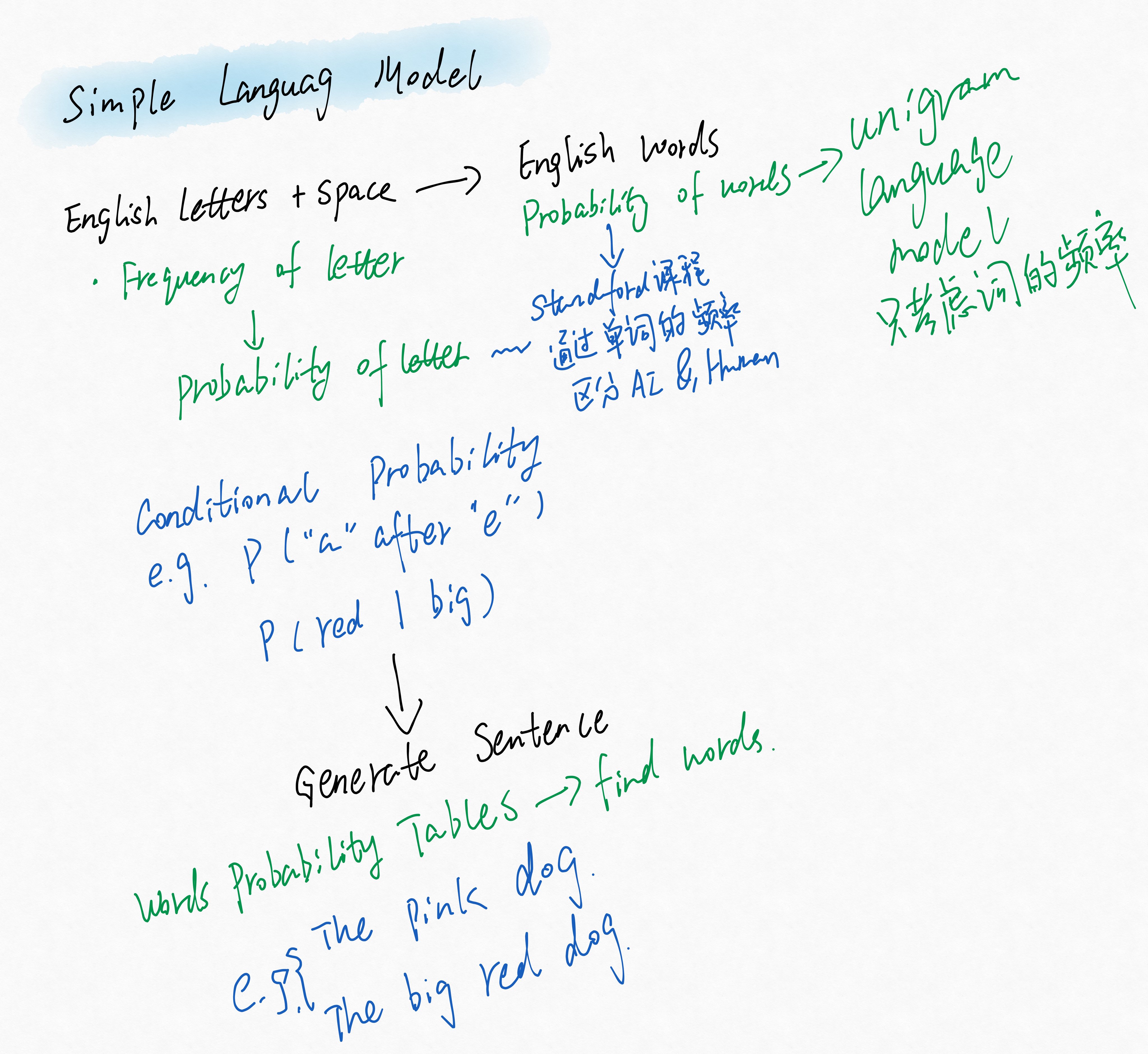
整理后的版本改了这些地方:标题拼写改为 Simple Language Models;P("a" after "e") 改用标准写法 P(a | e);条件概率部分补上了二元模型的名称和计数公式;生成句子部分补充了怎样抽词(0 到 1 之间取随机数,从 <s> 到 </s>);Stanford 的批注写明了课程名 Probability for AI。
Original handwritten notes
What changed in the tidied version: the title is spelled Simple Language Models; P("a" after "e") is written in standard notation as P(a | e); the conditional-probability line now names the bigram model and its count formula; the generation step now says how a word is drawn (a random number between 0 and 1, from <s> to </s>); and the Stanford note names the course, Probability for AI.
学习来源与资源
本期内容来自我在英属哥伦比亚大学(UBC)微证书项目“Natural Language Processing to Improve Patient Care”中“Overview of NLP and Large Language Models”课程的学习笔记。技术细节核对了 Jurafsky 和 Martin 的 Speech and Language Processing(第 3 版草稿,2026 年 8 月):第 3 章 N-gram Language Models;以及 Liang 等(2024)Monitoring AI-Modified Content at Scale: A Case Study on the Impact of ChatGPT on AI Conference Peer Reviews。
自己动手试试
- Google Books Ngram Viewer:比较 “big red” 和 “large red” 在历年书籍中出现的频率。这正是二元模型的计数起点。
- Stanford Probability for AI:上文提到的免费线上课程,讲现代 AI 背后的概率。
Learning sources and resources
This note is based on my study notes from the University of British Columbia (UBC) micro-certificate program "Natural Language Processing to Improve Patient Care," in the course "Overview of NLP and Large Language Models." Technical details were checked against Jurafsky and Martin, Speech and Language Processing (3rd edition draft, August 2026): Chapter 3, N-gram Language Models; and Liang et al. (2024), Monitoring AI-Modified Content at Scale: A Case Study on the Impact of ChatGPT on AI Conference Peer Reviews.
Try it yourself
- Google Books Ngram Viewer: compare how often "big red" and "large red" appear in books over time. These are the same kinds of counts a bigram model starts from.
- Stanford Probability for AI: the free online course on the probability behind modern AI mentioned above.