
NLP 学习笔记 / NLP008
大语言模型的问题与改进:幻觉、偏差、对齐与可解释性
上一篇笔记最后留下了两个挑战:数据污染和幻觉。这一篇来自课程的最后一讲,看大语言模型(LLM)还有哪些问题,以及研究者怎样应对。一共四类问题:幻觉与过时信息、不周到或有害的回答、偏差,以及黑箱问题。每一类都配有一种检测、减轻或解释它的方法,但没有哪一种能让问题彻底消失。
Open Issues in Large Language Models: Hallucination, Bias, Alignment and Interpretability
The last note ended with two challenges, data contamination and hallucination. This note, from the final lecture of the course, looks at what still goes wrong with large language models (LLMs) and what researchers do about it. It covers four problems: hallucination and stale information, unhelpful or toxic answers, bias, and the black-box problem. For each one, it shows a method that detects, reduces or explains the problem. None of these methods makes the problem go away completely.
- 章节 / section
- 关键概念 / key term
- 阅读提示 / reading note
 ELLE · 阅读向导 / READING COMPANION
把概念连起来,再往下读 / Take a moment to connect the ideas
和 Elle 一起理清基础概念 / A few foundations, with Elle
点开概念理清区别,再试三道小题;选错后可以重新选择。 / Tap a concept to explore it, then try three short questions. You can change any answer.
幻觉 / Hallucination
听起来合理,实际上不真实、没有意义或不忠实于原文的输出。即使最终答案正确,它也可能藏在推理步骤里。 / Output that sounds plausible but is untruthful, nonsensical or unfaithful to its source. It can hide in the reasoning even when the final answer is right.
原子事实 / Atomic fact
一条可以单独判断真假的短陈述。FActScore 把文本拆成原子事实,逐条到维基百科等可信来源核对;DoveScore 还会检查它们的先后顺序。 / One short claim that can be checked as true or false on its own. FActScore splits a text into atomic facts and checks each against a trusted source such as Wikipedia; DoveScore also checks their order.
检索增强生成 RAG / RAG
先检索与问题相关的文档,和问题组合成新的提示,再生成回答。答案可以是最新的、能注明来源,模型本身不变。 / Retrieve documents relevant to the question, combine them with it into a new prompt, then generate. The answer can be up to date and cite sources, and the model itself does not change.
人类反馈强化学习 RLHF / RLHF
用人类反馈微调模型,分三步:人写出理想答案;人给模型的回答排序,训练奖励模型;再更新模型,争取更高的奖励分数。 / Fine-tuning with human feedback in three steps: people write ideal answers, people rank model answers to train a reward model, then the model is updated to earn higher reward scores.
机制可解释性 / Mechanistic interpretability
打开权重、神经元和激活路径,找出某项任务背后的“电路”,比如回忆秘鲁首都、做两数相加。 / Opening up weights, neurons and activation paths to find the "circuits" behind a task, such as recalling the capital of Peru or adding two numbers.
全景图:四类问题与对策
从左上角的幻觉开始:先是幻觉的三种表现,再是蓝色的可能解决方法,其中 FActScore 和 DoveScore 用来检测幻觉,RAG 用来预防。下面是大语言模型的偏差:从哪里来,以及四种缓解办法。右上角,不周到或有害的回答引出 RLHF 和它的三个步骤。右下角是可解释性:为什么需要它,以及研究者看进模型内部的两种主要方法。右下角的框里是我的重点。
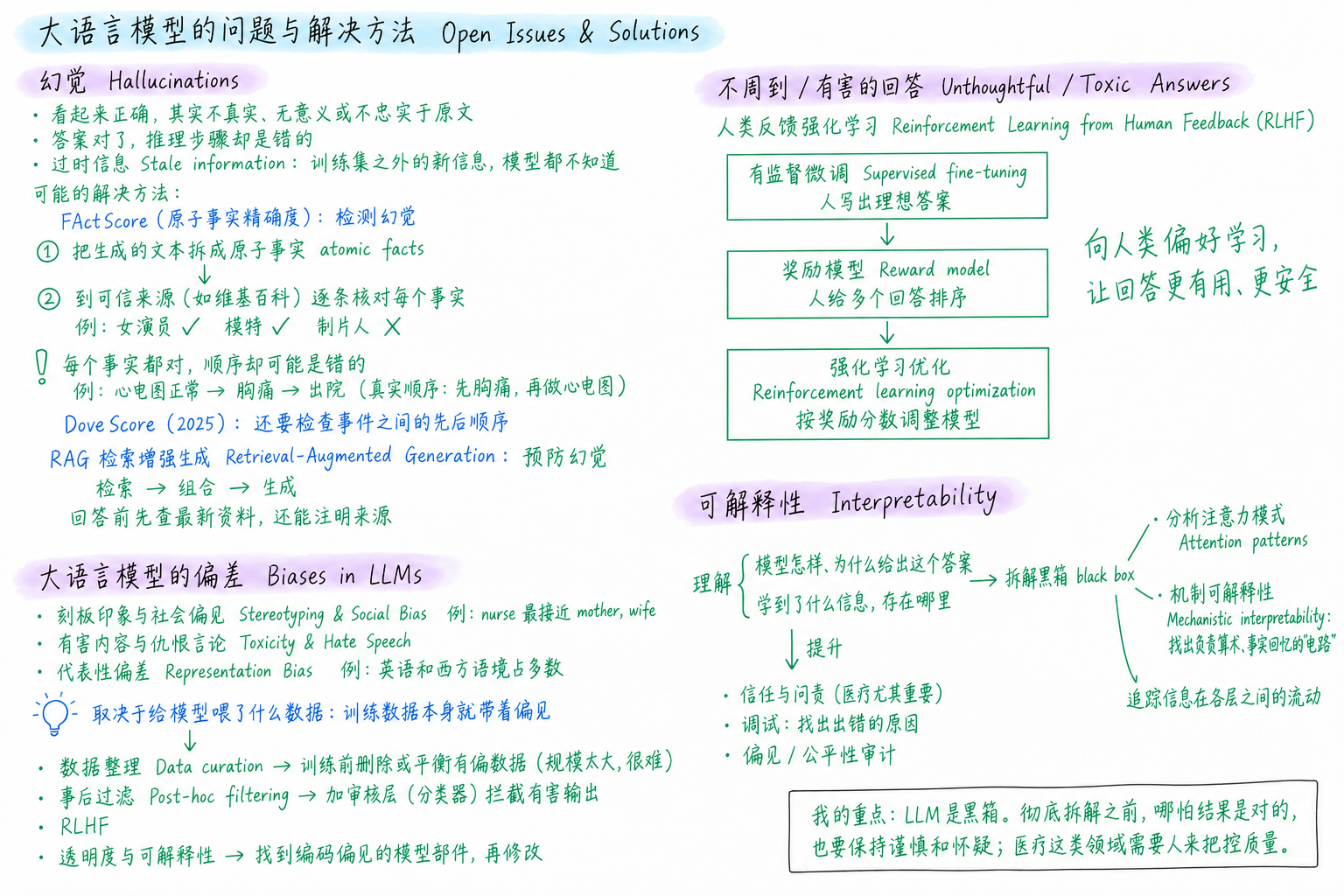
根据我的手写笔记整理,做了几处修正和补充。
The big picture: four problems and their solutions
Start at the top left with hallucinations: the three ways they show up, then the possible solutions in blue. FActScore and DoveScore detect hallucinations, and RAG helps prevent them. Below that are biases in LLMs, where they come from, and four ways to mitigate them. At the top right, unthoughtful or toxic answers lead to RLHF and its three steps. At the bottom right is interpretability, with why it matters and the two main ways researchers look inside the model. My takeaway is in the bottom-right corner.
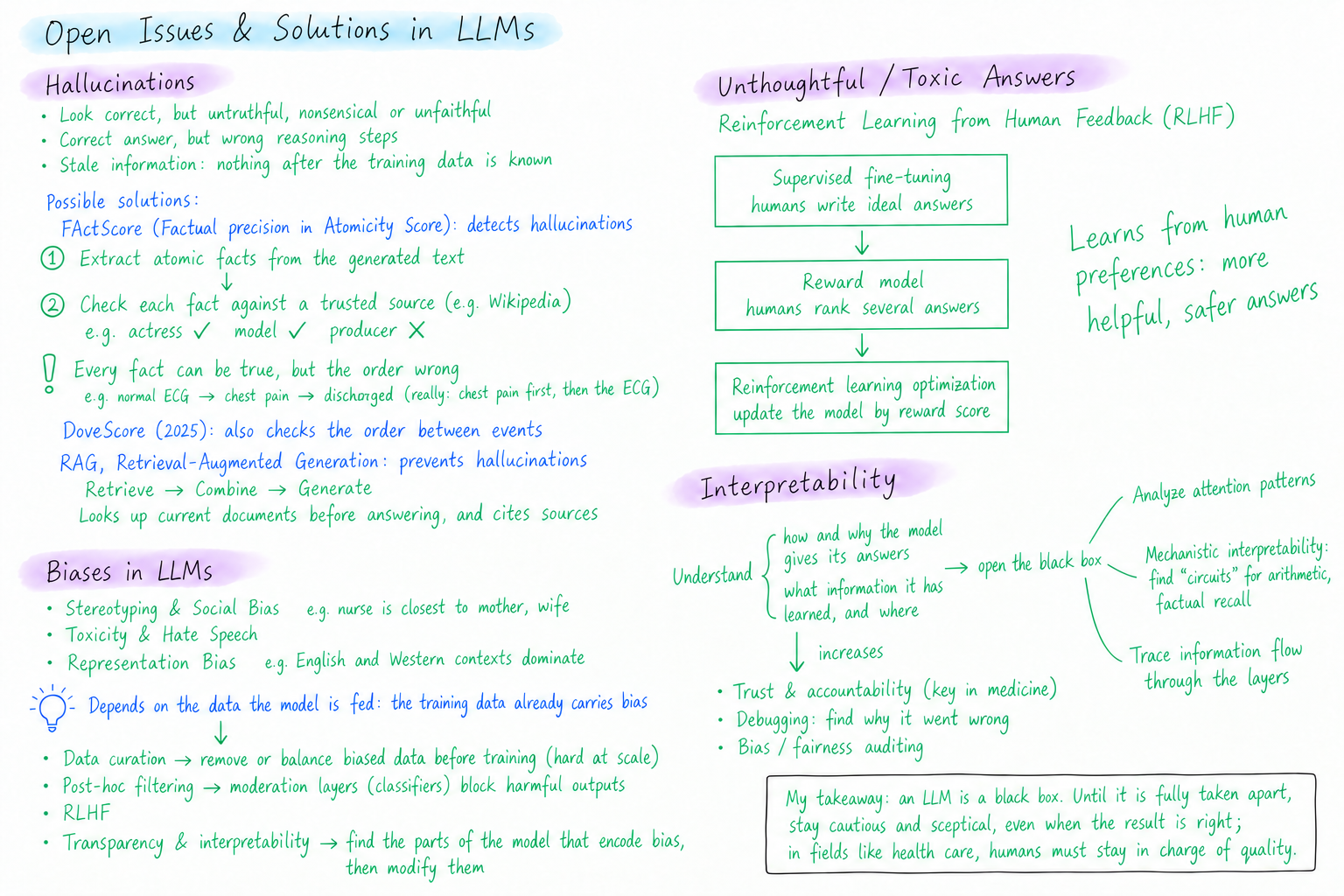
Tidied up from my handwritten page, with a few corrections and additions.
幻觉:流畅、自信,却是错的
LLM 生成的回答听起来合理,实际上却不真实、没有意义或者不忠实于原文,这就叫幻觉(hallucination)。最强的模型也不例外:GPT-4 技术报告自己就写明,模型“并不完全可靠”,在高风险场景使用时要格外小心。
课程给出了三种表现:
| 表现 | 课上的例子 |
|---|---|
| 听起来合理,其实是错的 | 问“1 克铁比 1 克羽毛重吗?”,模型回答“是”,还解释说铁的密度更大。 |
| 前后不一致 | 换个问法,“1 克铁和 1 克羽毛哪个重?”,同一个模型又答对了。 |
| 答案对了,推理错了 | 在一道美国医师执照考试(USMLE)题上,模型选对了答案,解释里的推理步骤却有错;换几种“一步一步想”的提示,它又给出了错误答案,错因五花八门。 |
第三种对医疗工作最要紧:最终答案正确,并不说明背后的推理是对的,所以只核对答案还不够。
为什么会这样?LLM 的训练目标是根据文本里的模式预测下一个 token。它可以学会下一个位置应该是一个数字,甚至是一个听起来合理范围内的数字,但训练过程并不保证这个数字是真的。说对说错,听起来都一样顺,缺乏相关知识的读者很容易被骗过去。
Hallucination: fluent, confident and wrong
An LLM hallucinates when it produces an answer that sounds plausible but is untruthful, nonsensical or unfaithful to its source. This is true even of the strongest models. The GPT-4 technical report says the model "is not fully reliable" and asks for great care in high-stakes contexts.
The course shows three forms:
| Form | Example from the lecture |
|---|---|
| Plausible but wrong | Asked "Is 1 gram of iron heavier than 1 gram of feathers?", the model says yes and explains that iron is denser. |
| Inconsistent | The same model gets it right when the question is rephrased as "What is heavier, 1 gram of iron or 1 gram of feathers?" |
| Right answer, wrong reasoning | On a US Medical Licensing Examination question, the model picked the correct option, but its explanation contained incorrect reasoning steps. With other step-by-step prompts it gave a wrong answer, for a mix of reasons. |
The third form matters most for health work. A correct final answer does not show that the reasoning behind it is sound, so checking only the answer is not enough.
Why does this happen? An LLM is trained to predict the next token from patterns in text. It can learn that a number should come next, and even what range of numbers sounds right, but nothing in that training guarantees the number is true. The text sounds right whether or not it is, so a reader without the background knowledge can easily be misled.
过时信息:停在训练截止那一天
另一个独立的局限:训练数据里没有的东西,LLM 一概不知。2024 年 12 月训练完成的模型,不可能知道 2025 年谁当上了加拿大总理;没有外部信息来源,它甚至不知道今天是几号。如果它硬要回答,这个空白就可能变成幻觉。
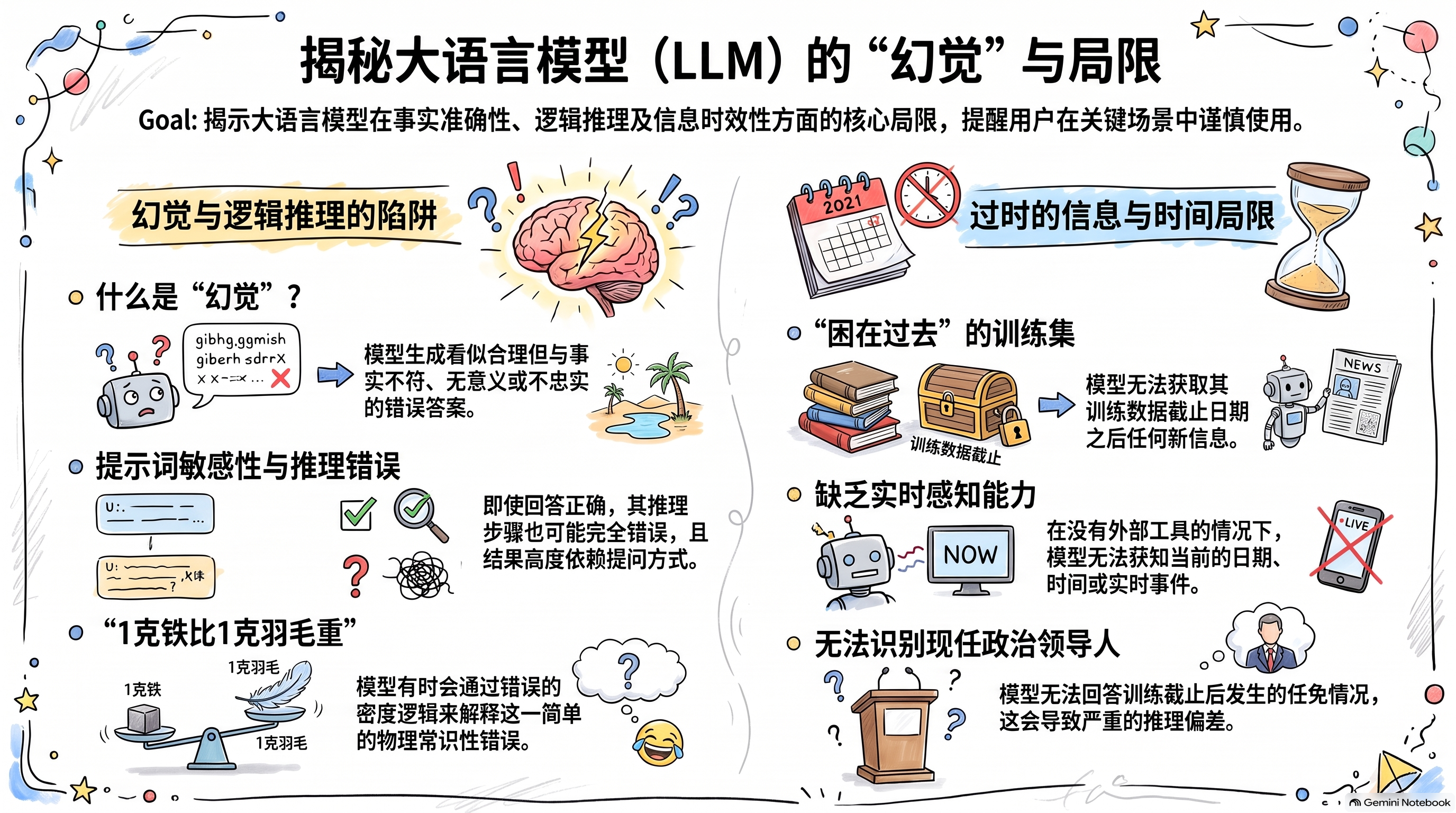
Stale information: stuck at the training date
A separate limitation: an LLM knows nothing that was not in its training data. A model trained in December 2024 cannot know who became Prime Minister of Canada in 2025, and without an external source it does not even know today's date. When it tries to answer anyway, the gap can turn into a hallucination.
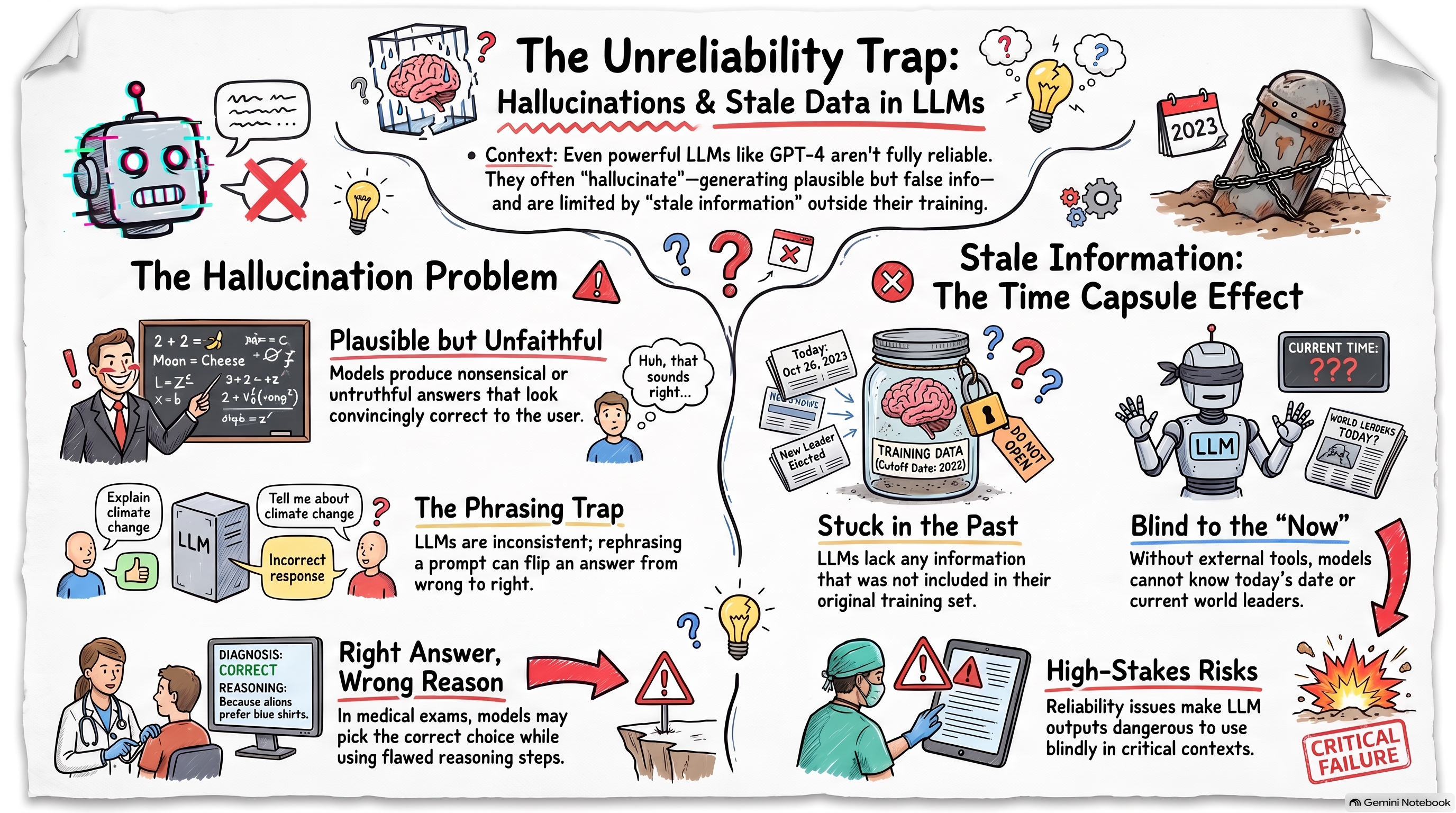
检测幻觉:FActScore 与 DoveScore
怎么判断一段长回答里有没有幻觉?细心的人会一句句读,一个事实一个事实地核对。FActScore(Factual precision in Atomicity Score,原子事实精确度;Min 等,2023)把这个过程自动化,分两步:
- 把文本拆成原子事实。 用另一个 LLM 把生成的每句话拆成一条条可以单独判断真假的短事实。“Bridget Moynahan 是美国女演员、模特和制片人”拆成四条:她是美国人、女演员、模特、制片人。
- 到可信来源逐条核对。 针对每条事实,从维基百科等来源检索相关段落,再让 LLM 判断这些段落是否支持它。课上的例子里,“制片人”找不到依据;“她在美国戏剧艺术学院学习”也不成立(她是在别的地方学的表演)。
得分就是被来源支持的原子事实所占的比例。注意,这里是用一个 LLM 去检查另一个 LLM 的输出。
FActScore 有个盲点:一段回答可以全部由真实的事实拼成,讲的却是假的经过。
| 原子事实 | 顺序 | |
|---|---|---|
| 实际经过 | 患者主诉胸痛。心电图(ECG)正常。患者出院。 | 胸痛 → 心电图 → 出院 |
| 生成的文本 | 心电图正常。患者主诉胸痛。患者出院。 | 心电图 → 胸痛 → 出院 |
每条事实都核对无误,FActScore 就会放行,可它讲的已经不是实际发生的事了。DoveScore(Zheng、Lapata、Pan,2025)在事实描述事件时还会检查事实之间的先后顺序,所以这段文本通不过。作者报告:用真实陈述拼出来的误导性文本,能让以往的细粒度评估方法 AUC 跌到 65% 以下。
FActScore 和 DoveScore 是在衡量幻觉,并不能预防幻觉。课上也说,检测幻觉还是一个没有解决的问题。
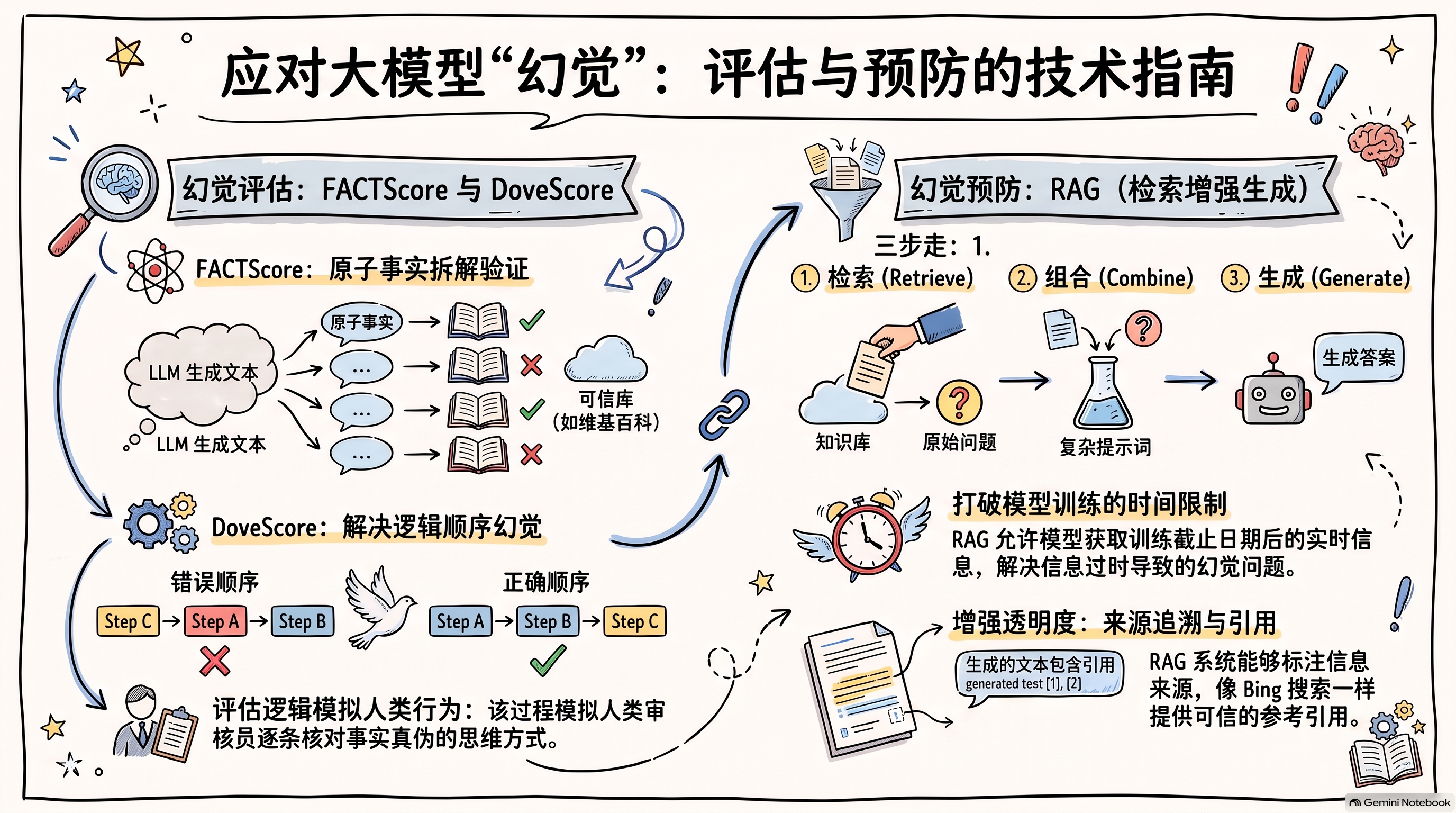
阅读提示:DoveScore 是检测顺序错误的评估方法,并不能“解决”逻辑顺序幻觉;左下角“模拟人类审核员逐条核对事实”说的其实是 FActScore 的思路。RAG 下面多出来的“1.”是图里的笔误。
Detecting hallucinations: FActScore and DoveScore
How can we tell whether a long answer contains hallucinations? A careful human would read it and check each fact, one after the other. FActScore (Factual precision in Atomicity Score; Min et al., 2023) automates that process in two steps:
- Break the text into atomic facts. Another LLM splits each generated sentence into short facts that can each be true or false. "Bridget Moynahan is an American actress, model and producer" becomes four facts: she is American, an actress, a model, and a producer.
- Check each fact against a trusted source. For each fact, relevant passages are retrieved from a source such as Wikipedia, and an LLM judges whether the passages support it. In the course example, "producer" is not supported, nor is the claim that she studied at the American Academy of Dramatic Arts (she studied acting elsewhere).
The score is the share of atomic facts that the source supports. Notice that the output of one LLM is being checked by another.
FActScore has a blind spot: an answer can be built entirely from true facts and still tell a false story.
| Atomic facts | Order | |
|---|---|---|
| What happened | The patient reported chest pain. The ECG was normal. The patient was discharged. | Chest pain → ECG → discharge |
| Generated text | The ECG was normal. The patient reported chest pain. The patient was discharged. | ECG → chest pain → discharge |
Every fact checks out, so FActScore gives the generated text a pass, even though it says something different from what happened. DoveScore (Zheng, Lapata and Pan, 2025) also checks the order between atomic facts when they describe events, so this text fails. Its authors report that misleading texts assembled from true statements push earlier fine-grained evaluators below an AUC of 65%.
FActScore and DoveScore measure hallucinations; they do not prevent them. As the lecture puts it, detecting hallucinations is not a solved problem.
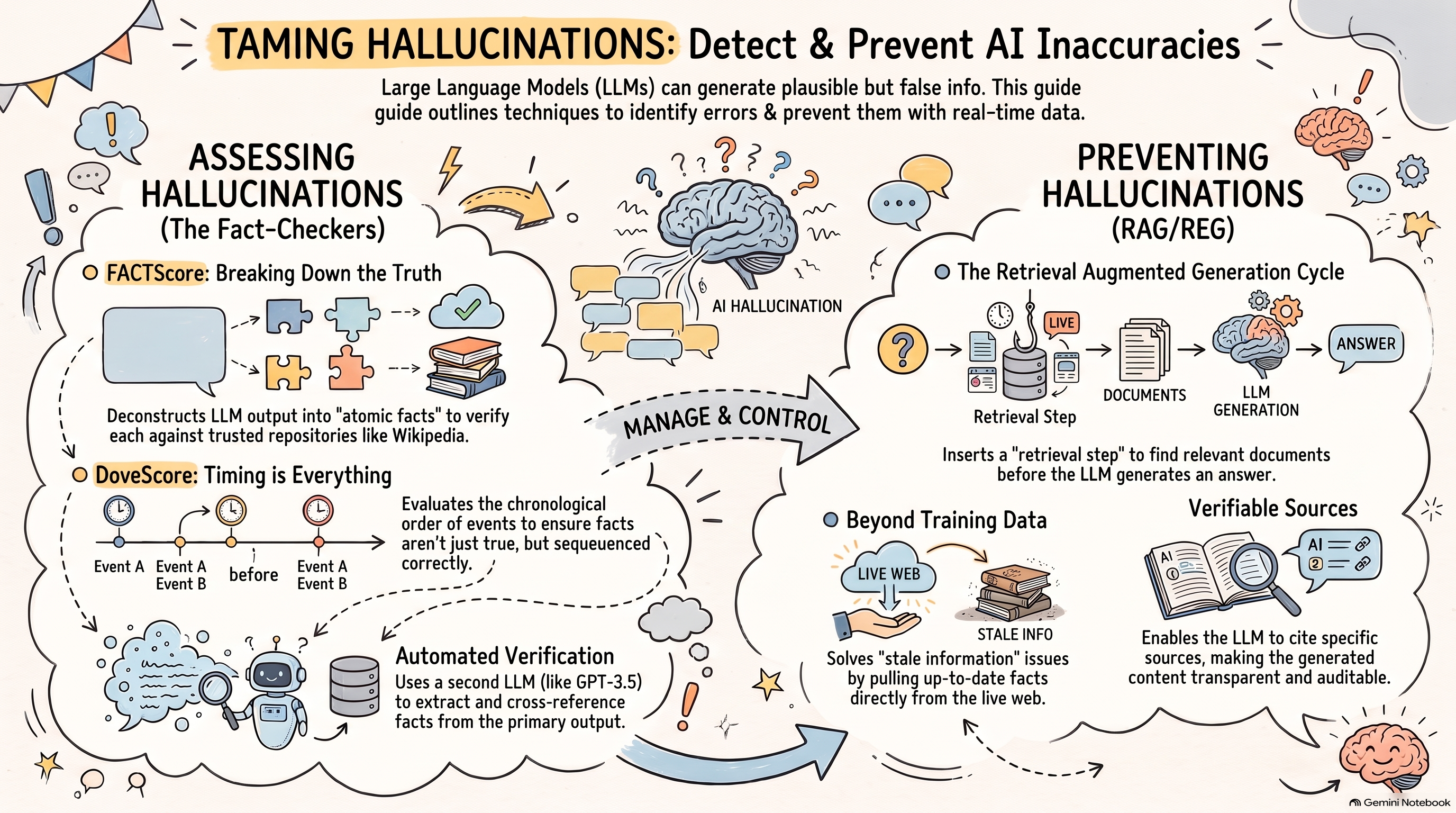
Reading note: "RAG/REG" in the right-hand heading is a slip; the method is RAG. RAG reduces hallucinations and stale information rather than solving them, and it can retrieve from any trusted document collection, not only the live web. "sequeuenced" should read sequenced.
预防幻觉:检索增强生成(RAG)
检索增强生成(Retrieval-Augmented Generation,RAG;Lewis 等,2020)在提问和回答之间加了一步:
| 步骤 | 直接用 LLM | 加上 RAG |
|---|---|---|
| 1 | 用户提问 | 用户提问 |
| 2 | (无) | 从知识库中检索与问题相关的文档,和问题组合成新的提示 |
| 3 | LLM 凭训练时学到的内容生成回答 | LLM 根据问题加上检索到的文档生成回答 |
文档可以是最新的、来自可信来源,所以 RAG 同时应对两个问题。问“现任加拿大总理是谁”,RAG 系统先检索最近的新闻,再据此回答。检索到的文档还能当作引用,读者可以查到每个说法的出处。课上的例子是 ChatGPT 加持的必应(Bing)搜索:它把复杂问题拆成几个简单问题,分别检索答案,再合并起来并注明来源。
放到医疗里是这样:回答一个药物剂量问题之前,系统先检索当前的临床指南,依据指南原文来回答,而不是依据模型训练时见过的旧版本。RAG 不改动模型本身,效果也取决于检索到了什么。检索到的文档本身有错或者过时,或者模型读错了,答案照样会错。
Preventing hallucinations: retrieval-augmented generation (RAG)
Retrieval-augmented generation (RAG; Lewis et al., 2020) adds one step between the question and the answer:
| Step | Plain LLM | With RAG |
|---|---|---|
| 1 | The user asks a question | The user asks a question |
| 2 | (none) | Retrieve documents relevant to the question from a knowledge source, and combine them with the question into a new prompt |
| 3 | The LLM generates an answer from what it learned in training | The LLM generates an answer from the question plus the retrieved documents |
Because the documents can be up to date and come from trusted sources, RAG addresses both problems at once. Asked who the current Prime Minister of Canada is, a RAG system first retrieves recent news, then answers from it. The documents also serve as citations, so the reader can check where each claim came from. The course's example is ChatGPT-enhanced Bing search, which breaks a complex question into simpler ones, retrieves answers to each, merges them and cites its sources.
In health care the same idea looks like this: before answering a question about a drug dose, the system retrieves the current clinical guideline and answers from that text, not from whatever version the model saw during training. RAG does not change the model, and it is only as good as what it retrieves. If the retrieved document is wrong or out of date, or the model misreads it, the answer can still be wrong.
不周到或有害的回答:RLHF
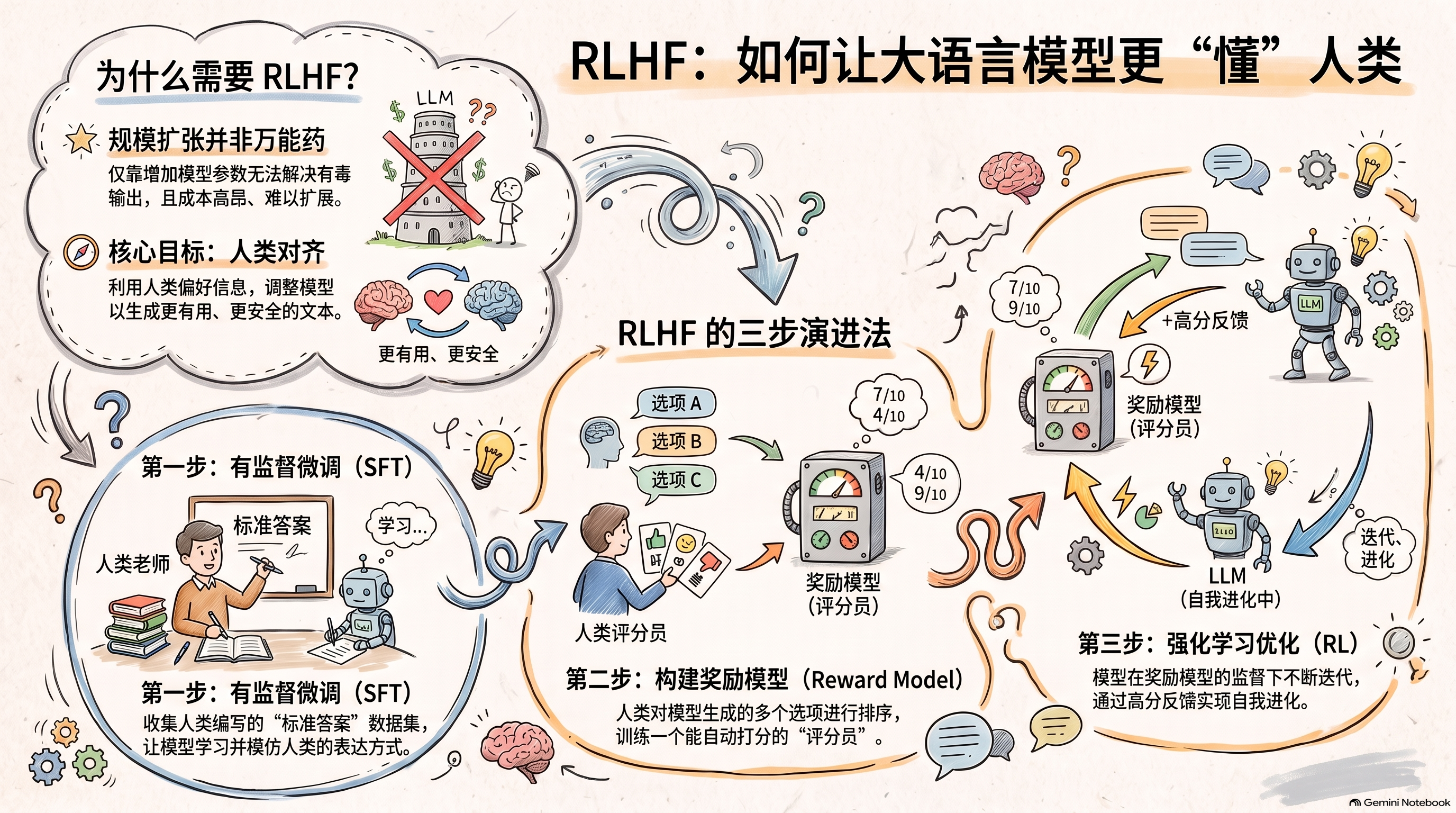
LLM 的回答有时内容不假,却没有帮助、考虑不周,甚至有害。一味把模型做大太昂贵,不是可持续的办法。人类反馈强化学习(Reinforcement Learning from Human Feedback,RLHF;Ouyang 等,2022)改用人类反馈来微调模型,让它的行为和用户的意图对齐。一共三步:
| 步骤 | 人做什么 | 训练什么 |
|---|---|---|
| 1. 有监督微调 | 标注员为提示写出理想答案,例如“给 6 岁孩子讲讲登月” | 微调 LLM,让它像标注员那样回答 |
| 2. 奖励模型 | 标注员把模型对同一提示的几个回答从好到差排序(课上的例子:D > C > A = B) | 训练一个单独的奖励模型,学会给任意回答打分,复现这些排序 |
| 3. 强化学习优化 | (不再需要新的标注) | LLM 生成回答,奖励模型打分,LLM 据此更新,争取更高的分数 |
也就是说,人类的偏好通过第 1 步的示范和第 2 步的排序进入,再由奖励模型在第 3 步大规模地传递下去。和 RAG 不同,RLHF 会改变模型的权重。这一讲的补充幻灯片还提到了直接偏好优化(DPO):它直接从偏好对里学习,不需要单独的奖励模型,是第 3 步的一个更简单的替代。
Unhelpful or toxic answers: RLHF
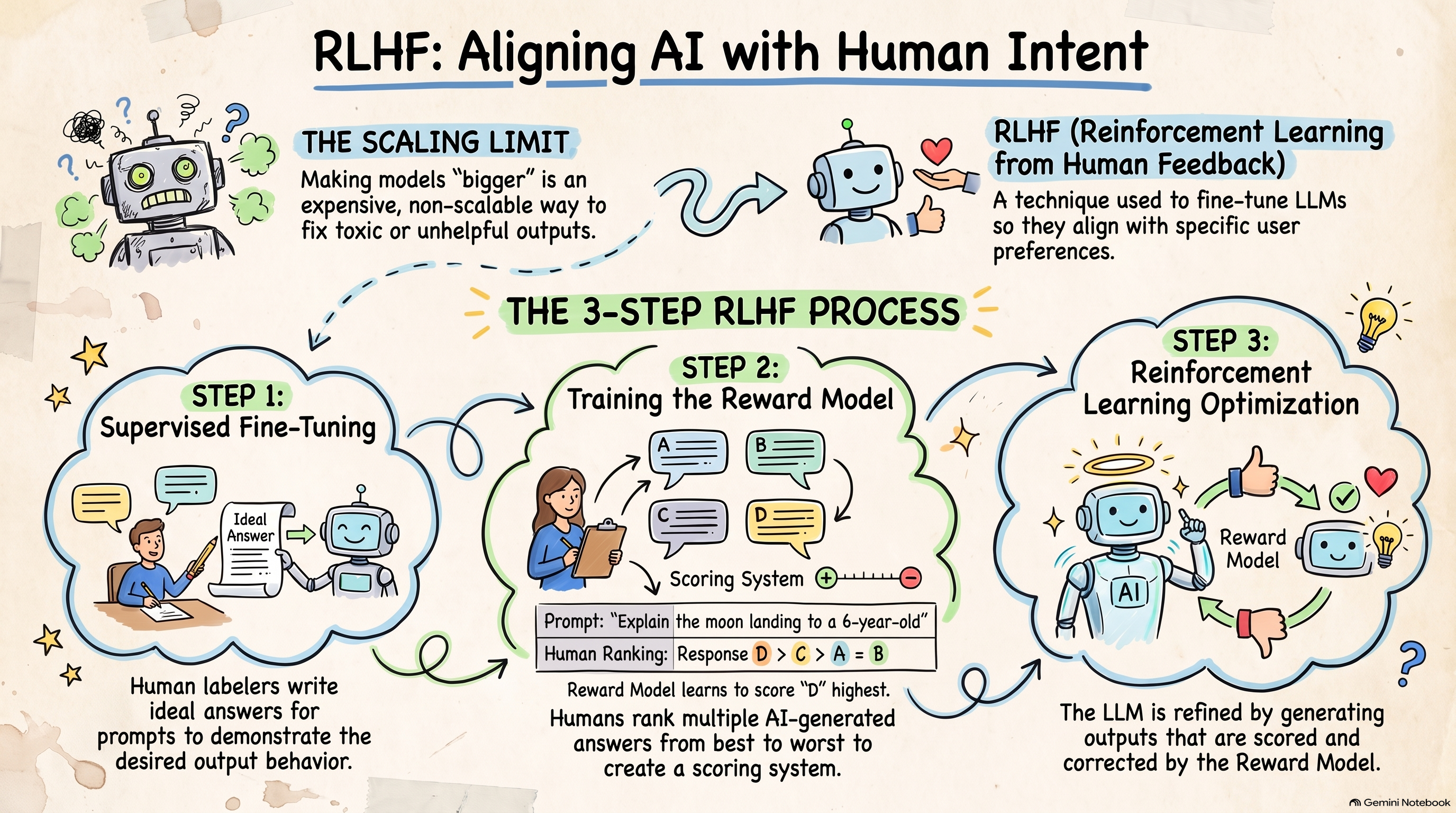
LLMs can also produce answers that are true but unhelpful, unthoughtful or even toxic. Making models ever bigger is too expensive to be a scalable fix. Reinforcement learning from human feedback (RLHF; Ouyang et al., 2022) instead fine-tunes the model on human feedback, to align its behaviour with what users want. It has three steps:
| Step | What people do | What is trained |
|---|---|---|
| 1. Supervised fine-tuning | Labelers write ideal answers to prompts, such as "Explain the moon landing to a 6-year-old" | The LLM is fine-tuned to answer the way the labelers did |
| 2. Reward model | Labelers rank several model answers to the same prompt, from best to worst (in the course example, D > C > A = B) | A separate reward model learns to give a score to any answer, reproducing those rankings |
| 3. Reinforcement learning optimization | (no new labels) | The LLM generates answers, the reward model scores them, and the LLM is updated to earn higher scores |
So human preferences enter through demonstrations in step 1 and rankings in step 2, and the reward model passes them on at scale in step 3. Unlike RAG, RLHF changes the model's weights. The lecture's supplementary slides also mention direct preference optimization (DPO), a simpler replacement for step 3 that learns from the preference pairs directly, without a separate reward model.
偏差:模型照出训练数据的样子
LLM 往往会反映、有时还会放大训练数据中的偏差。课程列出三种常见类型:
| 类型 | 表现 | 例子 |
|---|---|---|
| 刻板印象与社会偏见 | 关于性别、种族、宗教、年龄或其他身份的有害刻板印象 | 把某些职业和女性或男性绑在一起 |
| 有害内容与仇恨言论 | 复述训练数据里冒犯性或仇恨性的语言,碰到敏感话题时尤其明显 | 侮辱性称呼、冒犯性笑话 |
| 代表性偏差 | 数据里有些群体占比过高、有些过低,留下系统性的盲区 | 英语和西方文化语境占主导 |
性别的例子用的是词向量。每个词表示成一个向量,两个向量的相似度(余弦相似度)反映模型认为它们有多接近。和 nurse 最接近的词是 midwife(助产士)、mother(母亲)、wife(妻子)和 widower(鳏夫)。其中大多是女性词,说明这种表示吸收了“护士是女性”的刻板印象。(课程列表里还有 widower,即丧妻的男子,可见这种拉扯不只关乎性别,也偏向家庭和照护角色。)Bolukbasi 等(2016)在常用词向量里发现了同样的规律。
模型产出什么,取决于给它喂了什么数据。英文资料占多数,或者数据本身就带着偏见和有害内容,回答也会带上这些偏差。课程列出四种缓解办法:
| 方法 | 作用阶段 | 怎么做 |
|---|---|---|
| 数据整理 Data curation | 训练之前 | 删除或平衡有偏的数据。数据量达到数十亿甚至上万亿份文档时很难做到 |
| 事后过滤 Post-hoc filtering | 推理时,也就是回答时 | 用审核层(通常是分类器)检测并拦截有害或有偏的输出;很多商用 LLM 都这样做 |
| RLHF | 微调阶段 | 用人类反馈引导模型不去放大偏差 |
| 透明度与可解释性 | 训练之后 | 追查模型的哪些部分编码了某种偏见,再修改这些部分 |
怎样在去除偏差的同时不损失目标任务的准确度,仍在研究之中。
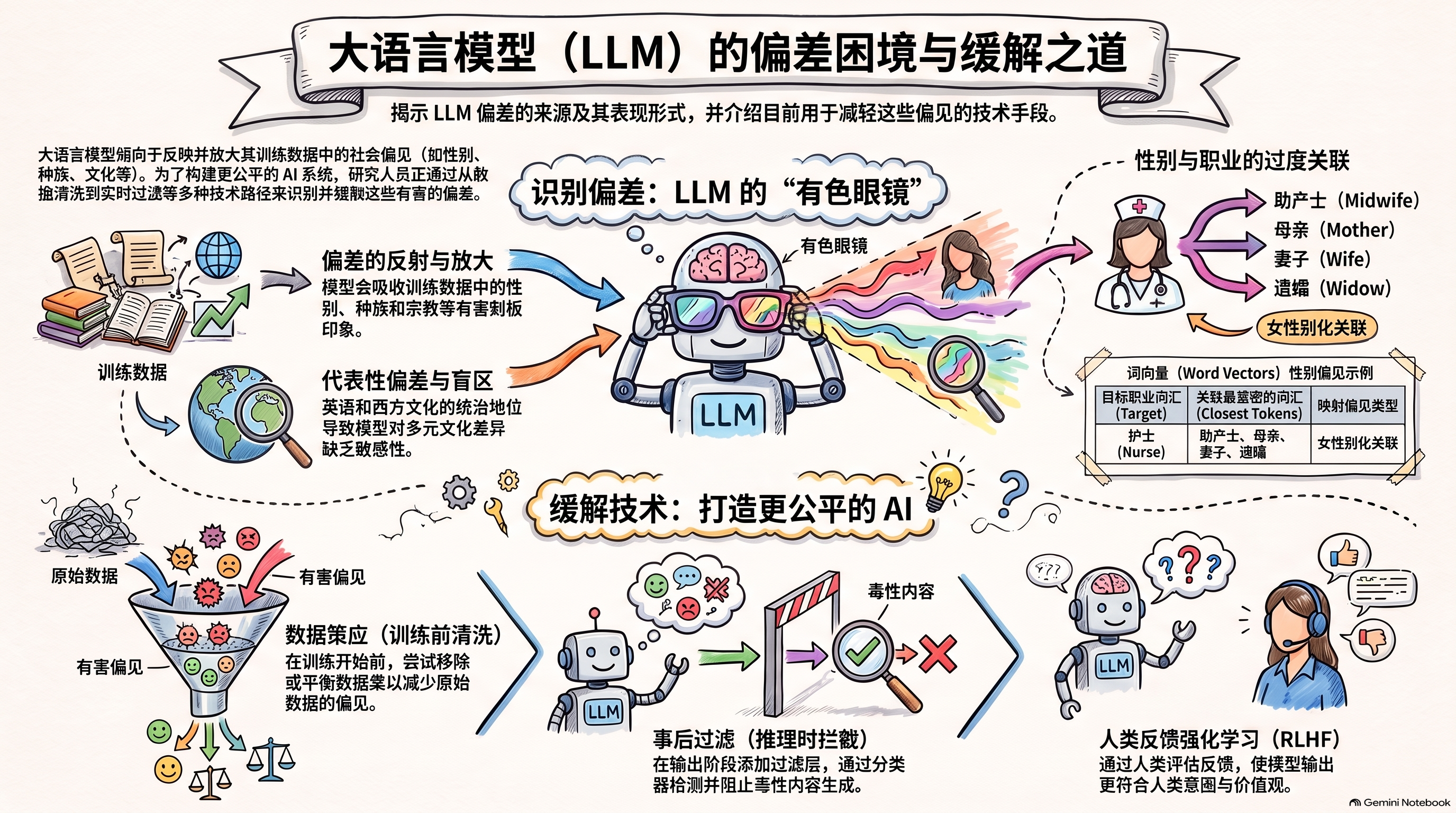
阅读提示:图中“数据策应”应为数据整理(data curation),“数据桊”应为数据集;右侧表格里“向汇”应为词汇,“最蓌密”应为最紧密,“迪瞒”是乱码。课程列表里是 widower(鳏夫),图里写成了“遗孀(Widow)”。课程的第四种办法,透明度与可解释性,图里没有画出来。
Bias: the model reflects its training data
LLMs tend to reflect, and sometimes amplify, biases in their training data. The course names three common types:
| Type | What it looks like | Example |
|---|---|---|
| Stereotyping and social bias | Harmful stereotypes about gender, race, religion, age or other identities | Linking certain professions with women or men |
| Toxicity and hate speech | Offensive or hateful language echoed from the training data, especially on sensitive topics | Slurs or offensive jokes |
| Representation bias | Some groups overrepresented in the data, others underrepresented, leaving systematic blind spots | Dominance of English and Western cultural contexts |
The gender example works with word vectors. Each word is represented as a vector, and the similarity between two vectors (their cosine similarity) shows how closely the model associates them. The words closest to nurse are midwife, mother, wife and widower. Most of these are female terms, so the representation has absorbed the stereotype that nurses are women. (Widower, a man whose wife has died, is on the course's list too; the pull is toward family and caring roles as well as gender.) Bolukbasi et al. (2016) showed the same pattern in standard word embeddings.
What a model produces depends on the data it was fed. If English material dominates, or the data already contains biased or harmful content, the answers will carry that bias. The course lists four ways to mitigate it:
| Method | When it acts | How |
|---|---|---|
| Data curation | Before training | Remove or balance biased data. Hard at the scale of billions or trillions of documents |
| Post-hoc filtering | At inference, while answering | Moderation layers, often classifiers, detect and block toxic or biased outputs; many commercial LLMs do this |
| RLHF | During fine-tuning | Human feedback steers the model away from amplifying bias |
| Transparency and interpretability | After training | Trace which parts of the model encode a bias, then modify those parts |
Research continues on removing bias without losing accuracy on the target task.
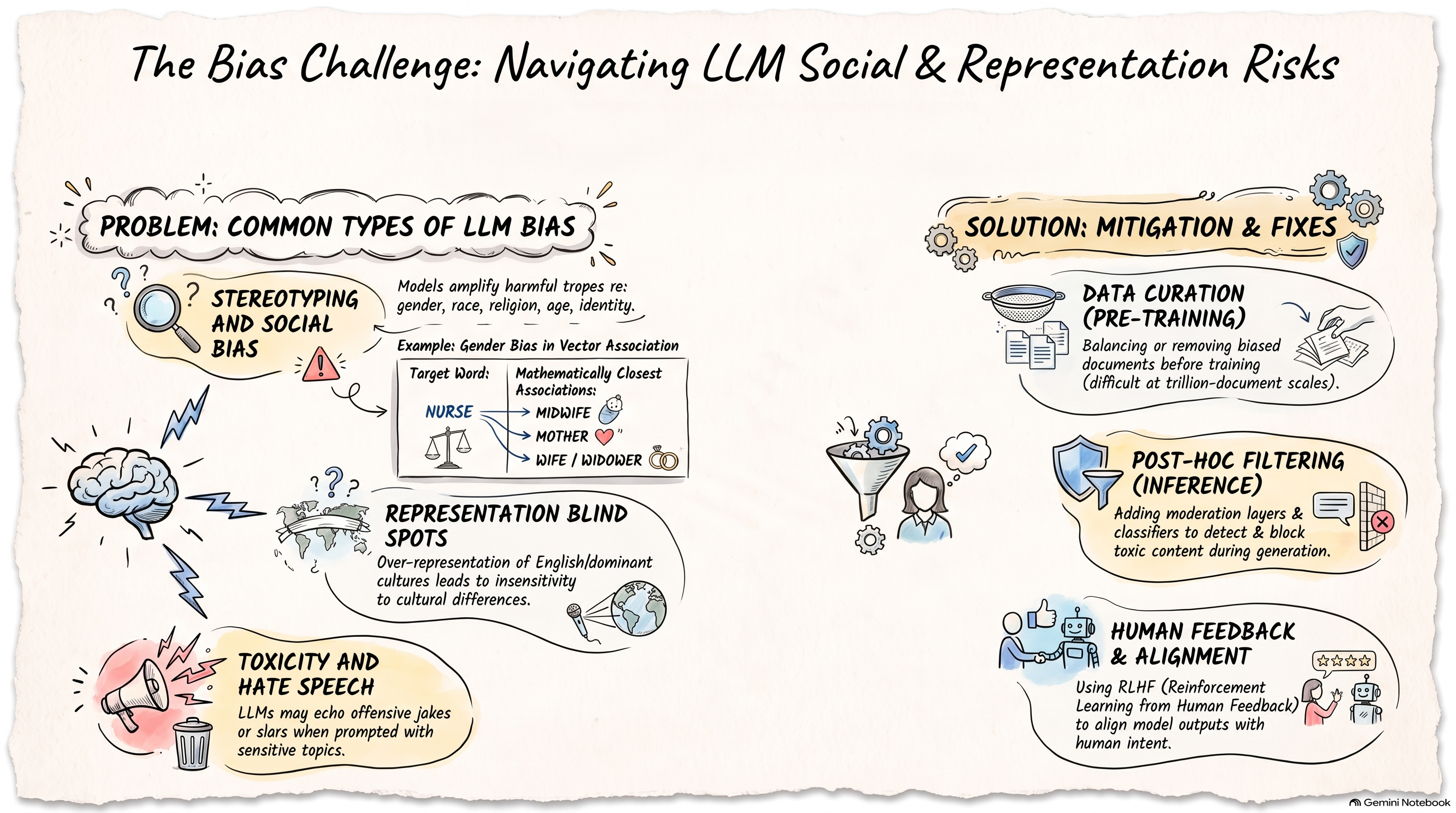
Reading note: "jakes" and "slars" in the toxicity box should read jokes and slurs. The fourth mitigation from the course, transparency and interpretability, is not shown.
可解释性:打开黑箱
LLM 是一个有数十亿权重的神经网络,知识和推理都隐含在这些权重里,我们看得到答案,却看不到答案是怎么得出的。可解释性(interpretability)就是要理解模型怎样、为什么给出它的输出,以及它表示了哪些信息、怎样表示、存在哪里。
它能提升三件事:
- 信任与问责:向专家和非专家解释模型的预测,这在医学等领域至关重要。
- 调试:查明模型为什么出错,比如产生幻觉,好修复对应的部分。
- 偏见与公平性审计:找出有害模式从哪里来。
课程介绍了两种主要方法:
| 方法 | 看什么 | 例子 |
|---|---|---|
| 分析注意力模式 | 注意力矩阵:每个词的含义在多大程度上取决于其他词(汇总后也可以看句子之间) | 从中提取树状结构,和已知的句法或篇章结构对比:哪些学到了、哪些缺失、怎样补进去 |
| 机制可解释性 | 权重矩阵、神经元、激活路径和“电路”(子网络) | 找出模型回忆“秘鲁首都”时被强烈激活的神经元;追踪做两数相加时信息怎样逐层流动;找出把中文翻译成他加禄语时活跃的电路 |
机制可解释性是两者中更有野心的一种。追踪信息流动、找出重要神经元、修改权重来检验假设,都是它的工具。目标是让模型更透明、更容易调试、也更安全。
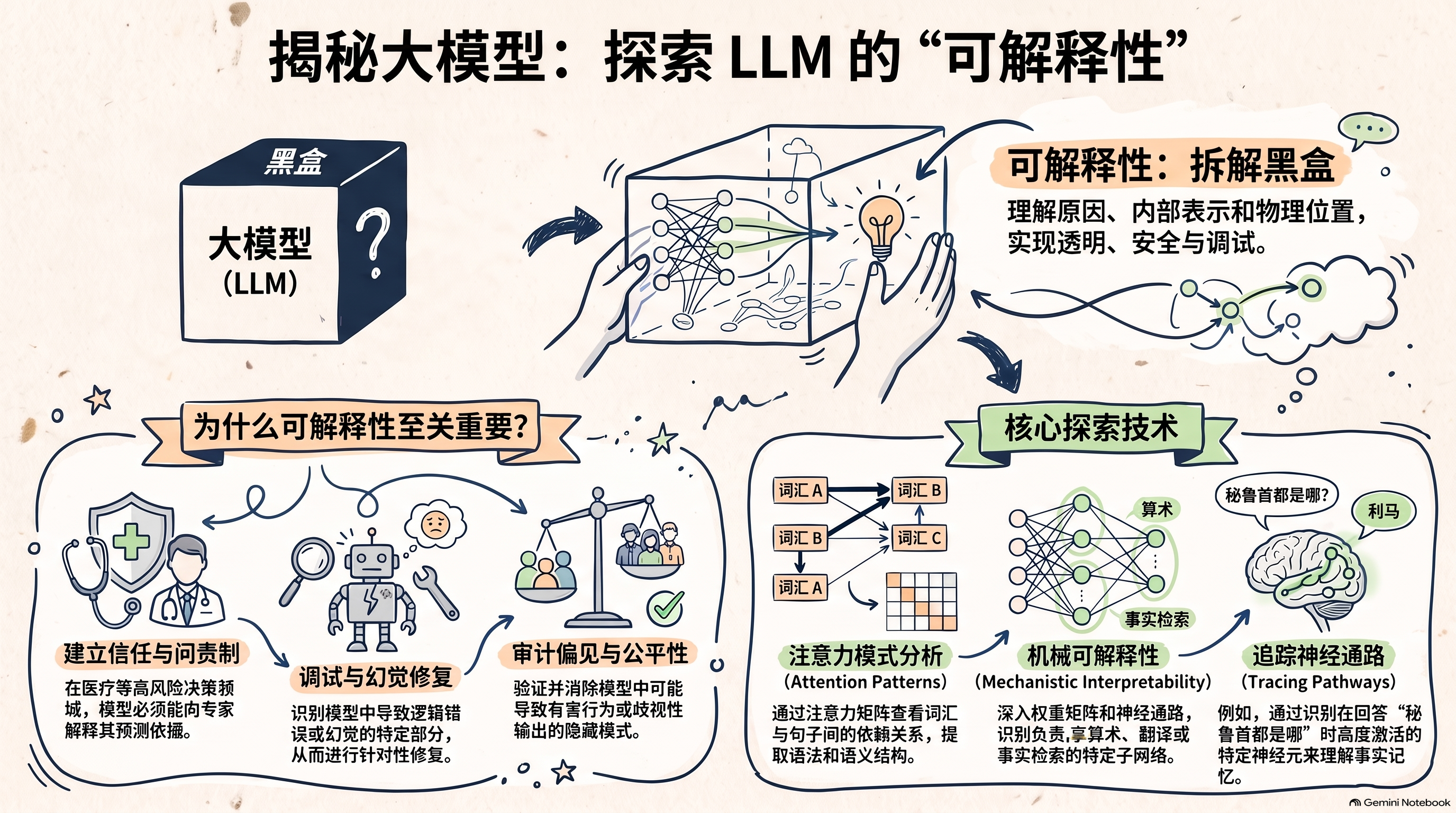
阅读提示:“物理位置”指的是信息存在网络的哪个位置;图下方有几处错字:“决策预域”应为决策领域,“预测依攄”应为预测依据,“负责享算术”应为负责算术。课上,“秘鲁首都”是找重要神经元的例子,追踪信息流用的是两数相加的例子,而且追踪信息流属于机制可解释性的工具之一。
Interpretability: opening the black box
An LLM is a neural network with billions of weights. Its knowledge and reasoning are stored implicitly in those weights, so we see the answer but not how it was reached. Interpretability tries to understand how and why the model produces its outputs, and what information it represents, how, and where.
It increases three things:
- Trust and accountability: explaining a prediction to experts and non-experts, which is critical in fields such as medicine.
- Debugging: finding out why the model made a mistake, such as a hallucination, so the responsible part can be fixed.
- Bias and fairness auditing: locating where harmful patterns come from.
The course describes two main approaches:
| Approach | What it inspects | Example |
|---|---|---|
| Analysing attention patterns | The attention matrices, which show how much each word's meaning depends on the other words (and, aggregated, each sentence on the others) | Extract tree-like structures from them and compare with known syntax or discourse structures: what is captured, what is missing, and how to inject it |
| Mechanistic interpretability | Weight matrices, neurons, activation paths and "circuits" (sub-networks) | Find the neurons that activate when the model recalls the capital of Peru; trace how information flows through the layers when it adds two numbers; find the circuit active when it translates Chinese into Tagalog |
Mechanistic interpretability is the more ambitious of the two. Tracing information flow, finding important neurons and patching weights to test a hypothesis are all tools within it. The goal is a model that is more transparent, easier to debug and safer.
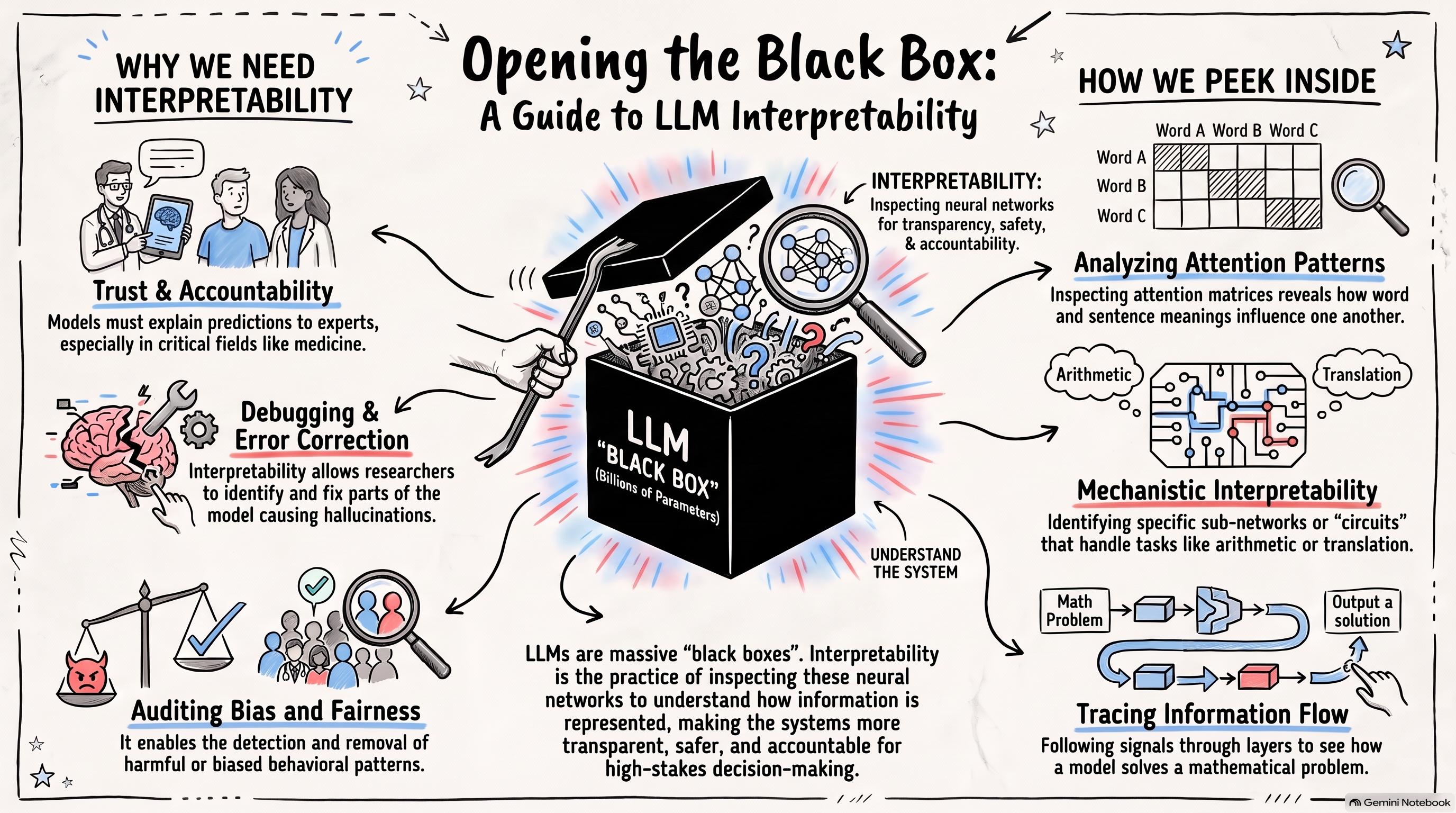
Reading note: tracing information flow is shown as a third method; the course treats it as one tool of mechanistic interpretability. Interpretability helps researchers find the parts behind hallucinations; reliably fixing them is still an open research goal.
我的思考
相信很多人在使用 ChatGPT、Gemini、Claude 等工具时,都遇到过它们编答案,还编得和真的一样,这就是 AI 的幻觉。回忆一下前面介绍的 LLM 怎样给出答案:训练时在 token 之间建立联系、学习概率,然后预测下一个 token。这也就意味着,LLM 可能知道下一个位置应该输出一个数字,甚至是一个合理范围内的数字,但具体数字是否正确,无法保证。这也是为什么人在缺乏相关知识时,很容易被骗过去。
这个问题目前还不能说完全解决,只能通过一些方法改进。RAG 就是其中一种:系统先查找最新、可信的资料,再根据资料回答,就像我回答一个用药问题之前,会先查最新的指南一样。
另一种幻觉是每个事实都对,顺序却错了,比如病历里写成先做心电图、后出现胸痛。每句话单独看都合理,而生成过程中并没有一步去核对事件实际的先后。FActScore 和 DoveScore 就是用来发现这类错误的:先提取原子事实,再评估每条事实是否正确,再评估事实之间的顺序。它们衡量问题,而不是预防问题,但先找得到,才谈得上改。
LLM 还可能存在偏差,或者给出考虑不周的回答。偏差主要来自喂给模型的数据:如果训练数据本身就带着偏见或有害内容,它生成的答案也很难好。所以改进首先要提高数据质量。由于在网络规模上清洗数据非常困难,过滤输出、RLHF 和可解释性也要一起用上。
其实这些问题最大的后果,是我们该对 LLM 生成的结果有多少信任。LLM 发展得很快,也确实能提高很多效率,但尤其是想要应用在一些特定行业时,比如健康医疗,以及涉及生命安全的技术开发,一定要谨慎,需要人来把控质量。LLM 是一个黑箱,对于看不见的步骤,在彻底拆解之前,我们都应该保持谨慎和怀疑,哪怕结果是正确的。
My thoughts
Many people using ChatGPT, Gemini, Claude and similar tools have seen them make up answers that look completely real. That is AI hallucination. Recall how an LLM produces an answer: training links tokens to each other and learns probabilities, and the model predicts the next token. So the model may know that the next token should be a number, even a number in a reasonable range, but nothing guarantees it is the right number. That is why people without the relevant knowledge are so easily fooled.
This problem cannot be fully solved yet, only reduced. RAG is one way: the system first looks up current, trusted documents and answers from them, much as I would check the latest guideline before answering a question about a medication.
Another kind of hallucination gets every fact right but puts them in the wrong order, like a clinical note saying the ECG came before the chest pain. Each sentence looks reasonable on its own, and nothing in generation checks the sequence against what actually happened. FActScore and DoveScore find this kind of error: extract the atomic facts, check whether each fact is correct, then check the order between them. They measure the problem rather than prevent it, but you cannot fix what you cannot find.
LLMs can also be biased or give unthoughtful answers. Bias comes mainly from the data the model is fed. If the training data already carries biased or harmful content, the answers will too, so improving data quality comes first. Because cleaning data at web scale is very hard, filtering outputs, RLHF and interpretability are used alongside it.
In the end, the biggest consequence of all these problems is a question of trust: how much should we trust what an LLM generates? LLMs are developing quickly and really can save a lot of time. But in fields such as health care, and anywhere a technology affects people's lives and safety, we have to be careful and keep humans in charge of quality. An LLM is a black box. Until a step we can't see has been fully taken apart, we should stay cautious and sceptical, even when the result is correct.
原始手写笔记
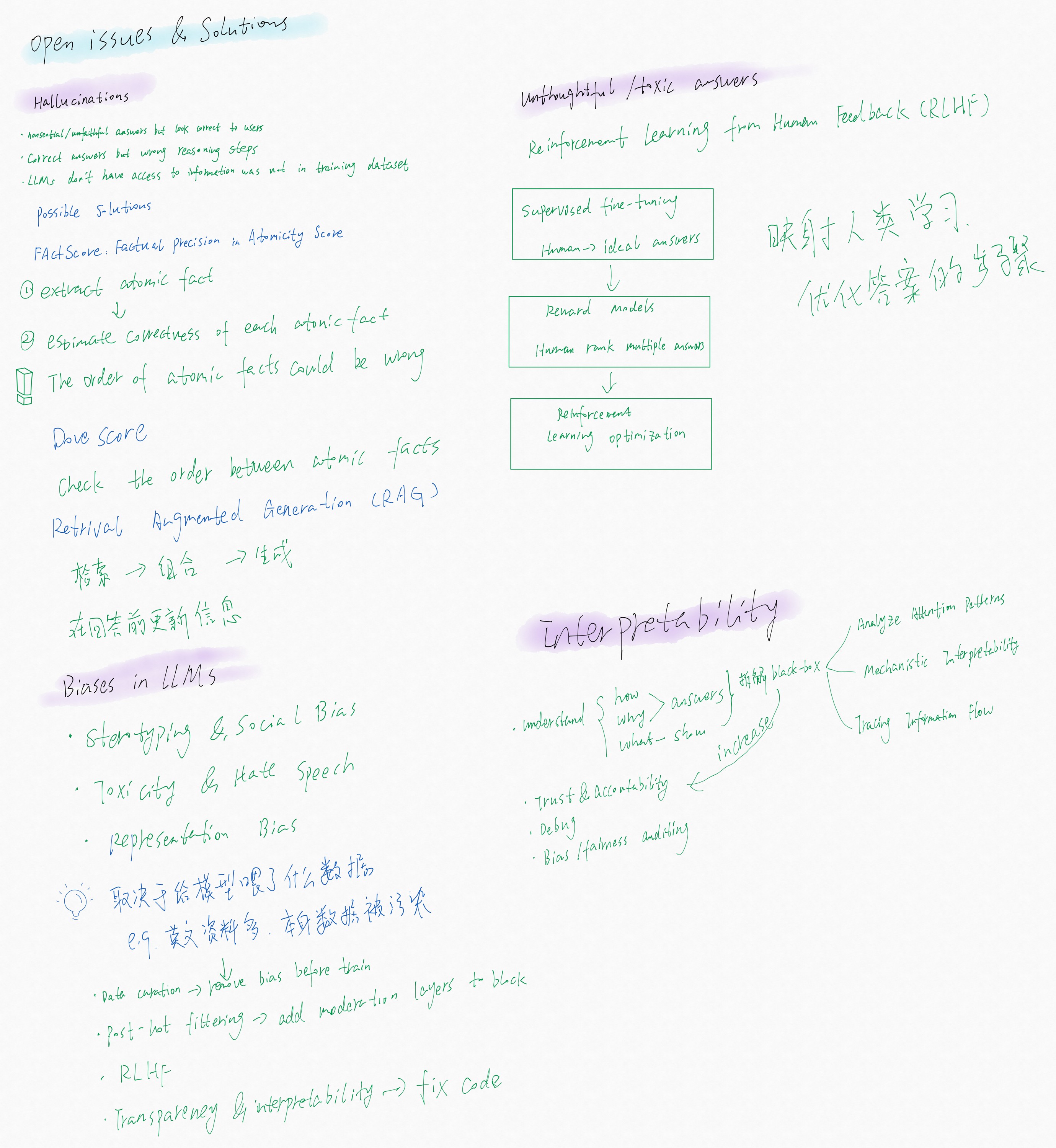
整理后的版本改了这些地方:过时信息(训练数据之后的事一概不知)单独列为一点,和幻觉并列;“Retrival”改为 Retrieval,“Dove score”改为 DoveScore(2025);解决方法按作用标明,FActScore 和 DoveScore 用来检测幻觉,RAG 用来预防;顺序那一行补上了课上胸痛和心电图的例子,FActScore 的步骤补上了 Bridget Moynahan 的例子;“Reward models”改为一个奖励模型,每一步加了一行说明训练什么;“映射人类学习”改为 RLHF 向人类偏好学习,让回答更有用、更安全;“本身数据被污染”改为训练数据本身带着偏见,以免和上一篇说的数据污染(测试题混进训练数据)混淆;“fix code”改为修改编码了偏见的模型部件,因为要改的是权重,不是代码;事后过滤写明用的是分类器,数据整理注明规模大、很难;可解释性的大括号改为理解模型怎样、为什么给出答案,以及学到了什么信息、存在哪里。
Original handwritten notes
What changed in the tidied version: stale information (no knowledge after the training data) now stands as its own point next to hallucination; "Retrival" is now Retrieval, and "Dove score" is DoveScore (2025); the solutions are labelled by job, FActScore and DoveScore to detect hallucinations and RAG to prevent them; the order line gained the course's chest-pain/ECG example and the FActScore steps the Bridget Moynahan example; "Reward models" is now one reward model, with a line on what each step trains; "映射人类学习" now says RLHF learns from human preferences to make answers more helpful and safer; "本身数据被污染" now says the training data already carries bias, to keep it apart from data contamination (test questions leaking into training data, from the last note); "fix code" now says modify the parts of the model that encode the bias, since the fix is in the weights, not in code; post-hoc filtering names its classifiers and data curation its difficulty at scale; and the interpretability brace now reads how and why the model gives its answers, and what information it represents and where.
学习来源与资源
这篇笔记来自我在不列颠哥伦比亚大学(UBC)微证书项目“Natural Language Processing to Improve Patient Care”中,“Overview of NLP and Large Language Models”课程的学习笔记(Giuseppe Carenini 主讲的“LLMs: Open Issues and Solutions”一讲)。技术细节核对了以下资料:
- OpenAI(2023),GPT-4 Technical Report(局限性部分)。
- Liévin、Hother、Winther(2022),Can large language models reason about medical questions?
- Min 等(2023),FActScore: Fine-grained Atomic Evaluation of Factual Precision in Long Form Text Generation(EMNLP 2023)。
- Zheng、Lapata、Pan(2025),Long-Form Information Alignment Evaluation Beyond Atomic Facts(DoveScore 与 MontageLie 基准)。
- Lewis 等(2020),Retrieval-Augmented Generation for Knowledge-Intensive NLP Tasks。
- Ouyang 等(2022),Training language models to follow instructions with human feedback(InstructGPT,RLHF 三步流程)。
- Bolukbasi 等(2016),Man is to Computer Programmer as Woman is to Homemaker? Debiasing Word Embeddings。
动手试一试
- FActScore(GitHub):作者公开的代码和数据,README 里说明了怎样用维基百科给自己模型生成的人物简介打分。
- Illustrating RLHF(Hugging Face):用图示一步步讲清 RLHF 的三个步骤。
- BertViz:在笔记本里可视化 Transformer 的注意力头,可以自己看看注意力模式。
- Neuronpedia:开放的机制可解释性平台,可以浏览单个神经元对应的特征,用自己的文本测试。
- Tracing the thoughts of a large language model(Anthropic):在实际使用的模型里追踪“电路”的易读案例,包括多步推理和编造答案。
Learning sources and resources
This note is based on my study notes from the University of British Columbia (UBC) micro-certificate program "Natural Language Processing to Improve Patient Care," in the course "Overview of NLP and Large Language Models" (the lecture "LLMs: Open Issues and Solutions" by Giuseppe Carenini). Technical details were checked against:
- OpenAI (2023), GPT-4 Technical Report (limitations section).
- Liévin, Hother and Winther (2022), Can large language models reason about medical questions?
- Min et al. (2023), FActScore: Fine-grained Atomic Evaluation of Factual Precision in Long Form Text Generation (EMNLP 2023).
- Zheng, Lapata and Pan (2025), Long-Form Information Alignment Evaluation Beyond Atomic Facts (DoveScore and the MontageLie benchmark).
- Lewis et al. (2020), Retrieval-Augmented Generation for Knowledge-Intensive NLP Tasks.
- Ouyang et al. (2022), Training language models to follow instructions with human feedback (InstructGPT, the three-step RLHF process).
- Bolukbasi et al. (2016), Man is to Computer Programmer as Woman is to Homemaker? Debiasing Word Embeddings.
Try it yourself
- FActScore on GitHub: the authors' code and data; the README shows how to score your own model's biographies against Wikipedia.
- Illustrating RLHF (Hugging Face): a clear, diagram-led walk-through of the three RLHF steps.
- BertViz: visualizes attention heads in Transformer models in a notebook, so you can look at attention patterns yourself.
- Neuronpedia: an open platform for mechanistic interpretability; browse the features individual neurons respond to and test them with your own text.
- Tracing the thoughts of a large language model (Anthropic): a readable example of tracing circuits inside a production model, including multi-step reasoning and made-up answers.