
Tools I Use / TOOL01
Buzz: Offline Speech-to-Text, Tested on a Simulated Patient Interview
Buzz is a free, open-source desktop app that turns speech into text with OpenAI's Whisper models, entirely on your own computer. I used it for an assignment in my health AI course: transcribe a simulated patient interview, then have an LLM turn the transcript into a patient note. This page covers how to install and use it, what the small and large models actually heard, and what I would do differently with real clinical audio.
- section
- key term
- reading note
What Buzz is
Buzz is a desktop front end for Whisper, OpenAI's open speech-recognition model. You pick a file, choose a model size, and Buzz transcribes it locally: no account, no upload.
| Buzz | |
|---|---|
| Cost and licence | Free, open source (MIT licence) |
| Runs on | Windows, macOS (Apple silicon), Linux |
| Where the audio goes | Nowhere: transcription runs on your own computer |
| Input | Audio or video files, YouTube links, live microphone |
| Output | TXT, SRT and VTT subtitles, and a Word file with speaker labels |
Installing it
Everything is linked from the Buzz page on GitHub, under Installation:
- Windows: download the installer from SourceForge. The app is not signed, so Windows shows a warning; choose More info → Run anyway.
- macOS: download the
.dmg. Current versions need Apple silicon; 1.4.5 is the last one for Intel Macs. - Linux: Flatpak, Snap or AppImage.
The first time you use a model, Buzz downloads it. The larger the model, the bigger the download.
How I used it
The assignment gave us a 3.5-minute recording of a simulated patient interview: a doctor and a patient who has become short of breath after a long flight. My workflow had two steps:
- Buzz turned the recording into a transcript. I ran it twice, with the smallest model (Tiny) and with Large-v3-Turbo, to compare them.
- An LLM turned the transcript into a structured patient note.
Because the interview was simulated, privacy was not an issue here. With real patient recordings, an offline tool matters: the audio never leaves your computer. You would still need to follow your organization's rules for patient data.
Using it: from file to transcript
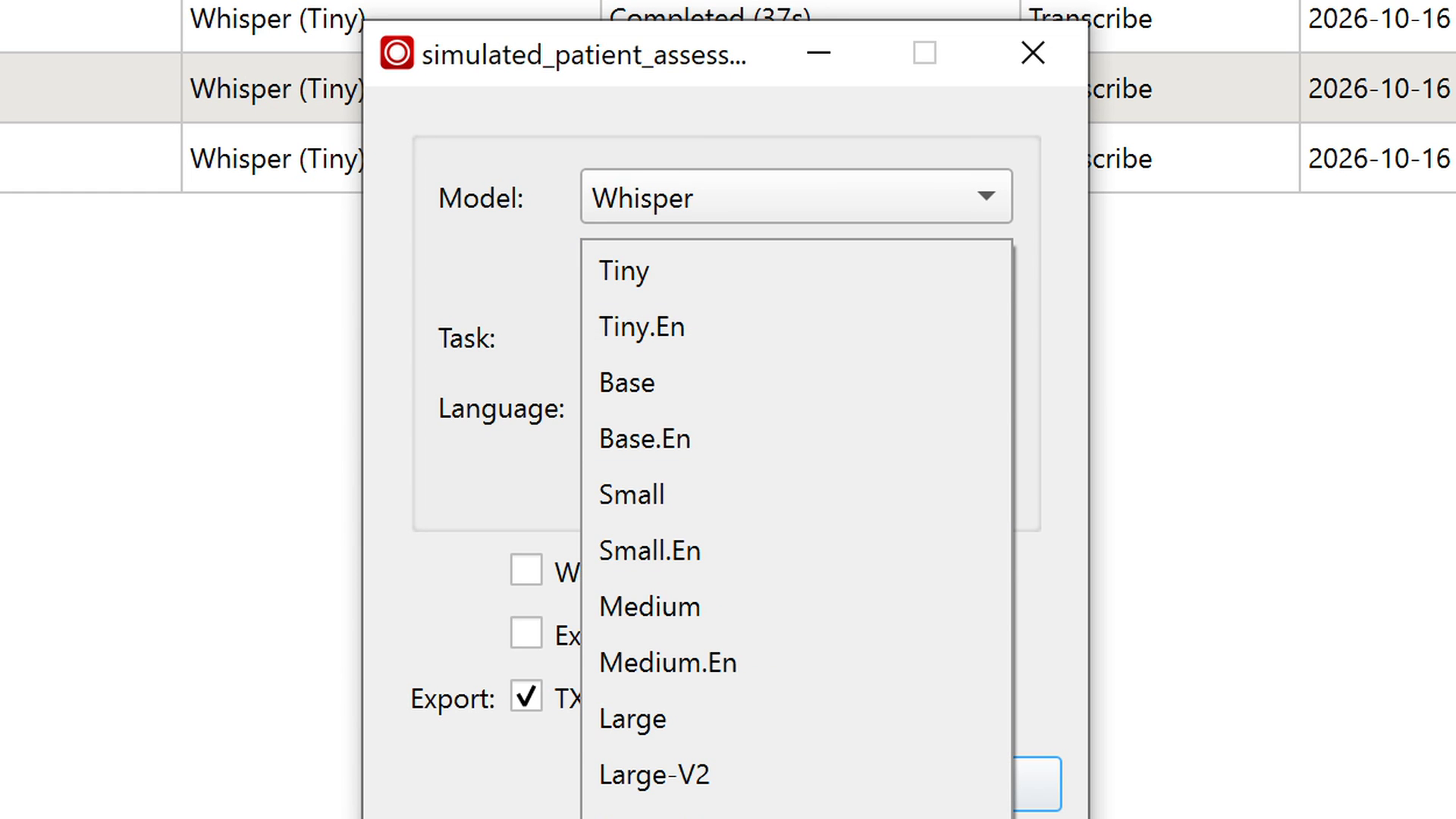
Choose File → Import File, pick the recording, choose a Whisper model and press Run. Tiny is the smallest and fastest; Large-v3-Turbo is much bigger and more accurate. On my laptop, the 3.5-minute interview took about 20 to 40 seconds with Tiny and about a minute with Large-v3-Turbo.
Double-click a finished task to open the transcript viewer. Its toolbar is where most of the useful features live:
| Button | What it does |
|---|---|
| View | Switch between plain text, a timestamped table, and a view by speaker |
| Export | Save as TXT, SRT or VTT subtitles, or a Word file with speaker labels |
| Translate | Translate the transcript with an LLM; needs an OpenAI API key in Preferences |
| Resize | Adjust line length for subtitles; merging lines works only if word-level timings were on during transcription |
| Identify Speakers | Separates the voices (about a minute and a half on my laptop), then lets you name them, such as Doctor and Patient |
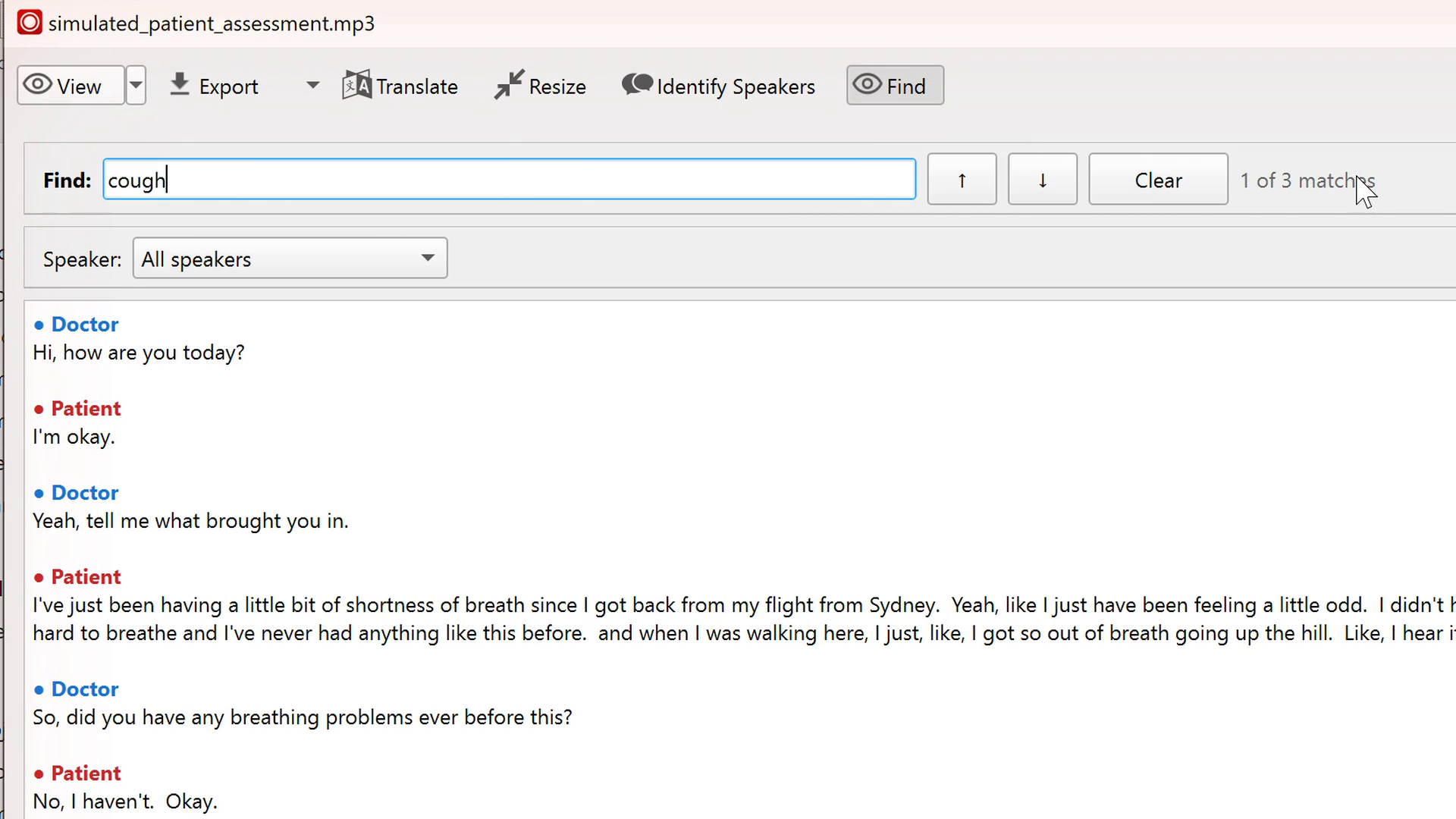
| Find | Jumps to every match of a word in the transcript |
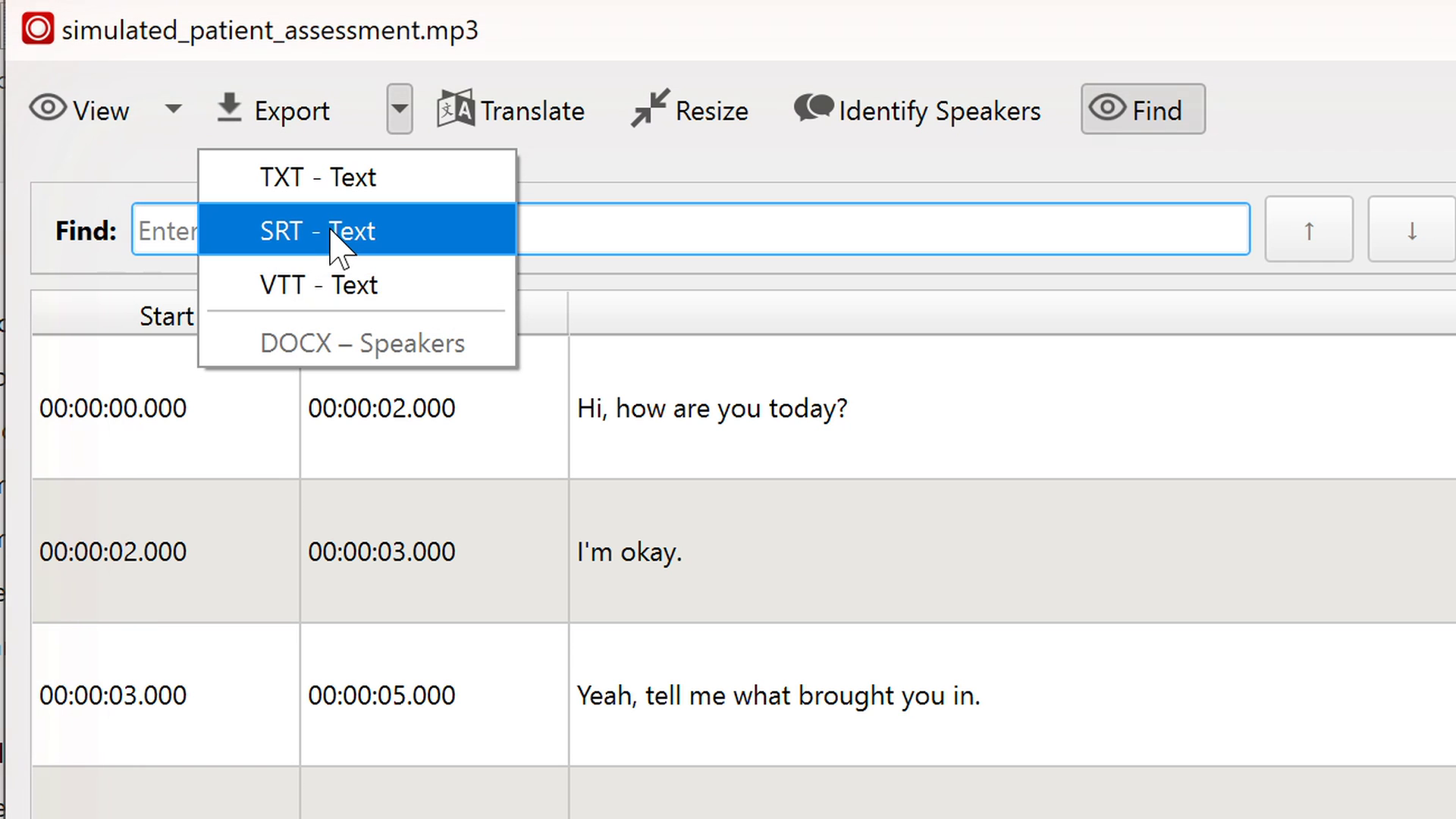
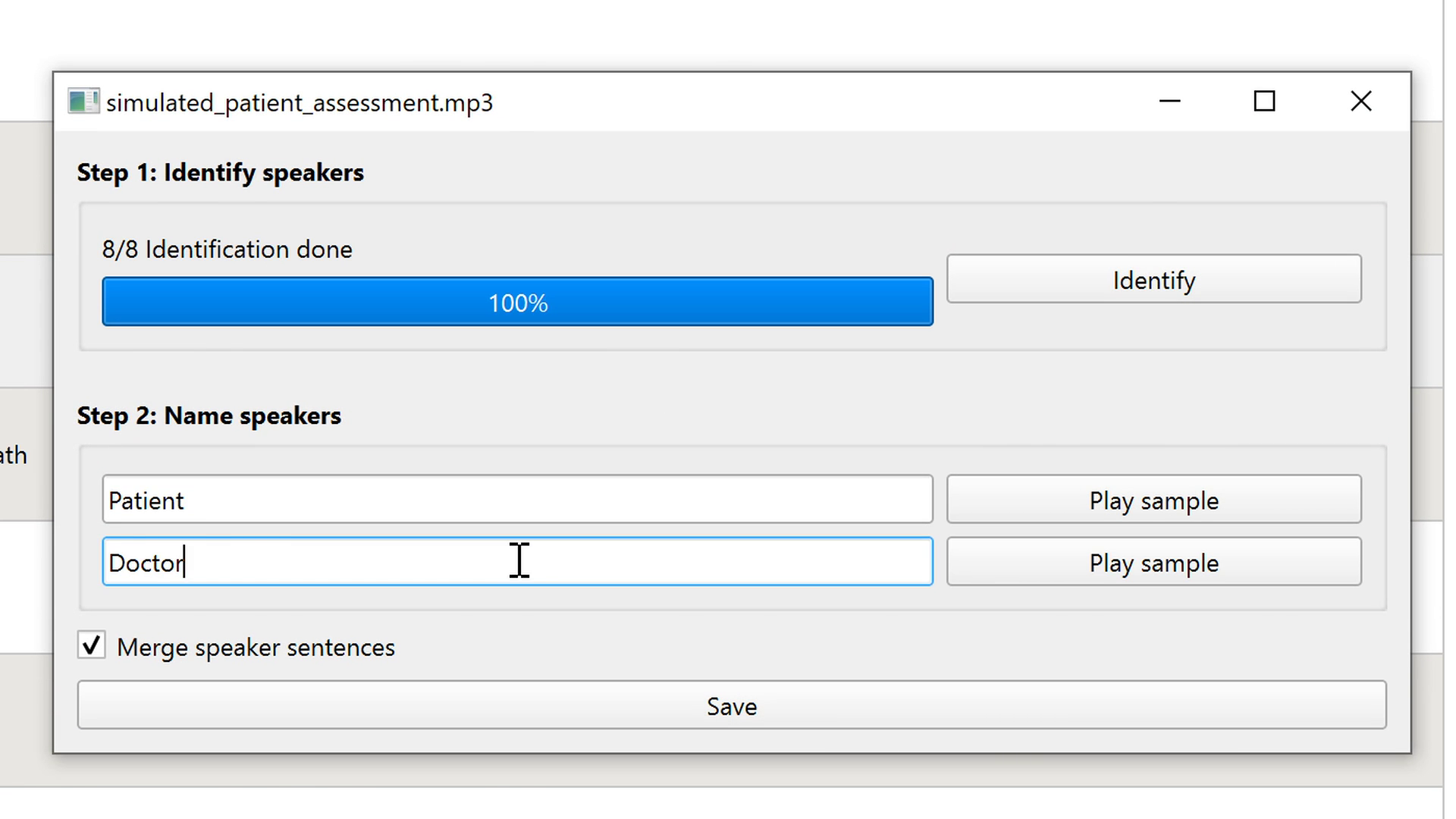
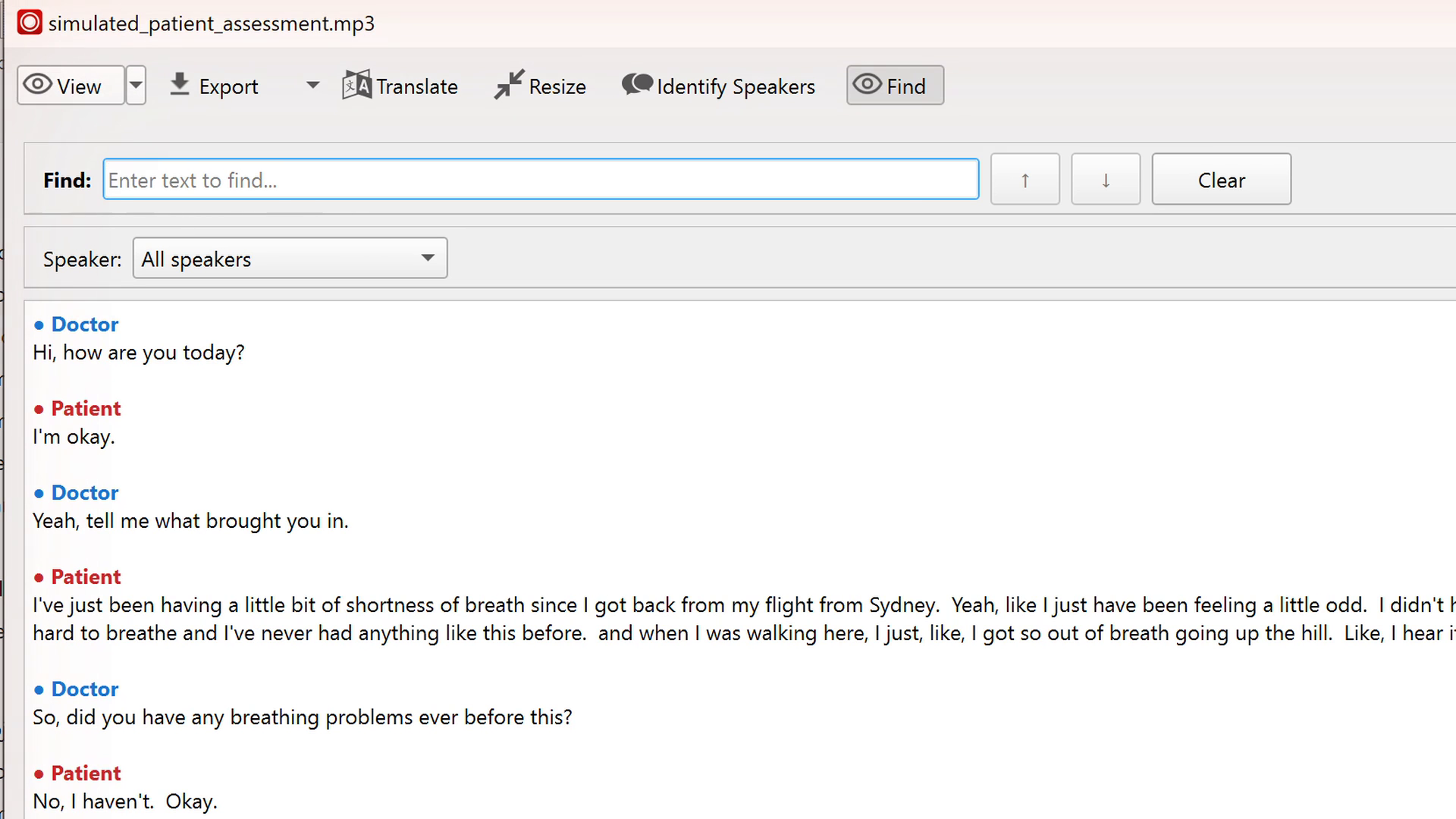
Speaker numbers are not fixed. In one of my runs Speaker 0 was the patient, in another the doctor, so check a few lines (or press Play sample) before naming them.
Same recording, two models
The difference between the two models was clear. Two moments show it best. Listen first, then compare the transcripts.
| Model | Transcript |
|---|---|
| Large-v3-Turbo ✓ | How long have you been on it? Demuline. Sorry. That's what it is. |
| Tiny ✗ | Though, how long have you been on a Demi-Lensary? |
When I checked the medication name separately, Demuline was correct. Medication names are rare words that sound like other words, which makes them hard for any speech model.
| Model | Transcript |
|---|---|
| Large-v3-Turbo ✓ | So there's no cough or phlegm or anything like that? |
| Tiny ✗ | So there's no cough. No. I'm already. No. |
Tiny dropped "phlegm" completely, and Buzz's Find confirms it: searching the Tiny transcript for phlegm returns no matches. Tiny also turned some questions into statements, for example "Periods are okay." where Large-v3-Turbo wrote "Your periods are okay?". Large-v3-Turbo even caught a few words I could not hear clearly myself.
Where Large-v3-Turbo still slipped
- A repetition loop at the end. In the last seconds of the recording it wrote "Okay." about twenty times in a row. Whisper is known to repeat itself like this on quiet or repetitive audio; Tiny did not do it here.
- Speaker labels. One of the doctor's questions, "Are you on any medicines?", was merged into the patient's turn and labelled as the patient.
Both errors are easy to miss when you only skim a transcript, and both would carry into anything built on it.
From transcript to patient note
The LLM's note was well organized and caught the key clinical details: shortness of breath that started today, a recent long-haul flight from Sydney, oral contraceptive use, sharp right-sided pain on a deep breath, and no fever, cough or phlegm.
But the note can only use what the transcript gives it. From the Tiny transcript, the note never mentioned that the patient denied phlegm: the word was simply not there.
I gave the LLM a rule: flag anything it is not sure about. It did, and the flag landed exactly where the risk was:
Medications: oral contraceptive pill, reported in the transcript as "Demuline" … [CHECK: The medication name may be transcribed incorrectly and should be verified against the medication list or original audio.]
My takeaway
- Buzz is free and easy to start with, and because it runs offline it is a reasonable first choice for sensitive recordings.
- Model size matters. For anything clinical I would use the larger model; Tiny's errors landed on exactly the words that matter.
- It does more than transcribe: it tells speakers apart, searches, and exports to the formats you need for notes or subtitles.
- When an LLM works on the transcript next, give it rules. Asking it to flag uncertain items made my review much faster: I knew where to look.
- A person still checks medication names, speaker labels, and what the patient denied, before the note is used.
Links and resources
- Buzz on GitHub: downloads, installation notes and source code.
- Buzz documentation: preferences, file import, speaker identification and the command-line interface.
- OpenAI Whisper: the speech-recognition models Buzz runs, with the list of model sizes.