
NLP 学习笔记 / NLP006
神经语言模型:从词向量到反向传播
上一期的简单语言模型靠数次数算概率。这一期换一种做法:不再存一张计数表,而是让一个神经网络去学习“下一个词是什么”。要看懂它,需要四个概念:神经网络、概率、词嵌入(embedding)和反向传播(backpropagation)。它们也是后面大语言模型(LLM)的基础,因为 LLM 本质上就是规模巨大的神经语言模型。
Neural Language Models: From Word Vectors to Backpropagation
The simple language models in the last note got their probabilities by counting. This note takes a different route: instead of storing a table of counts, a neural network learns what the next word is likely to be. Four concepts carry the idea: neural networks, probability, embeddings and backpropagation. They are also the foundation for what comes next, because large language models (LLMs) are, at heart, very large neural language models.
- 章节 / section
- 关键概念 / key term
- 阅读提示 / reading note
 ELLE · 阅读向导 / READING COMPANION
把概念连起来,再往下读 / Take a moment to connect the ideas
和 Elle 一起理清基础概念 / A few foundations, with Elle
点开概念理清区别,再试三道小题;选错后可以重新选择。 / Tap a concept to explore it, then try three short questions. You can change any answer.
词嵌入 embedding / Embedding
把一个词写成一串数字,神经网络才能计算。语境相似的词,向量也相似;这些向量在训练中和权重一起学出来。 / A word written as a list of numbers so a neural network can compute with it. Words used in similar contexts get similar vectors, and the vectors are learned during training together with the weights.
权重与偏置 / Weights and bias
每条连接带一个权重。神经元把每个输入乘以权重、加起来,再加上偏置:(0.2 × 10) + (−0.1 × 20) + 0 = 0。 / Each connection carries a weight. A unit multiplies each input by its weight, adds them up and adds a bias: (0.2 × 10) + (−0.1 × 20) + 0 = 0.
激活函数 / Activation function
作用在加权和上的公式,决定传给下一层什么。ReLU 常用于隐藏层,Sigmoid 输出 0 到 1、适合二分类,Softmax 把最后一层变成下一个词的概率。 / A formula applied to the weighted sum that decides what passes to the next layer. ReLU is common in hidden layers, sigmoid gives 0 to 1 for yes/no outputs, and softmax turns the last layer into next-word probabilities.
反向传播 / Backpropagation
猜错之后,把输出层的误差一层层往回传,算出每个权重对误差的责任,再逐个调整。误差越大,改得越多。 / After a wrong guess, the error at the output is sent back through every layer to work out how much each weight contributed; then each weight is adjusted. Bigger errors mean bigger changes.
全景图:从词向量到反向传播
从左上角开始:三个绿色标题依次是语言模型的基本功能(根据前面的词,预测下一个词的概率分布)、词即向量,以及神经网络。紫色的部分是词嵌入的定义和这一期的四个核心概念,下面一行提醒:权重是核心,而且是从数据里学出来的。蓝色的小图和两个方框是神经元的结构:输入、加权求和加偏置、激活函数、输出,再叠加成输入层、隐藏层和输出层。中间红色的大框是训练循环:词嵌入经过一层层计算得到下一个词的概率,算出误差,再沿着弧形箭头反向传播回去,更新每一层的权重。左下角是三种激活函数,右下角是我的重点。
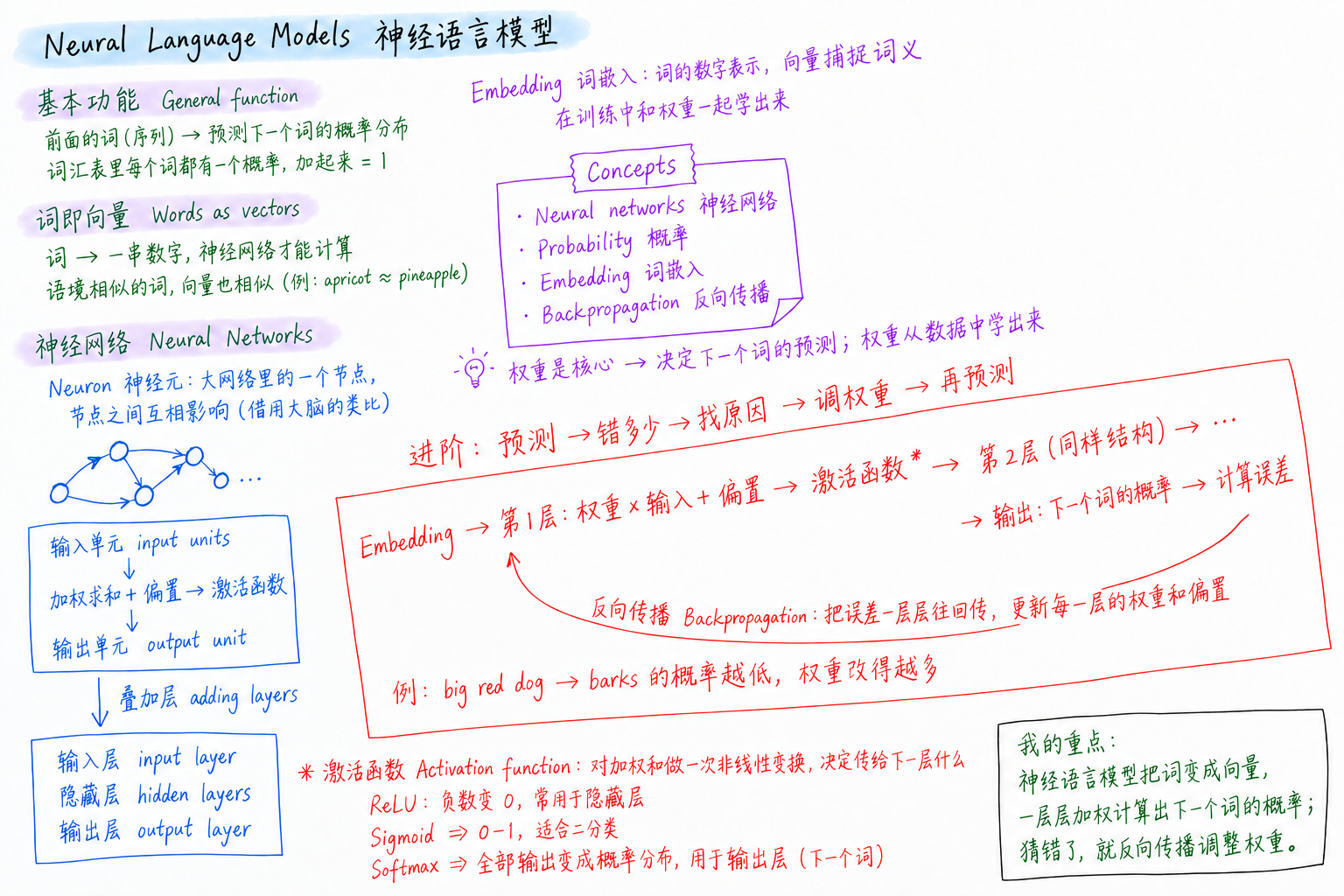
根据我的手写笔记整理,做了几处修正和补充。
The big picture: from word vectors to backpropagation
Start at the top left. The three green headings are what a language model does (predict a probability distribution for the next word from the words before it), words as vectors, and neural networks. The violet notes define embeddings and list the four key concepts of this note, with a reminder underneath: the weights are the core, and they are learned from data. The blue sketch and its two boxes show how a neuron works: inputs, a weighted sum plus a bias, an activation function, an output; stacked up, these become input, hidden and output layers. The large red box in the middle is the training loop: embeddings pass through the layers to give next-word probabilities, the error is calculated, and the curved arrow carries it back through backpropagation to update every layer's weights. The activation functions are at the bottom left, and my takeaway is at the bottom right.
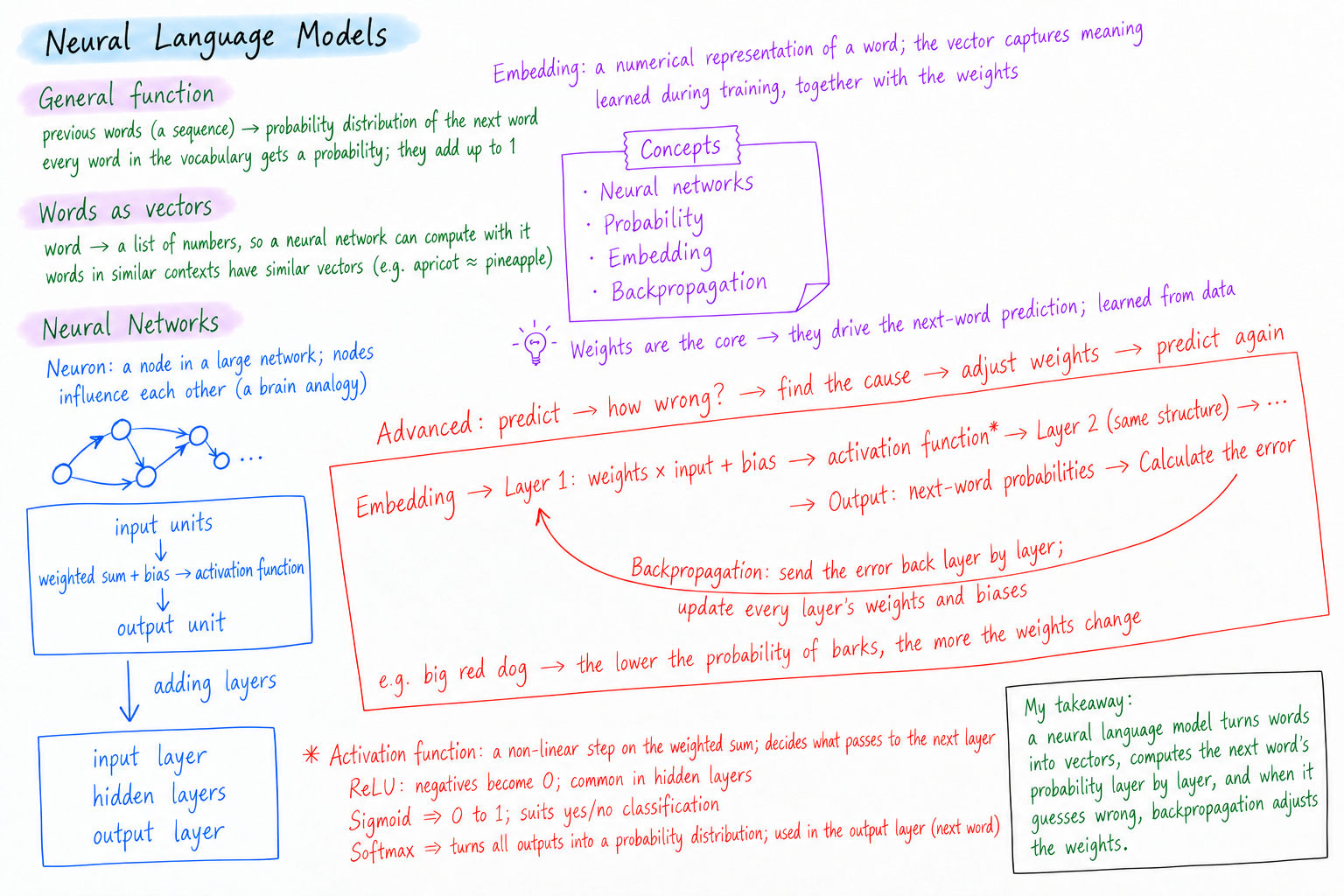
Tidied up from my handwritten page, with a few corrections and additions.
语言模型的基本功能
不管用什么方法实现,语言模型做的都是同一件事:给定前面的一串词,算出下一个词的概率分布。也就是说,词汇表里的每个词都会得到一个概率,所有概率加起来等于 1。
| 输入:“Next, we list some ___” | 下一个词的概率 |
|---|---|
| problems | 0.0014 |
| interesting | 0.0043 |
| the、cat | 接近 0 |
有了这个功能,语言模型就能完成两件事,和上一期的计数模型一样:
- 生成句子:给一个开头(在 LLM 里叫提示词,prompt),从概率分布里抽出一个词,接到句子后面,再算下一个词的分布,如此反复。
- 给句子打分:把每个词在前文条件下的概率相乘,就是整句话的概率。
区别在于概率从哪里来。计数模型查的是数出来的表;神经语言模型用一个神经网络把概率算出来。
What every language model computes
However it is built, a language model does one thing: given a sequence of previous words, it computes a probability distribution over the next word. Every word in the vocabulary gets a probability, and together they add up to 1.
| Input: "Next, we list some ___" | Probability of the next word |
|---|---|
| problems | 0.0014 |
| interesting | 0.0043 |
| the, cat | close to 0 |
That one function supports the same two tasks as the count-based models in the last note:
- Generating text: start from a beginning (in LLMs, the prompt), sample a word from the distribution, add it to the sequence, compute the next distribution, and repeat.
- Scoring a sentence: multiply the probability of each word given the words before it to get the probability of the whole sentence.
What changes is where the probabilities come from. A count-based model looks them up in a table of counts; a neural language model computes them with a neural network.
词即向量:词嵌入
神经网络只会处理数字:输入是一串数字(向量),输出也是一串数字。所以要用神经网络做语言模型,先要把词变成向量。这些表示词的向量叫做词嵌入(embedding)。
用数字表示词,听上去很反直觉,其实在语言学里由来已久。维特根斯坦说过,一个词的意义在于它在语言中的用法。课程里的例子是 tesgüino:读到“一瓶 tesgüino 放在桌上”“喝 tesgüino 会醉”“tesgüino 是用玉米做的”,我们就能猜出它是一种像啤酒的酒。这就是分布式语义(distributional semantics)的直觉:一个词的向量,应该捕捉它通常出现在什么语境里。
| 方法 | 每个格子记什么 | 能比较什么 |
|---|---|---|
| 词–文档矩阵 | 某个词在某篇文档里出现几次,例如 battle 在《亨利五世》里出现 15 次 | 比较列,得到文档相似度;比较行,得到词的相似度 |
| 词–词共现矩阵 | 某个词出现在另一个词前后 ±7 个词以内的次数,例如 data 出现在 information 附近 6 次 | 比较行:apricot 和 pineapple 的向量相近,digital 和 information 的向量相近 |
核心结论是:语境相似的词,向量也相似。衡量两个向量有多像,最常用的是余弦相似度。神经语言模型同样用向量表示词,但做法不同:它的词嵌入是短而稠密的向量,不是数出来的,而是在训练中和网络权重一起学出来的。

阅读提示:词–文档矩阵里阿拉伯数字和旁边的计数笔画对不上,只是示意。右下角“杏子 × 糖 = 1”并不代表“高相关”:1 只是 sugar 在 apricot 附近出现了一次。判断两个词是否相似,要比较整行向量,而不是看单个格子。
Words as vectors: embeddings
A neural network only handles numbers: a list of numbers (a vector) goes in, and another list comes out. So to build a language model from a neural network, words first have to become vectors. The vectors that represent words are called embeddings.
Representing words as numbers sounds strange, but it has a long history in linguistics. Wittgenstein wrote that the meaning of a word is its use in the language. The course example is tesgüino. After reading "a bottle of tesgüino is on the table," "tesgüino makes you drunk" and "we make tesgüino out of corn," we can guess it is an alcoholic drink like beer. That is the intuition behind distributional semantics: a word's vector should capture the contexts it tends to appear in.
| Method | What each cell counts | What you can compare |
|---|---|---|
| Term-document matrix | How often a word appears in a document, e.g. battle appears 15 times in Henry V | Columns give document similarity; rows give word similarity |
| Word-word co-occurrence matrix | How often a word appears within ±7 words of another, e.g. data appears near information 6 times | Rows: apricot and pineapple have similar vectors, and so do digital and information |
The key result: words that appear in similar contexts have similar vectors. The usual way to measure how alike two vectors are is cosine similarity. Neural language models also represent words as vectors, but in a different way: their embeddings are short, dense vectors that are not counted but learned during training, together with the network's weights.
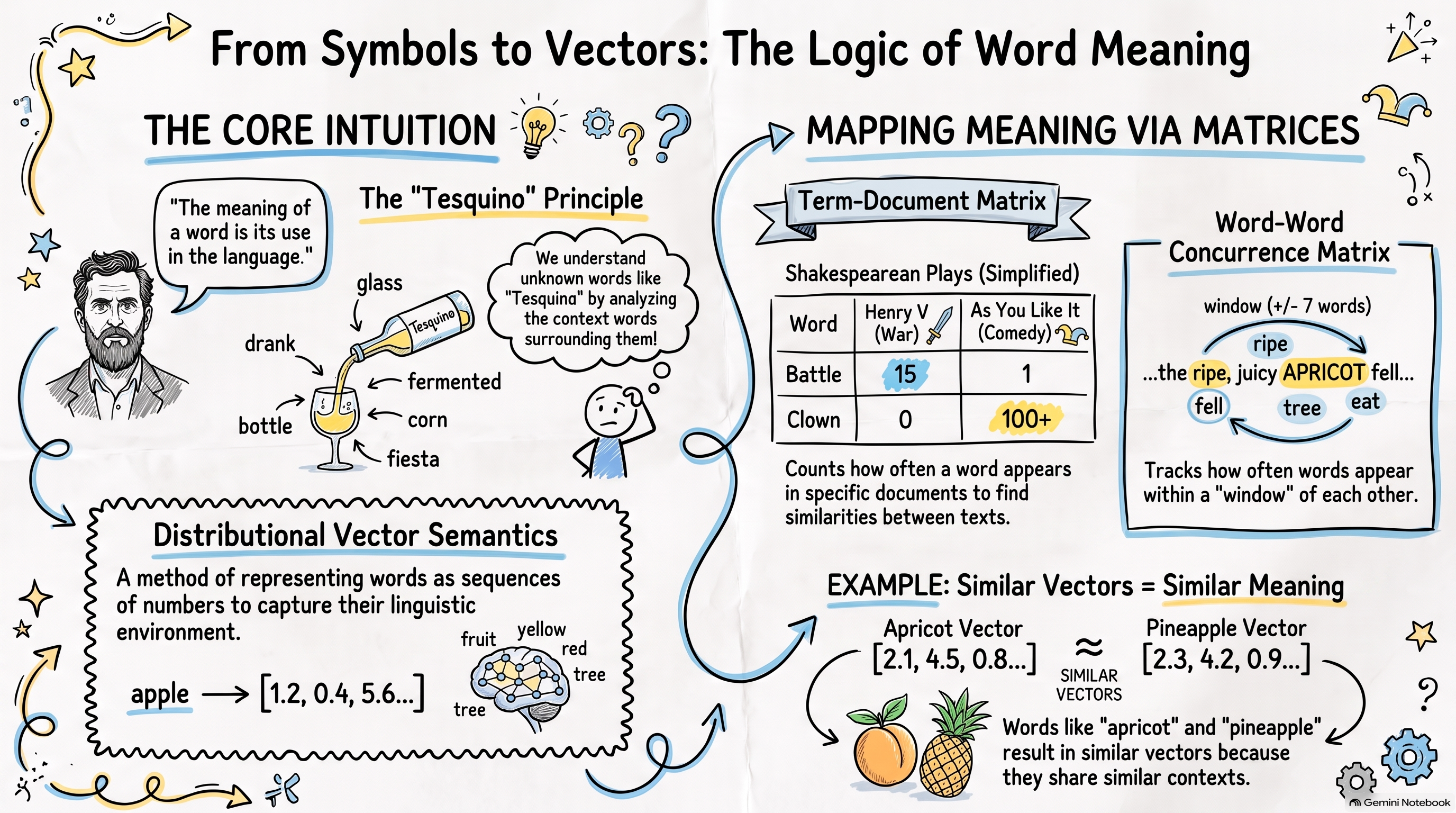
Reading note: the unknown word is tesgüino (the image spells it Tesquino and Tesquina), and "Concurrence Matrix" should be co-occurrence matrix. In the course table, clown appears over 100 times in Twelfth Night, not in As You Like It (6 times), and Henry V is a history play, not a war play.
神经网络:神经元、权重与层
神经网络这个名字来自一个类比:大脑由神经元组成,每个神经元是大网络里的一个节点,神经元之间按照网络结构互相影响。人工神经网络借用了这个类比,并不是在模拟真实的大脑。
最基本的网络只有输入单元和输出单元,连接上带着权重。输出单元先算输入的加权和:
(0.2 × 10) + (−0.1 × 20) = 2 − 2 = 0
实际的神经元还会加上一个偏置(bias),再把结果交给激活函数:
输出 = 激活函数(权重 × 输入 之和 + 偏置)
课程里的垃圾邮件例子有五个输入单元,都是邮件的特征:发件人是否认识、标题里有没有 win、正文有没有 free、有没有个人称呼、正文多少个词。加权求和、经过激活函数后得到 0.8,可以理解为“这封邮件有 80% 的可能是垃圾邮件”。
要做更复杂的判断,就叠加层:在输入层和输出层之间加入隐藏层。这看起来复杂,其实只是同一个基本结构重复了很多次,每个节点都用上一层所有相连节点的加权和来计算。预测时一层一层往前算,直到输出层,这叫前向计算。
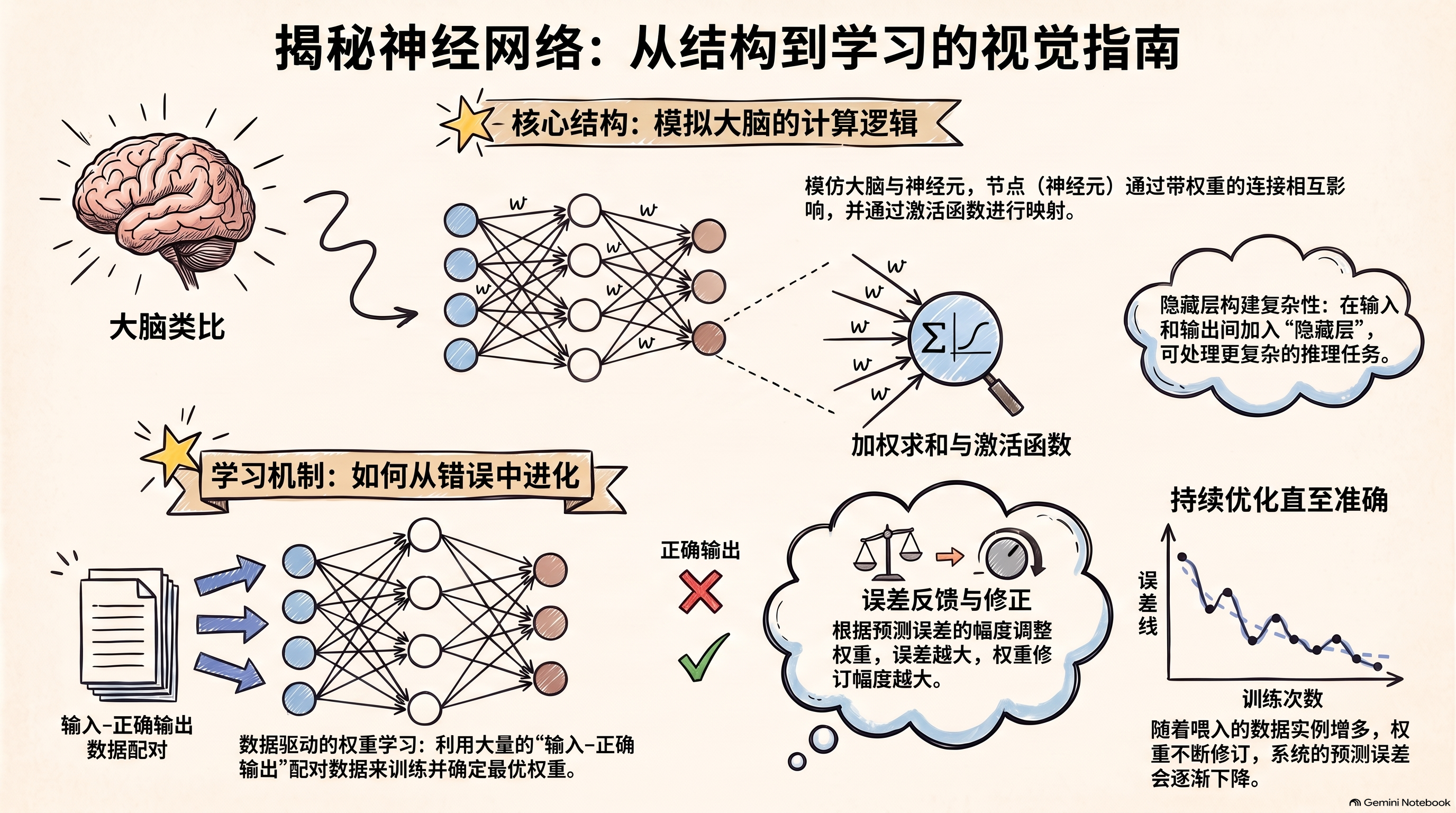
阅读提示:“模拟大脑的计算逻辑”应理解为借用大脑的类比,人工神经元只是一个简单的数学单元。右下角纵轴标为“误差线”,应为“误差”。
Neural networks: neurons, weights and layers
The name comes from an analogy: the brain is made of neurons, each a node in a large network, and neurons influence each other through the structure of that network. Artificial neural networks borrow the analogy; they do not simulate a real brain.
The most basic network has input units and an output unit, with a weight on each connection. The output unit first computes the weighted sum of its inputs:
(0.2 × 10) + (−0.1 × 20) = 2 − 2 = 0
A real unit also adds a bias, then passes the result through an activation function:
output = activation(sum of weight × input + bias)
In the course's spam example, the five input units are features of an email: whether the sender is known, whether the title contains win, whether the body contains free, whether there is a personal greeting, and how many words the body has. The weighted sum goes through the activation function and comes out as 0.8, which can be read as an 80% chance that the email is spam.
For harder judgments, you add layers: hidden layers between the input and the output. That sounds complicated, but it is the same basic structure repeated many times; each node is the weighted sum of all the nodes connected to it in the layer before. To make a prediction, the network computes one layer at a time until it reaches the output. This is the forward pass.
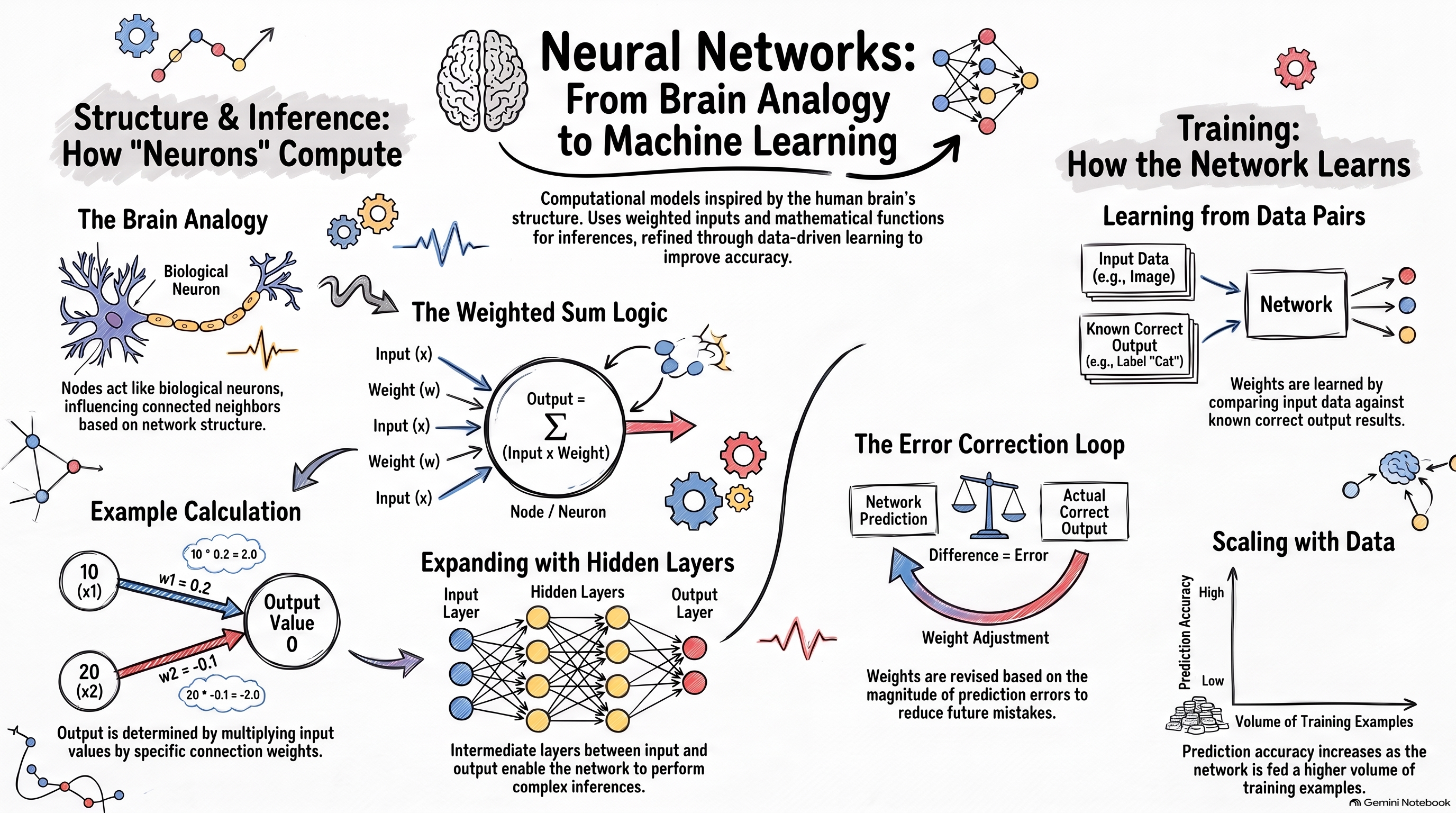
Reading note: the weighted-sum diagram shows only Σ(input × weight). A real unit also adds a bias and applies an activation function; the worked example, whose output is 0, leaves both out, as the course does at first.
激活函数:决定传给下一层什么
激活函数是一个数学公式,作用在加权和上。它带来了非线性:如果没有它,叠加再多层,整个网络也只相当于一次加权求和。不同的公式输出范围不同,所以用在不同的位置:
| 激活函数 | 做什么 | 常见位置 |
|---|---|---|
| ReLU | 负数变成 0,正数保持不变:max(z, 0) | 隐藏层 |
| tanh | 压缩到 −1 到 1 之间 | 隐藏层 |
| Sigmoid | 压缩到 0 到 1 之间 | 二分类的输出,例如“是不是垃圾邮件” |
| Softmax | 把一整组分数变成加起来为 1 的概率分布 | 多分类的输出层,例如“下一个词是哪个” |
所以,激活函数决定了加权的结果怎样转换、怎样传递到下一层。神经语言模型的最后一层用 Softmax:词汇表里有几万个词,就输出几万个概率,这正是语言模型需要的“下一个词的概率分布”。SLP3,第 6 章
Activation functions: what passes to the next layer
An activation function is a mathematical formula applied to the weighted sum. It adds non-linearity: without it, any number of stacked layers would collapse into a single weighted sum. Different formulas have different output ranges, so they suit different places in the network:
| Activation function | What it does | Typical place |
|---|---|---|
| ReLU | Turns negative values into 0 and keeps positive ones: max(z, 0) | Hidden layers |
| tanh | Squeezes values into −1 to 1 | Hidden layers |
| Sigmoid | Squeezes values into 0 to 1 | Binary outputs, such as spam or not |
| Softmax | Turns a whole set of scores into probabilities that add up to 1 | Output layer with many classes, such as which word comes next |
So the activation function decides how the weighted result is transformed and passed on to the next layer. A neural language model ends with softmax: with tens of thousands of words in the vocabulary, it outputs tens of thousands of probabilities, which is exactly the next-word distribution a language model needs. SLP3, Chapter 6
学习:猜错了,反向传播
权重不是人定的,而是从数据里学出来的。训练数据是大量“输入–正确输出”的配对,网络一次看一个例子:
- 预测:前向计算,得到输出。
- 计算误差:和正确答案比,差了多少。
- 找原因:反向传播把误差从输出层一层层往回传,算出每个权重和偏置对这个误差负多少责任。
- 调权重:按各自的责任修改权重,误差越大,改得越多(这一步叫梯度下降)。
- 再预测:换下一个例子,重复。
课程里的旅游目的地例子:如果正确答案是“不喜欢”,网络输出 0.001,几乎没错,权重基本不用改;如果输出 0.89,错得很多,权重就要大改。例子喂得越多,误差越低。
需要注意的是:误差只在输出层算一次,反向传播会经过所有层,每一层的权重都会更新,而不是每一层各自预测、各自纠错。SLP3,第 6 章
Learning: wrong guesses and backpropagation
Nobody sets the weights by hand; they are learned from data. The training data is a large set of input and correct-output pairs, and the network sees one example at a time:
- Predict: run the forward pass and get an output.
- Calculate the error: compare it with the correct answer.
- Find the cause: backpropagation sends the error back from the output layer through every layer and works out how much each weight and bias contributed to it.
- Adjust the weights: change each one in proportion to its share; bigger errors mean bigger changes (this step is gradient descent).
- Predict again: move on to the next example and repeat.
In the course's travel example, if the correct answer is "didn't like it" and the network outputs 0.001, it is nearly right and the weights barely change. If it outputs 0.89, the error is large and the weights change a lot. The more examples it sees, the lower the error.
One point to keep straight: the error is calculated once, at the output. Backpropagation then passes through all the layers and updates the weights in each one; the layers do not each make and correct their own prediction. SLP3, Chapter 6
组装:神经语言模型
把以上几部分接起来,就是一个简单的神经语言模型:
- 输入:前三个词,各自换成词嵌入向量。
- 隐藏层:加权求和、加偏置、经过激活函数。
- 输出层:Softmax 给出词汇表里每个词作为下一个词的概率。
训练就是在大量文本上反复“预测下一个词”。以 “…the big red dog barks against the big pink dog…” 为例:输入 big red dog,正确的下一个词是 barks。barks 得到的概率越低,误差越大,反向传播改动的权重就越多。然后窗口往后挪一个词,用 red dog barks 去预测 against,以此类推。在整个网络规模的文本上这样训练,权重就会越来越可靠。词嵌入也是这样学出来的:它们和权重一起被更新。

阅读提示:“在全网海量数据上训练后,模型预测将变得极其精准”指的是比计数模型更准,并不是不会出错。
| 计数模型(上一期) | 神经语言模型 | |
|---|---|---|
| 概率从哪里来 | 数次数再相除 | 神经网络算出来 |
| 词的表示 | 词本身(一个符号) | 学出来的词嵌入向量 |
| 没见过的词组 | 概率为零,需要平滑 | 相似的词向量相近,可以类推 |
| 生成和打分的表现 | 基础 | 即使结构简单,也更好 |
| 代价 | 快、透明、容易解释 | 训练更慢、更耗能,也更难解释 |
“可以类推”是什么意思?假设训练时见过 “make sure that the cat gets fed”,却从没见过 dog 后面接 gets fed。计数模型在 “the dog gets” 之后不会预测 fed;神经语言模型知道 cat 和 dog 的词嵌入相近,就能预测出 fed。SLP3,第 6 章
下一期的大语言模型,就是在这个基础上把模型和数据都放大很多倍。
Putting it together: a neural language model
Connect these pieces and you have a simple neural language model:
- Input: the previous three words, each replaced by its embedding.
- Hidden layer: weighted sums, a bias and an activation function.
- Output layer: softmax gives every word in the vocabulary its probability of coming next.
Training means predicting the next word, over and over, across a large amount of text. Take "…the big red dog barks against the big pink dog…": the input is big red dog, and the correct next word is barks. The lower the probability the model gives barks, the bigger the error and the more backpropagation changes the weights. Then the window slides one word along, and red dog barks is used to predict against, and so on. Trained this way on text the size of the web, the weights become reliable. The embeddings are learned the same way: they are updated along with the weights.
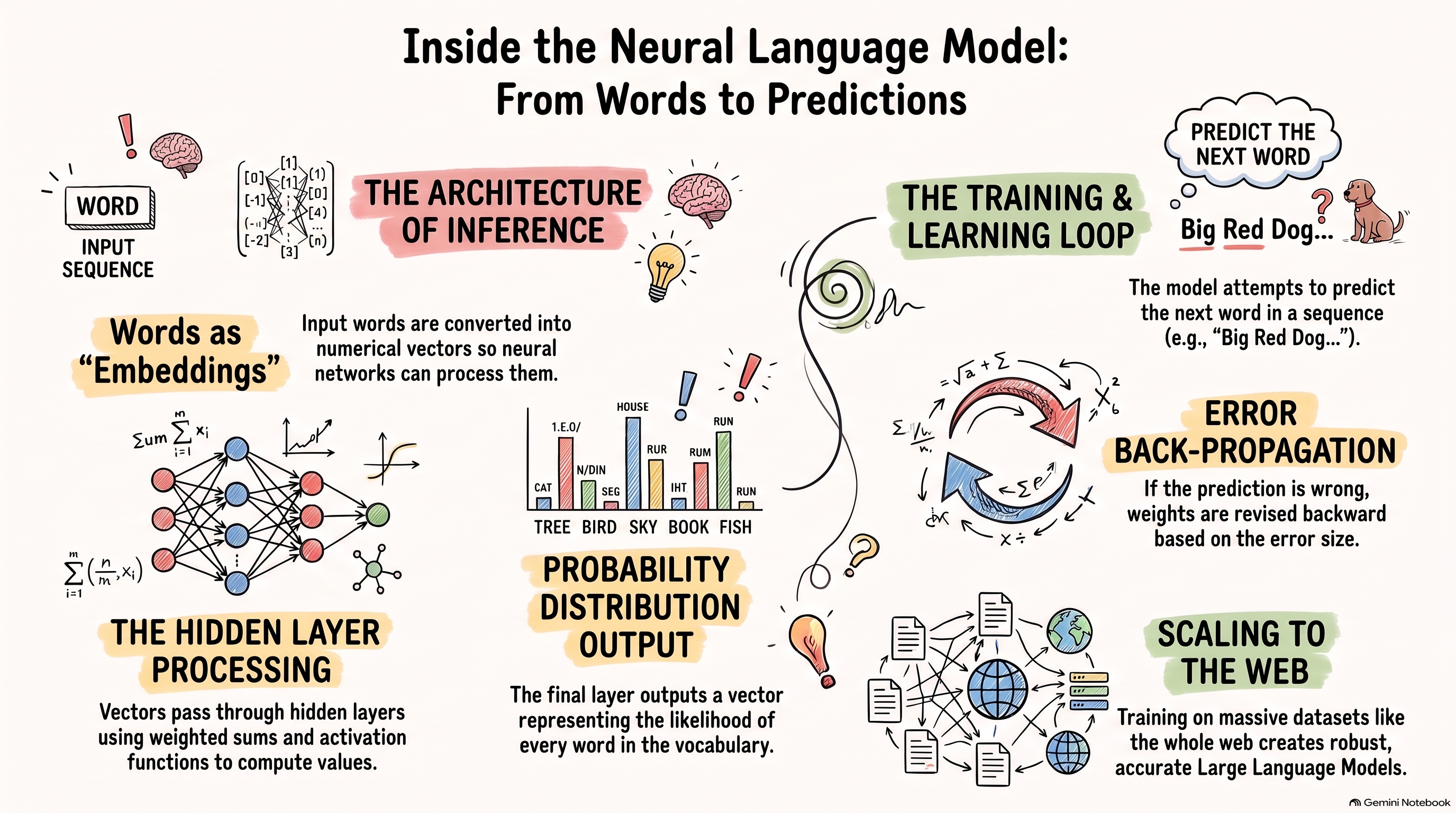
Reading note: the word labels on the bar chart (1.E.O/, N/DIN, SEG and others) are garbled; the chart only stands for one probability per word in the vocabulary.
| Count-based model (last note) | Neural language model | |
|---|---|---|
| Where probabilities come from | Counting and dividing | Computed by a neural network |
| How a word is represented | The word itself, as a symbol | A learned embedding vector |
| An unseen word pair | Probability zero, unless smoothed | Similar words have similar vectors, so it can generalize |
| Generating and scoring | Basic | Better, even with a simple network |
| Cost | Fast, transparent, easy to interpret | Slower to train, uses far more energy, harder to interpret |
What does "generalize" mean here? Suppose training included "make sure that the cat gets fed" but never had gets fed after dog. A count-based model will not predict fed after "the dog gets". A neural language model knows that cat and dog have similar embeddings, so it can predict fed. SLP3, Chapter 6
The large language models in the next note build on exactly this, scaling up both the model and the data.
我的思考
这期需要掌握四个概念:什么是神经网络;再次强调的概率;什么是词嵌入;什么是反向传播。神经语言模型想要完成的,是根据前面的一个或几个词,按照概率预测下一个词。
为了方便电脑计算,需要把单词转成向量。词嵌入就是这个过程:它是词的数字表示,向量捕捉了文本的含义。这也意味着,如果两个词相似,它们的向量也相似。
神经网络借用了大脑神经网络的类比。神经元是网络里的一个点,神经元之间会互相影响,也可以理解为它们之间可能有关系。构建这个网络,先有输入单元,然后通过激活函数(一个数学公式,不同的目的可以选不同的公式)得到下一个输出单元;这个步骤可以重复多层,最后得到结果。所以在这个网络里,每个神经元连接上的权重,会影响下一个词的预测结果。
在建立模型的过程中,会不断矫正:先预测,看看错了多少,找到原因,调整权重,再预测。这里就用到了反向传播。
My thoughts
This note has four concepts to master: what a neural network is; probability, once again; what an embedding is; and what backpropagation is. What a neural language model sets out to do is predict the next word from probabilities, based on the word or words that came before.
To make computation easy for a computer, words have to be turned into vectors. That is what an embedding is: a numerical representation of a word, a vector that captures the meaning of the text. It also means that if two words are similar, their vectors are similar too.
Neural networks borrow the analogy of the brain's neural networks. A neuron is a point in the network, and neurons influence each other; you can think of it as neurons possibly being related. To build the network, you start with input units, then go through an activation function (a mathematical formula; different purposes call for different formulas) to reach the next output unit. This step can repeat over many layers until you get the final result. So in this network, the weight on each neuron's connections affects the prediction of the next word.
While the model is being built, it keeps correcting itself: predict first, see how wrong it is, find the cause, adjust the weights, and predict again. That is where backpropagation comes in.
原始手写笔记
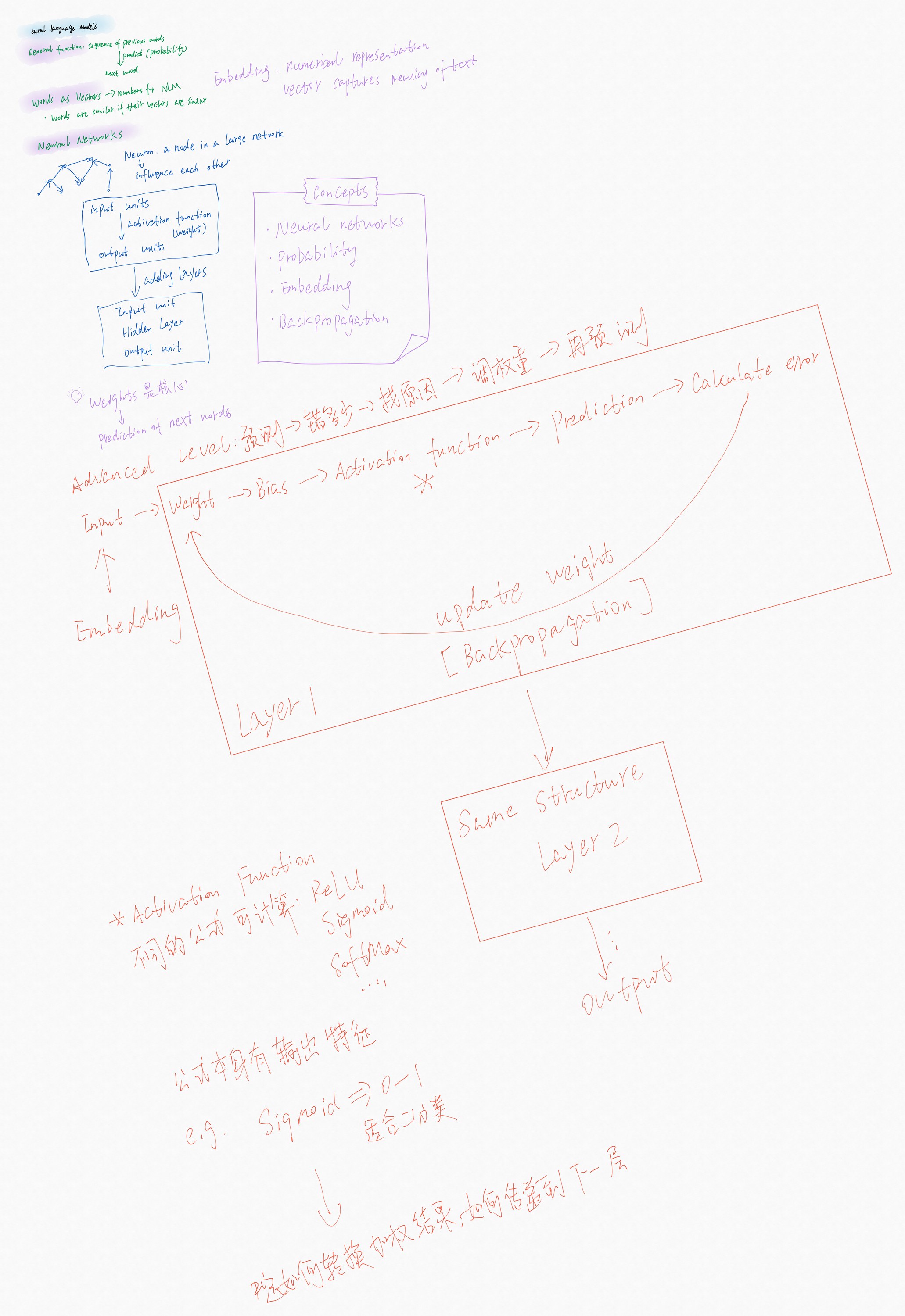
整理后的版本改了这些地方:补全了标题 Neural Language Models;神经元方框里写明权重在连接上,神经元先做加权求和、加偏置,再经过激活函数(原图把 weights 写在激活函数旁);训练循环改为先经过所有层得到预测、在输出端算一次误差,再由反向传播更新每一层的权重和偏置(原图把预测和纠错画在第 1 层里面);三种激活函数写明了各自的位置,Softmax 用在输出层;词嵌入补上了“在训练中和权重一起学出来”,并加了 apricot ≈ pineapple 的例子。
Original handwritten notes
What changed in the tidied version: the title is completed as Neural Language Models; the neuron box now says the weights sit on the connections and the unit takes a weighted sum, adds a bias and then applies the activation function (the original wrote weights next to the activation function); the training loop now runs through every layer before the prediction, calculates the error once at the output, and backpropagates it to update every layer's weights and biases (the original drew the prediction and correction inside Layer 1); each activation function now says where it is used, with softmax at the output layer; and the embedding note adds that embeddings are learned together with the weights, with apricot ≈ pineapple as an example.
学习来源与资源
本期内容来自我在英属哥伦比亚大学(UBC)微证书项目“Natural Language Processing to Improve Patient Care”中“Overview of NLP and Large Language Models”课程的学习笔记(Giuseppe Carenini 讲授的 Neural Language Models 一讲)。技术细节核对了 Jurafsky 和 Martin 的 Speech and Language Processing(第 3 版草稿,2026 年 8 月):第 5 章 Embeddings 和 第 6 章 Neural Networks。
自己动手试试
- TensorFlow Playground:在浏览器里搭一个小神经网络,增减隐藏层、切换 ReLU、tanh、Sigmoid,看训练时误差怎样一步步下降。
- GeeksforGeeks:Activation Functions in Neural Networks:上文只举了三个例子,这个页面列出了更多激活函数(线性、tanh、Leaky ReLU、ELU 等),每个都配有公式和曲线图。
- Embedding Projector:在三维空间里浏览真实的词向量,搜索一个词,看看离它最近的是哪些词。
Learning sources and resources
This note is based on my study notes from the University of British Columbia (UBC) micro-certificate program "Natural Language Processing to Improve Patient Care," in the course "Overview of NLP and Large Language Models" (the Neural Language Models lecture by Giuseppe Carenini). Technical details were checked against Jurafsky and Martin, Speech and Language Processing (3rd edition draft, August 2026): Chapter 5, Embeddings and Chapter 6, Neural Networks.
Try it yourself
- TensorFlow Playground: build a small neural network in your browser, add or remove hidden layers, switch between ReLU, tanh and sigmoid, and watch the error fall during training.
- GeeksforGeeks: Activation Functions in Neural Networks: the three above are only examples; this page lists many more (linear, tanh, Leaky ReLU, ELU and others), each with its formula and a graph.
- Embedding Projector: explore real word vectors in 3D; search for a word and see which words sit closest to it.