UBC · Extraction and Analysis of Clinical Documents · Module 1, Lesson 1 / NLP009
Where Can NLP Help in Health Care? Clinical Documents, Patient Voices and the Cancer Journey
Health care produces huge amounts of unstructured text, yet most machine learning in health still works with structured data such as electronic health records (EHRs) and insurance claims. The first lesson of UBC's Extraction and Analysis of Clinical Documents explains why natural language processing (NLP) is worth the effort: where the text comes from, which NLP tasks matter, what about other languages and speech, and what a cancer patient's reports look like to a computer. This note is my summary of that overview.
- section
- key term
- reading note
 ELLE · READING COMPANION
Take a moment to connect the ideas
A few foundations, with Elle
Tap a concept to explore it, then try three short questions. You can change any answer.
Clinical documents vs UGC
Clinical documents (pathology, imaging, operative reports) are written by health care professionals: formal, dense, full of jargon. User-generated content (blogs, messages, forum posts) is written by patients and families: diverse, often subjective, and full of their experiences and needs.
Fields of interest
The pieces of information a task needs from a report, such as whether there is cancer, its type, grade, size and location. NLP extracts them automatically and puts them into a structured table or the EHR.
Negation
A report can name a finding in order to rule it out: "no lymphovascular invasion". The "no" may sit right before the term or several sentences later ("there is no evidence"), so finding a term is not the same as the patient having it.
Siloed documents
Each report is written for a local decision about the next step and is rarely linked to the others over time, so a patient's full history across years is never assembled.
The big picture: what NLP can do with health care text
Start at the top left with the four groups of NLP tasks, then the multilingual issue below it: most tools were built on English text, so there are two ways to handle other languages. At the bottom left is a cancer journey, from diagnosis to treatment to monitoring after remission, with the curved arrow back to diagnosis when a relapse is suspected; every step produces a report. On the right, in red, is the problem: these documents stay siloed, are full of jargon, and wait for scarce experts to read them. The green line beneath it is what NLP offers. The red line along the bottom is something I have noticed in practice, and my takeaway is in the bottom-right corner.
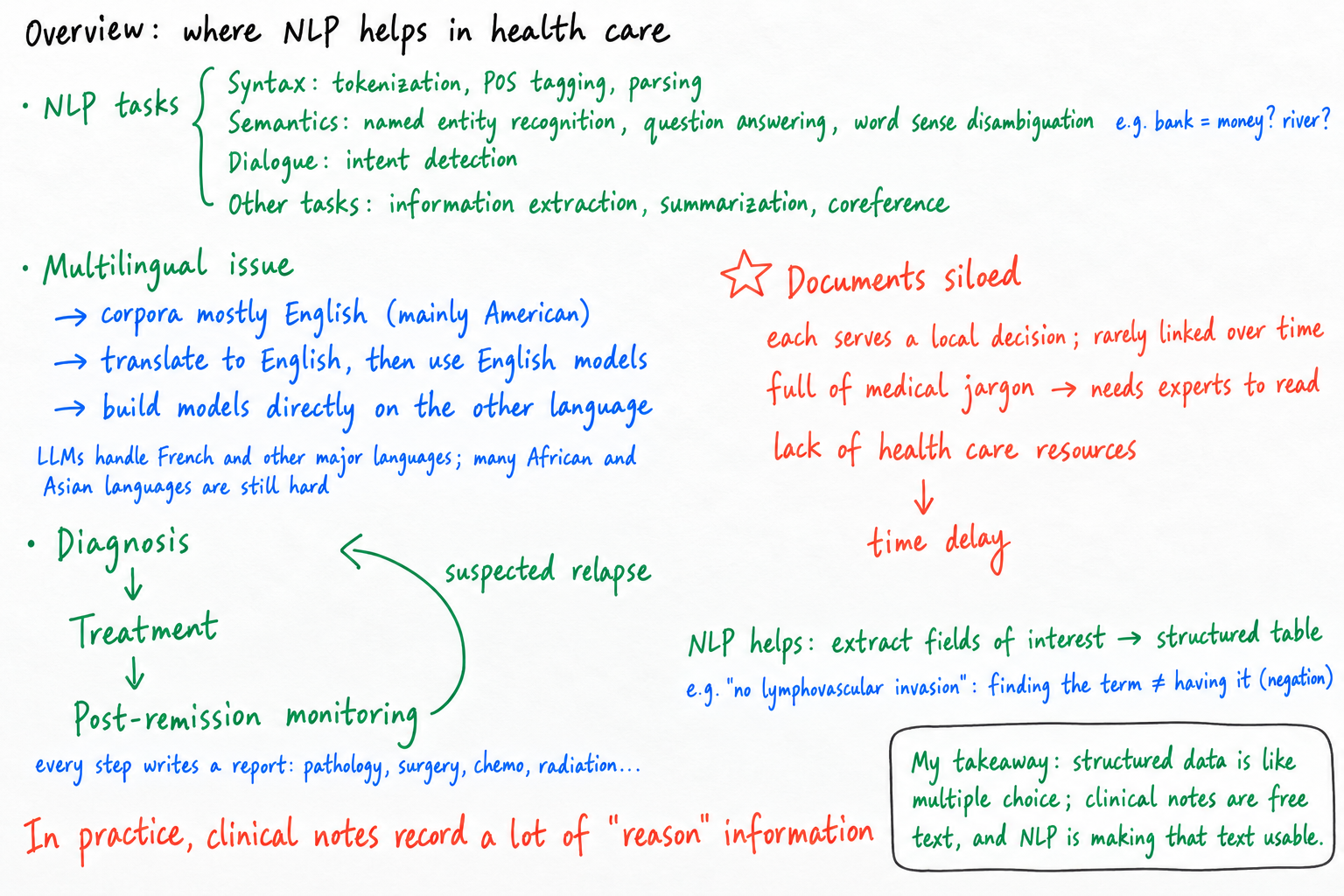
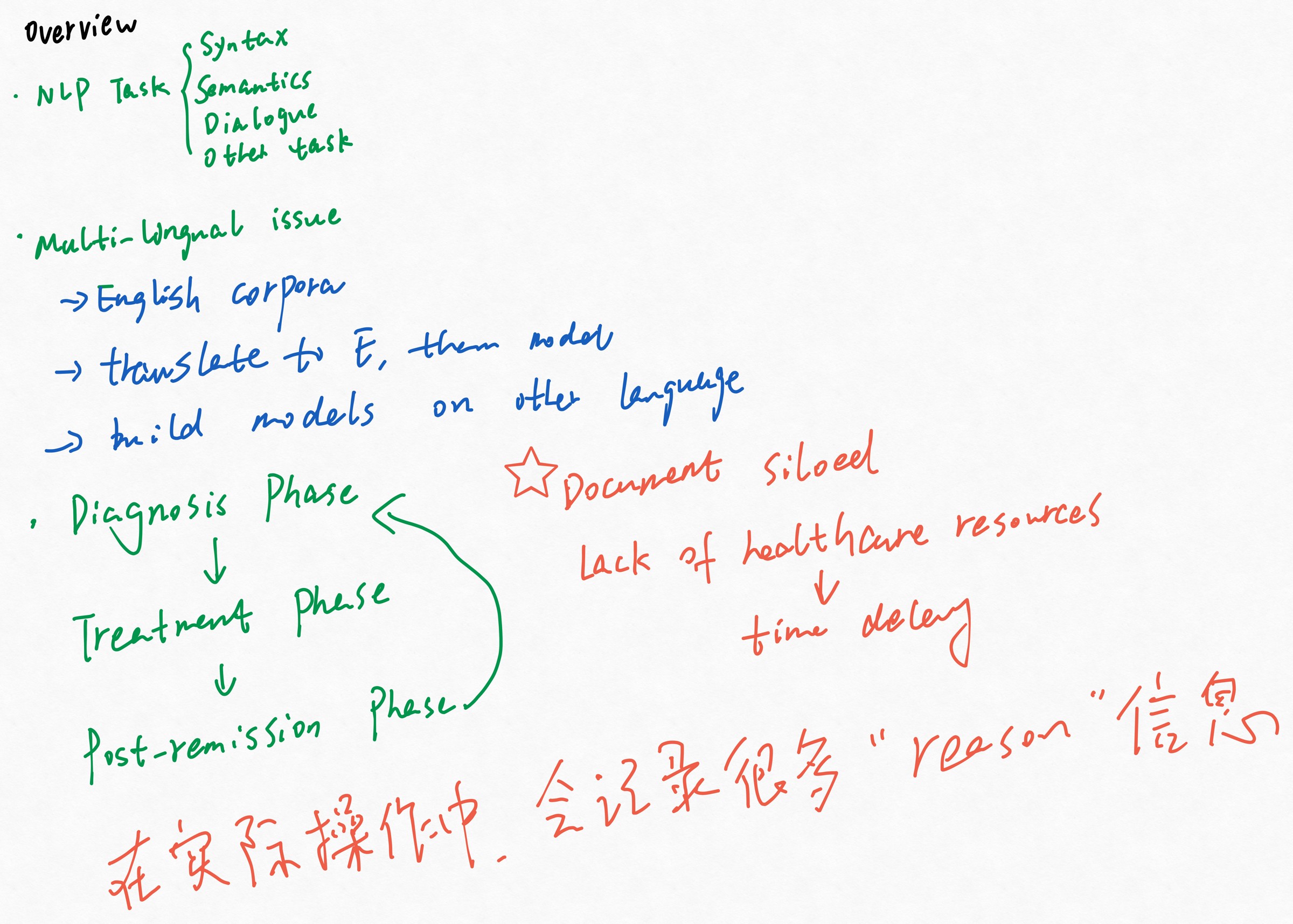
Tidied up from my handwritten page, with a few corrections and short examples added.
Tap a region to jump to that part of the note; use ⤢ Enlarge to see the full picture.
Two sources of health care text
The course separates unstructured health text into two sources, and the micro-certificate gives each its own course:
| Clinical documents | User-generated content (UGC) | |
|---|---|---|
| Who writes it | Health care professionals | Patients, their families and others |
| Examples | Pathology, imaging and radiology reports; operative reports | Blogs, forum posts, text messages, emails, chats |
| What it is like | Formal, dense, full of medical terms; rarely subjective | Diverse writers and styles; often ungrammatical; often subjective |
| What it tells us | Diagnoses, findings and treatments | Opinions, experiences, needs, feelings and moods |
| In the program | This course (course two) | Course three |
Subjective does not mean uninformative. The lecture's example: when choosing a restaurant in a new city, most of us read online reviews. We know they are subjective, but a place rated 4.8 out of 5 still tells us something compared with one rated 3. In the same way, how patients describe their experience is useful information for patient care.
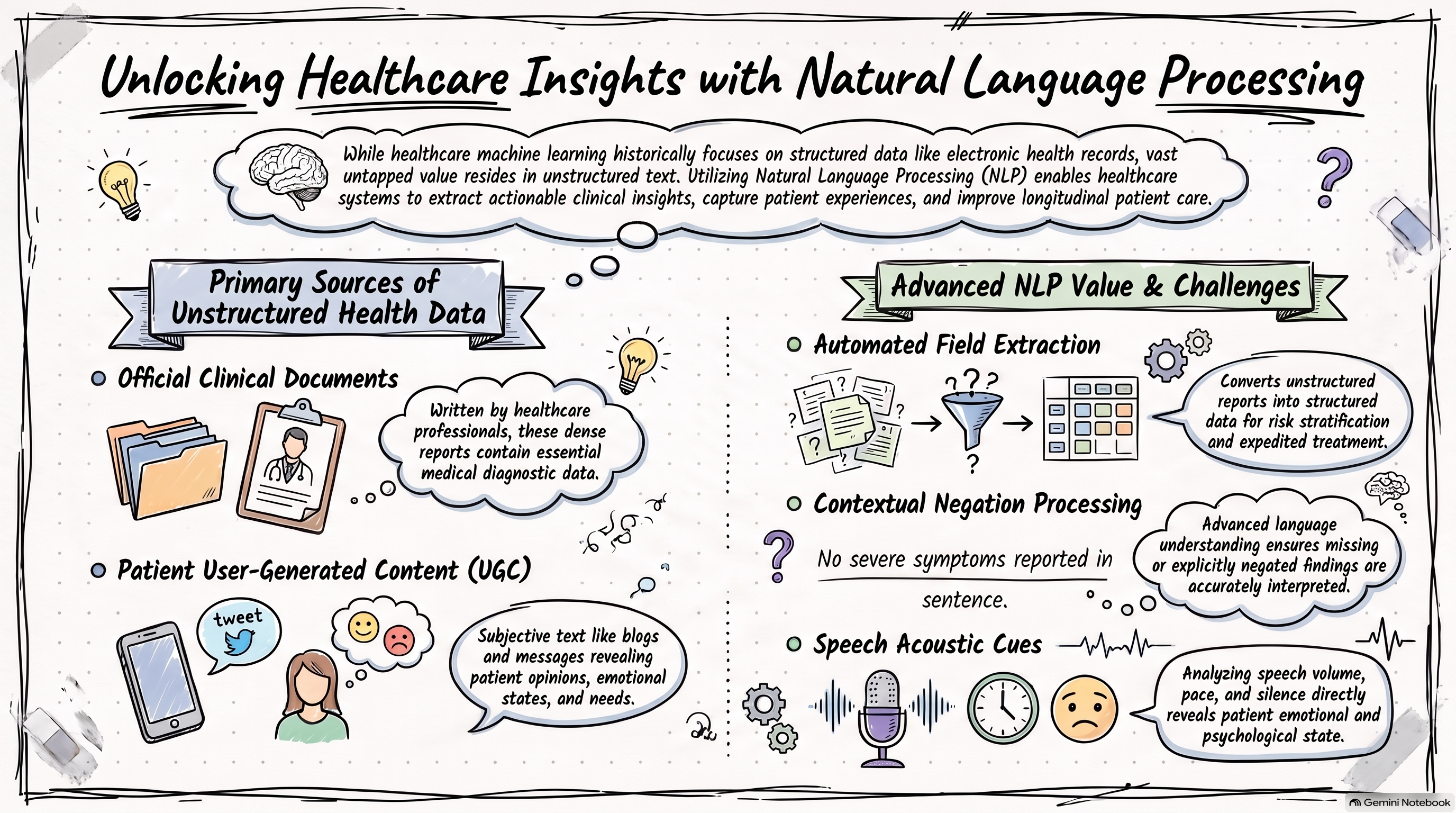
A reading note: the sentence under negation in this picture came out garbled; the lecture's example is "no lymphovascular invasion" in a pathology report (below). Also, speech volume, pace and silence are linked to emotion and mood; they do not "directly reveal" a patient's state.
Four groups of NLP tasks
"Processing" in NLP covers many things. The lecture sorts the tasks into four columns:
| Group | What it is about | Examples |
|---|---|---|
| Syntax | Tied to grammar: forming words, phrases and sentences | Tokenization, lemmatization and stemming, part-of-speech tagging, parsing, word segmentation, sentence breaking |
| Semantics | Not tied to grammar: what the writer means and intends | Natural language understanding and generation, question answering, machine translation, named entity recognition (NER), sentiment analysis, topic segmentation, word sense disambiguation |
| Dialogue | Conversations and what the writer wants | Open-domain and task-oriented dialogue, intent detection, classification |
| Other tasks | Larger tasks built on the first three | Language models, summarization, information retrieval and extraction, emotion recognition, coreference resolution, speech |
Two examples from the lecture. Word sense disambiguation: "bank" can be the place that holds your money or the edge of a river, and the context decides which. Intent detection: when a patient writes a message, are they asking for information, or expressing fear or frustration?
For this course the key tasks are natural language understanding, question answering, information extraction and summarization. Course three adds sentiment analysis, topic segmentation, intent detection and emotion recognition. Several of the syntax tasks were covered in the first course: see basic text processing and tokens, sentences and labels.
Other languages and speech
Most NLP is English. Most NLP research is driven by collections of documents (corpora) in English, mostly American English, largely chosen by the big technology companies that built the large language models. But even in Canada, health care also runs in French. There are two ways to handle another language:
- Translate, then model: machine translation is now good, so French documents can be translated into English and processed with existing English tools.
- Model the language directly: build models on the French documents themselves. Today's large language models handle French well.
For major Western languages such as French, Spanish and German, this is largely solved. For many languages of Africa, Asia and the Middle East, it is still a challenge.
Speech is a growing source of data: voice assistants, and now AI scribes that listen to clinical visits (covered later in this course). The simple route is to transcribe speech into text and apply NLP. But speech carries features that text loses. Volume and pace are linked to emotion and mood: people tend to speak faster when excited, slower when tired, and very quietly when depressed. Even silence carries meaning. Analyzing those features directly gives a deeper picture than the transcript alone. This course and course three, however, work with English text.
A cancer journey: many reports, few connections
Clinical documents follow a patient through care. Take a cancer journey:
- Diagnosis: symptoms lead to tests, perhaps a biopsy or surgery. Each procedure produces a report, such as an operative report or a pathology report.
- Treatment: rounds of chemotherapy, surgery or radiation, each with its own report.
- Monitoring after remission: regular visits, for example to the family doctor, each generating more reports.
- If a relapse is suspected, the journey goes back to diagnosis.
Over 5, 10 or 50 years, these documents could form a full history of the patient's health.
Siloed, full of jargon, short of experts
In practice, the documents of a cancer journey rarely form that history:
- Siloed: each report is written to make a local decision about the next step, and reports are rarely linked over time.
- Full of jargon: only human experts can interpret them.
- Short of experts: with limited health care resources, waiting for an expert to read each document can delay time-sensitive care.
The course's answer is NLP-enabled assistive technology: use NLP and machine learning to extract fields of interest from clinical documents automatically. These fields support many downstream tasks: detecting cancer, assigning a diagnostic group (breast, colon, leukemia and so on), predicting response to treatment from prior history, and stratifying risk so that high-risk cases can be triaged for faster treatment.
One report, three challenges: fields, experts and negation
The lecture's example is a breast cancer surgical pathology report. It is not long, but it is dense, with several sections and the pathologist's points in the final diagnosis. Fields of interest a computer should find include:
| Question | What the report says |
|---|---|
| Is there cancer? | Invasive ductal carcinoma |
| How serious? | Nottingham score 8 out of 9, which is grade 3 |
| How large, and where? | Its size, and its location in the upper half of the specimen |
| Has it spread into vessels? | No lymphovascular invasion |
The report shows three challenges at once:
- Fields are scattered. Where each field appears depends on how that clinician wrote the report.
- Interpretation needs experts. NLP can answer these questions automatically, as natural language understanding and question answering.
- Negation. Lymphovascular invasion is a hallmark of severity, and this report explicitly says there is none. A keyword search would find the term and get the meaning backwards. Here "no" sits right before the term, but negation can take many forms: a report might say it looked for lymphovascular invasion and, five sentences later, that "there is no evidence" of it. Linking that phrase back to the term (coreference) is part of understanding the text.
Once extracted, the fields go into a structured form, such as a spreadsheet or the EHR, where they support the downstream analyses above. The next lesson shows how such extracted fields can improve patient care.
My thoughts
This lesson is also why I became interested in practical applications of NLP in health care. After years of working in academic research, I often ask myself what research really means and how it can actually help the public. I don't think the public reads published papers; that is not where most people get their information, and papers are written in the language of people "inside the circle." But over time my work has shown me that in the real world, research can connect with the public. For example, our clinical trials ask participants whether they would like us to follow up and tell them the results. That has deepened how I understand academic research itself.
Through many different studies, I have also seen how many ways information is recorded in the clinic. The typical EHR records structured data, which is like a multiple-choice question. Clinical notes, written by health care providers such as physicians, nurses and social workers, are mostly open-box free text, and in practice they record a lot of information about reasons. This information used to be hard to analyze, but with the development of NLP it is starting to become usable.
Learning sources and resources
This note is based on my study notes from the University of British Columbia (UBC) micro-certificate program "Natural Language Processing to Improve Patient Care," in the course Extraction and Analysis of Clinical Documents (Module 1, the lesson "Overview and Motivations" by Raymond Ng). Technical details were checked against:
- Christopher W. Elston and Ian O. Ellis (1991), Pathological prognostic factors in breast cancer. I. The value of histological grade in breast cancer, Histopathology (the Nottingham grading system: a score of 8–9 is grade 3).
- Wendy W. Chapman et al. (2001), A simple algorithm for identifying negated findings and diseases in discharge summaries, Journal of Biomedical Informatics (NegEx, a classic rule-based approach to clinical negation).
Try it yourself
- medspaCy: an open-source Python library for clinical NLP. Its ConText component marks extracted findings as negated, uncertain or historical, so you can see the "no lymphovascular invasion" problem on your own sentences.