UBC · Extraction and Analysis of Clinical Documents / UBC10
UBC's Extraction and Analysis of Clinical Documents: Course Intro
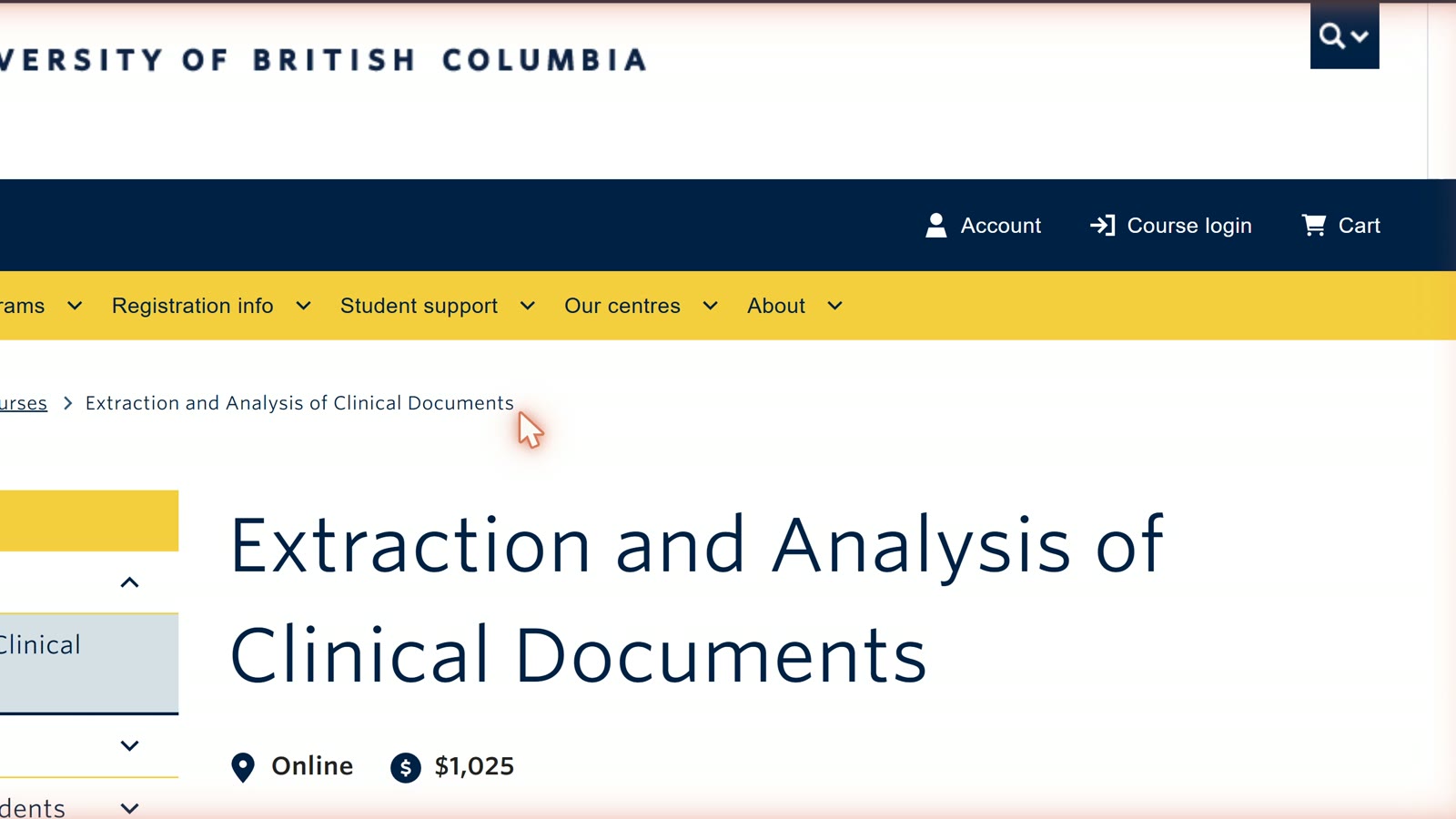
I have started my second UBC course: Extraction and Analysis of Clinical Documents, from UBC Extended Learning. The first course built the foundations of NLP and large language models; this one puts them to work on clinical notes, reports and assessments. This page covers where the course fits, how it runs, who presents it, what its four modules cover, and my first impression after module one.
- section
- key term
- reading note
The course and where it fits
The course is the second of three five-week courses in UBC's micro-certificate Natural Language Processing to Improve Patient Care. Clinical notes, reports and assessments hold a lot of detail about patients, but because the text is unstructured it is hard to analyze at scale. The course teaches NLP methods to classify, extract and summarize information from these documents, and how large language models can support clinical questions and documentation.
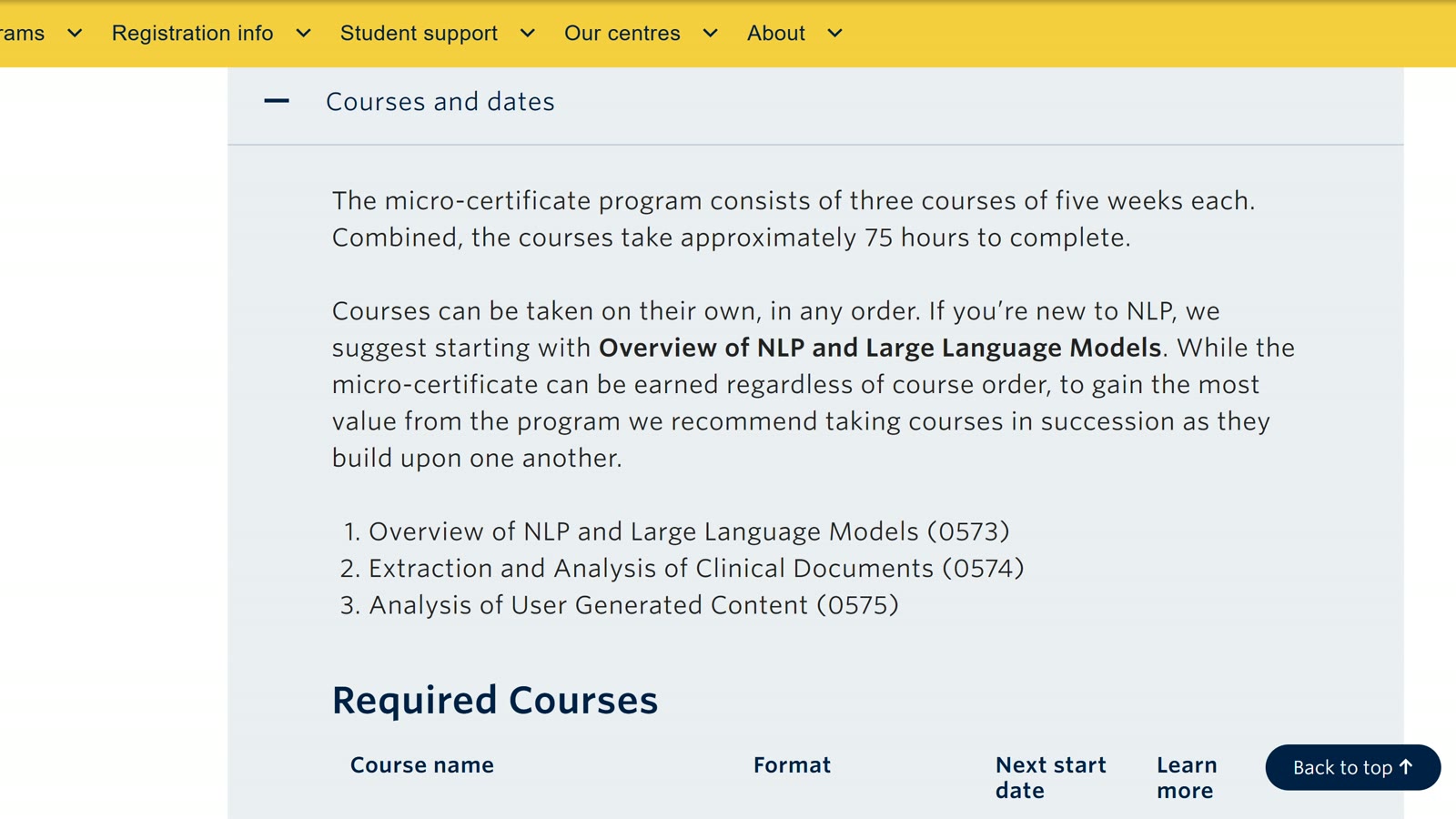
The three courses can be taken on their own and in any order, but UBC recommends taking them in sequence, and starting with Overview of NLP and Large Language Models if you are new to NLP.
| Format | 100% online, with optional weekly office hours |
| Length | Five weeks; the three-course program takes about 75 hours in total |
| Cost | $1,025 per course, $3,075 for the program |
| To pass | A minimum grade of 70%; the course is approved by UBC CPD for 24 credits |
How it runs
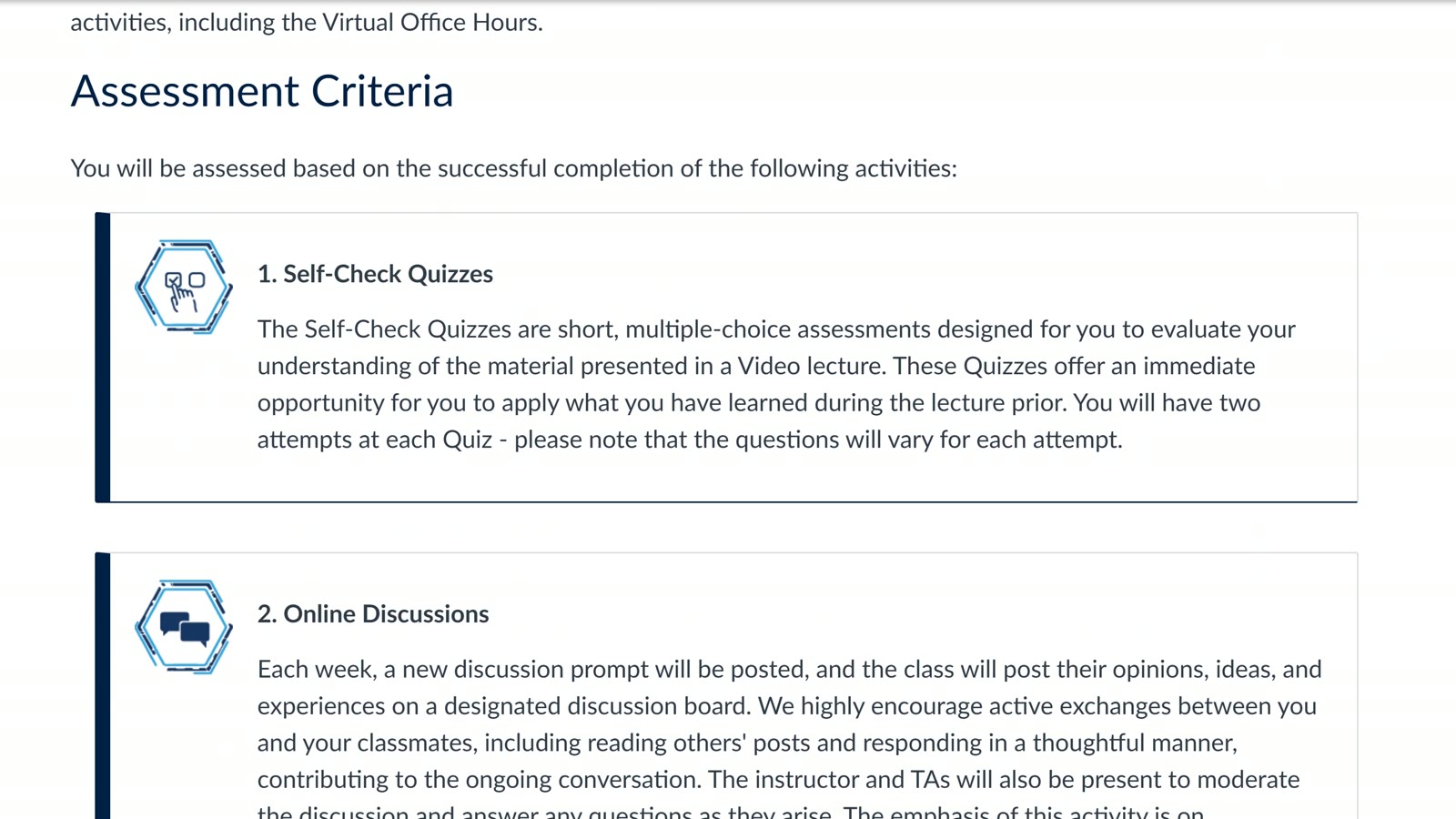
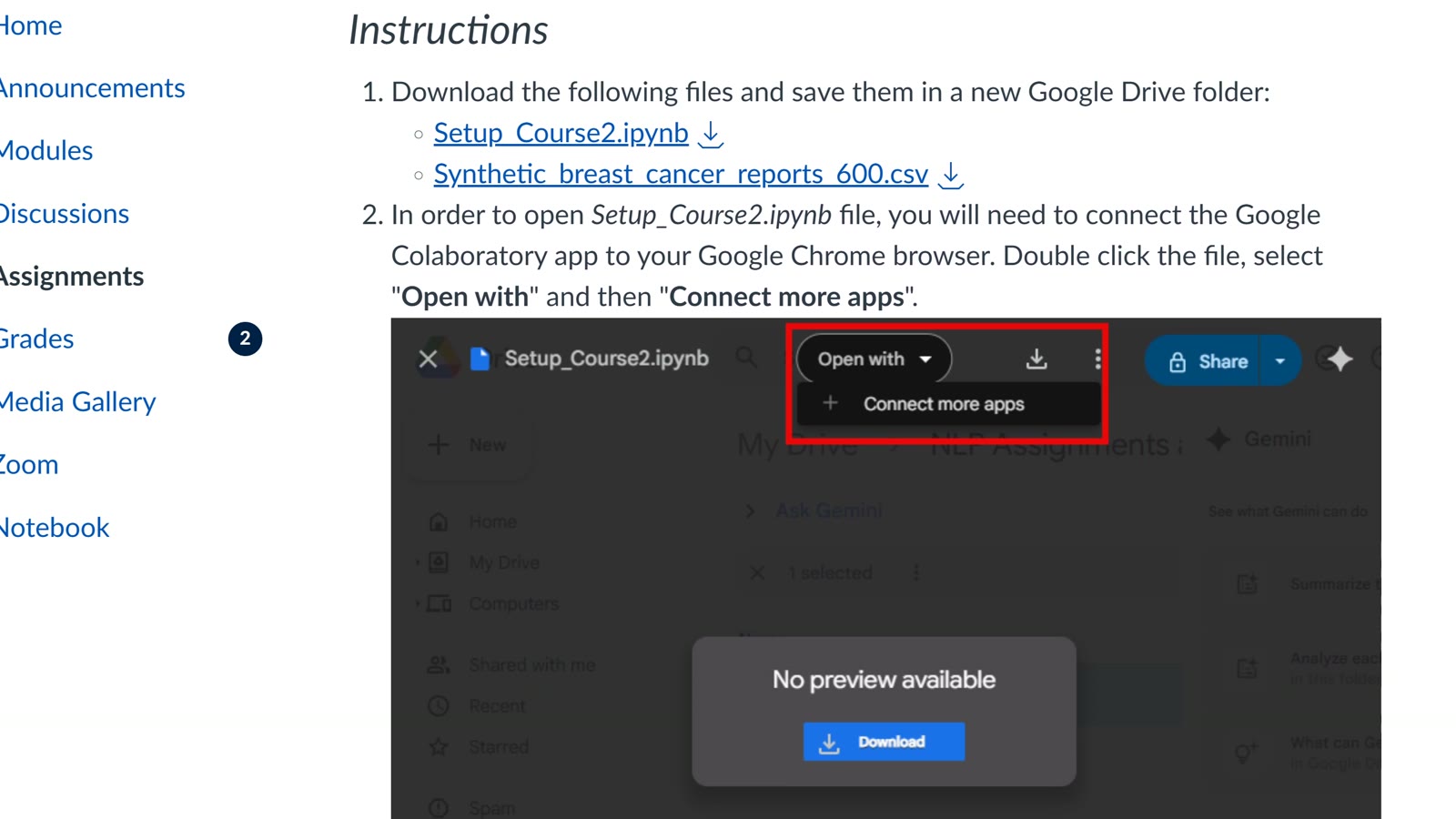
Like the first course, it is fully online. You work at your own pace within weekly deadlines, about five to seven hours a week. Each module has short video lessons, self-check quizzes (two attempts each), hands-on labs and a graded discussion. The labs are Python notebooks that run in Google Colab, so all you need is a Google account and a browser.
Once a week there is an optional one-hour live session on Zoom with the course facilitator, for questions and a guided group discussion.
Who presents the lessons
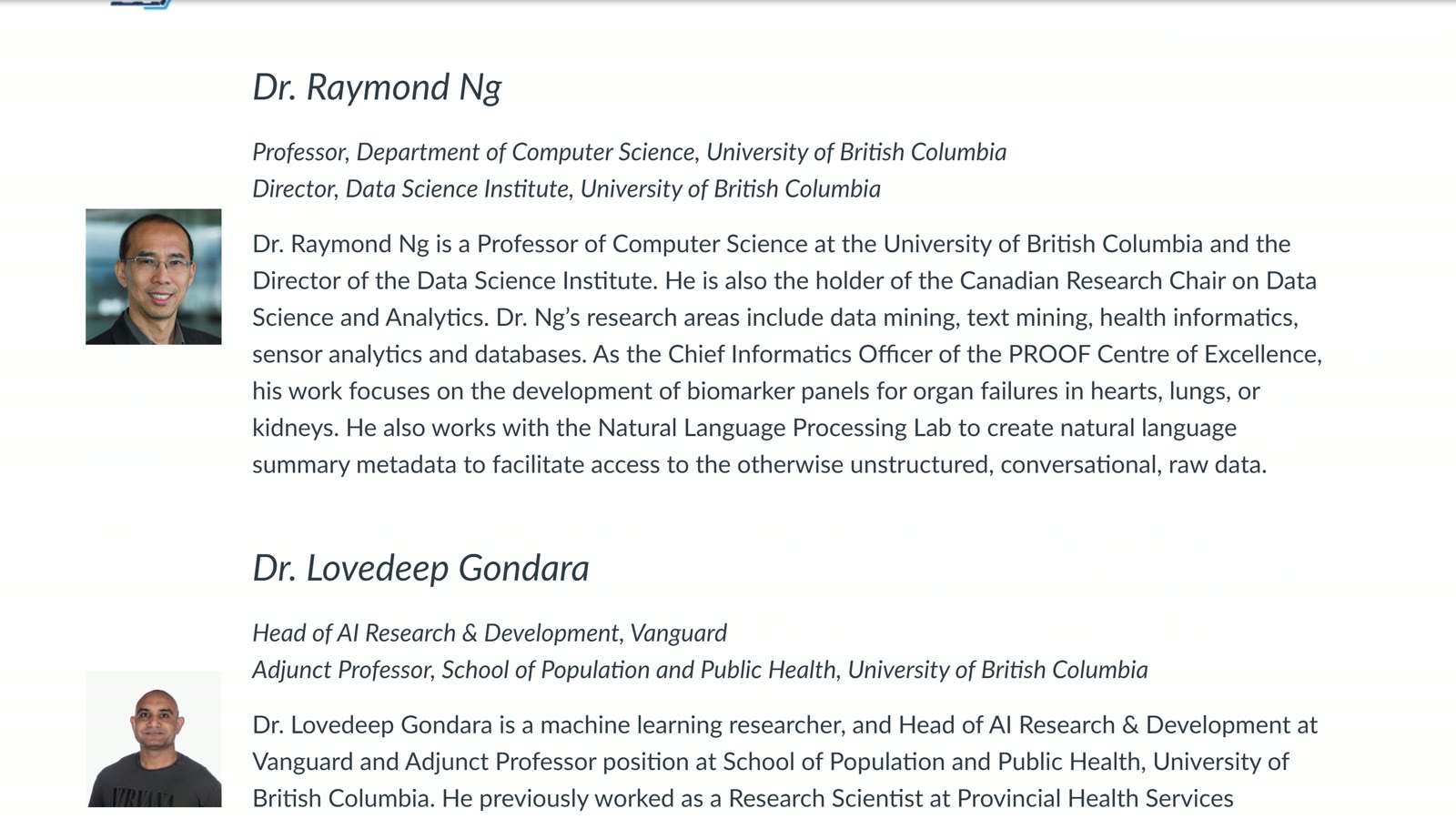
Most lessons are presented by Raymond Ng, a professor of computer science and the director of UBC's Data Science Institute, whose research covers data mining, text mining and health informatics. In module one he is joined by Lovedeep Gondara, who researches language models and their applications in health care, and Saffrin Granby, a data scientist at Vancouver Coastal Health. So the examples come from people who have built these tools inside B.C.'s health system.
Four modules
The course opens with real projects and then works through the main tasks:
| Module | What it covers |
|---|---|
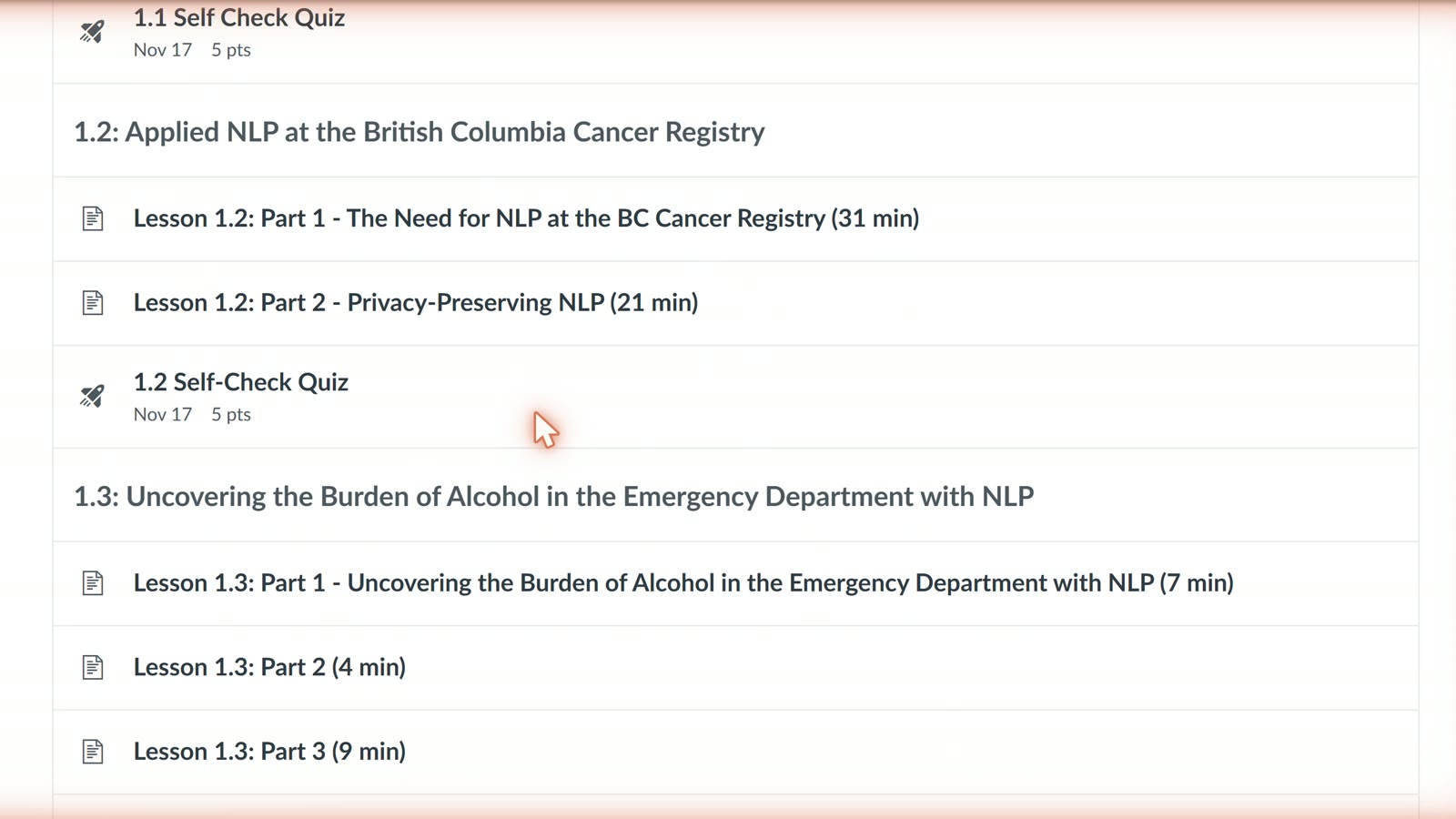
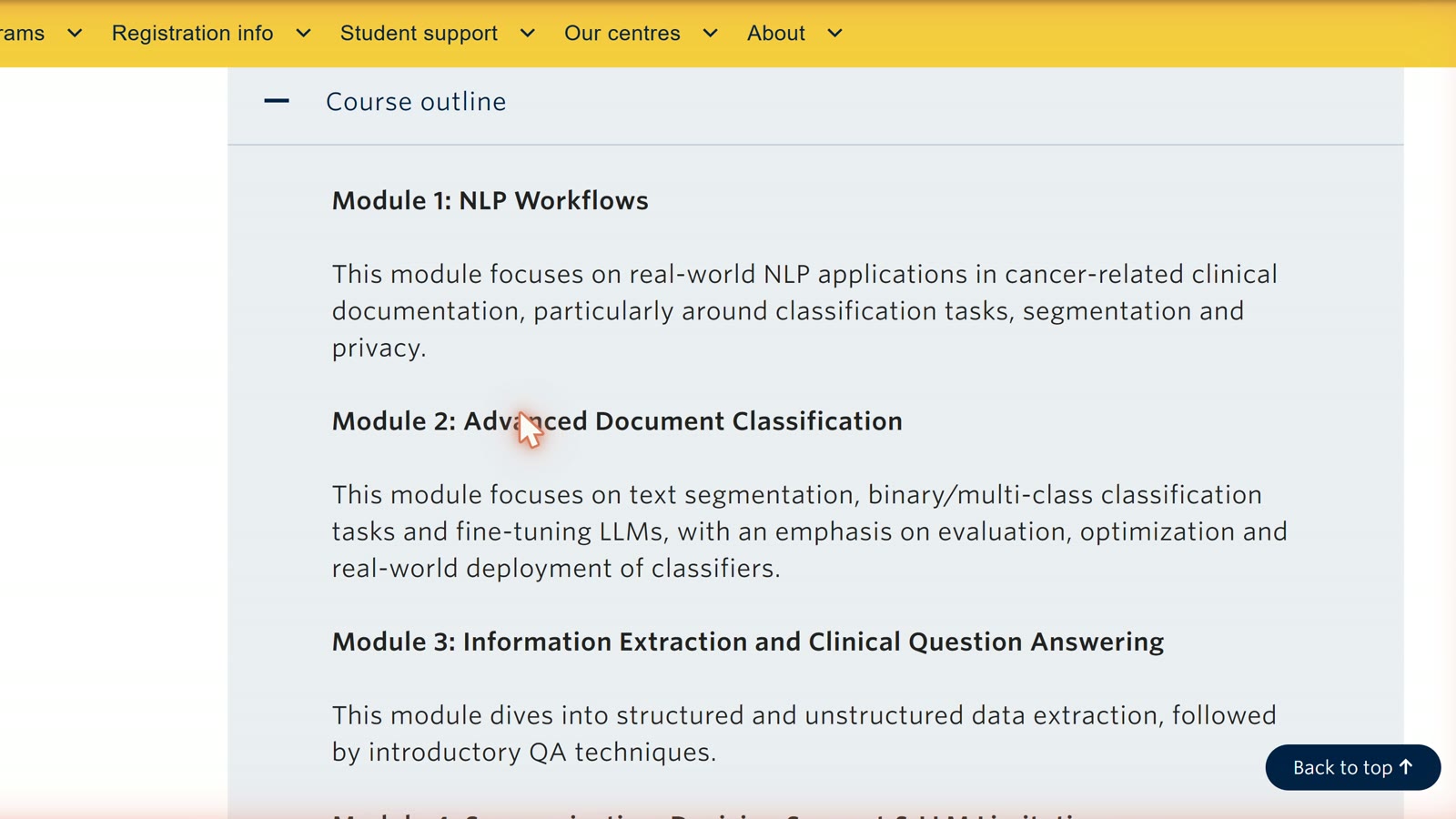
| 1. NLP Example Use Cases and Workflows | The B.C. Cancer Registry, privacy-preserving NLP, the burden of alcohol in the emergency department, e-scooter injuries, barriers to hospital discharge, and NLP with unlabelled data |
| 2. Advanced Document Classification | Splitting a report into sections, filtering which pathology reports a cancer registry needs, sorting them into diagnostic groups, ensembling and fine-tuning LLMs |
| 3. Information Extraction and Clinical Question Answering | Extracting fields of interest from reports, and question answering with large language models |
| 4. Summarization, Decision Support and Conclusions | Summarizing clinical documents, AI scribes, the clinical journey of patients, and the limits of these models in clinical care |
Where I am, and my first impression
I'm still near the beginning: I've finished module one, set up the lab in Colab and posted my first discussion, and now I'm working through classification.
So far, the course has shared real cases that are close to practice. The labs are fairly easy to complete, but the cases give me a general understanding of how NLP is applied in health care, in a way that is closer to reality.
Notes and videos to come
As I work through the course, I'll turn each module into notes on this site, with a video for each one, as I did with the first course.
Links
- Extraction and Analysis of Clinical Documents: the course page on UBC Extended Learning.
- Natural Language Processing to Improve Patient Care: the micro-certificate and its three courses.
- Videos from this course on YouTube.